

Psalm 44:9
wonderfully odiferous
Myrrh and stacte and cassia perfume thy garments, from the ivory houses: out of which (Psalm 44:9 DR)
It is sometimes said that clothes make the man, by which we mean that the raiment with which we clothe ourselves often provides an outward indication of an inward state. That is, if we dress slovenly it can betoken sloth and indifference, whereas if we take care of our outer vestments it can betoken industriousness and self-discipline.
Our nature is a garment of sorts—the body especially—which St. Paul describes in terms of raiment:
For we know, if our earthly house of this habitation be dissolved, that we have a building of God, a house not made with hands, eternal in heaven. For in this also we groan, desiring to be clothed upon with our habitation that is from heaven. Yet so that we be found clothed, not naked. For we also, who are in this tabernacle, do groan, being burthened; because we would not be unclothed, but clothed upon, that that which is mortal may be swallowed up by life. (2 Corinthians 5:1-4 DR)
In this verse the Psalmist continues with the theme of anointing from the previous verse, lauding the virtues with which Christ is clothed that issue forth as sweet fragrances. The various aromatic substances delineated here are not randomly noted but were precious aromatics that have allegorical import as gifts of the Holy Spirit, as St. Bellarmine notes:
These aromatic substances represent the gifts of the Holy Ghost, who diffuses a wonderful odor of sanctity; and the prophet having in the previous verse spoken of the unction of Christ, when he said, “therefore God, thy God, hath anointed thee,” he now very properly introduces the myrrh, aloes, and cassia, in explanation of the beautiful odors consequent on such anointing, of which St. Paul speaks, 2 Cor. 2, when he says, “For we are unto God the good odor of Christ.” (St. Robert Bellarmine, A Commentary on the Book of the Psalms, 44, 8-9.)
Myrrh is a bitter herb that was very odiferous and thus prized for its aromatic qualities; it is perhaps no surprise this also is one of the gifts given to Christ by the Magi. Being bitter it was often associated with death (and used for burial) and thus was seen by Christian commentators as a symbol of Christ’s passion and death, and thus of patience:
And as Christ, in his passion, especially exhaled the strongest odors of virtue, of resolute patience, of humble obedience, and ardent love, he, therefore, brings in myrrh, bitter, but odoriferous, to represent patience… (ibid.)
Stacte, St. Bellarmine notes, is properly the term for a drop of anything but was often used as a proxy for aloes, which are more of a gum and often applied to the skin even in our own time; these also fragrant aloes represent humility and obedience:
…aloes, also bitter, though aromatic, to represent humility and obedience: of which St. Paul says, “He humbled himself, becoming obedient even unto death…” (ibid.)
Finally, cassia is the bark of a tree which is also highly aromatic, closely related to ceylon cinnamon trees, although with tougher bark and a more robust flavor. In ancient Egypt it was often used in embalming and possibly part of anointing oils in Moses’ time. It represents “that most ardent love that caused him to pray even for his persecutors, while they were nailing him to the cross.” (ibid.)
These gifts of the Holy Spirit, as St. Bellarmine deems them, are the perfumes for the garments in this verse, which he understands as referring mystically to Christ’s humanity:
All these aromas flowed “from the garments and the ivory houses” of Christ. The “garments” mean Christ’s humanity, that covered his divinity, as it were, with a garment or a veil; and the “ivory houses” represent the same humanity, which, like a fair temple of ivory, afforded a residence to the divinity. (ibid.)
And as Christ took upon himself our humanity as a garment, as it were, so we are to clothe ourselves with Christ and the virtue with which he was adorned:
But put ye on the Lord Jesus Christ, and make not provision for the flesh in its concupiscences. (Romans 13:14 DR)
Put ye on therefore, as the elect of God, holy, and beloved, the bowels of mercy, benignity, humility, modesty, patience: Bearing with one another, and forgiving one another, if any have a complaint against another: even as the Lord hath forgiven you, so do you also. But above all these things have charity, which is the bond of perfection... (Colossians 4:12-14 DR)
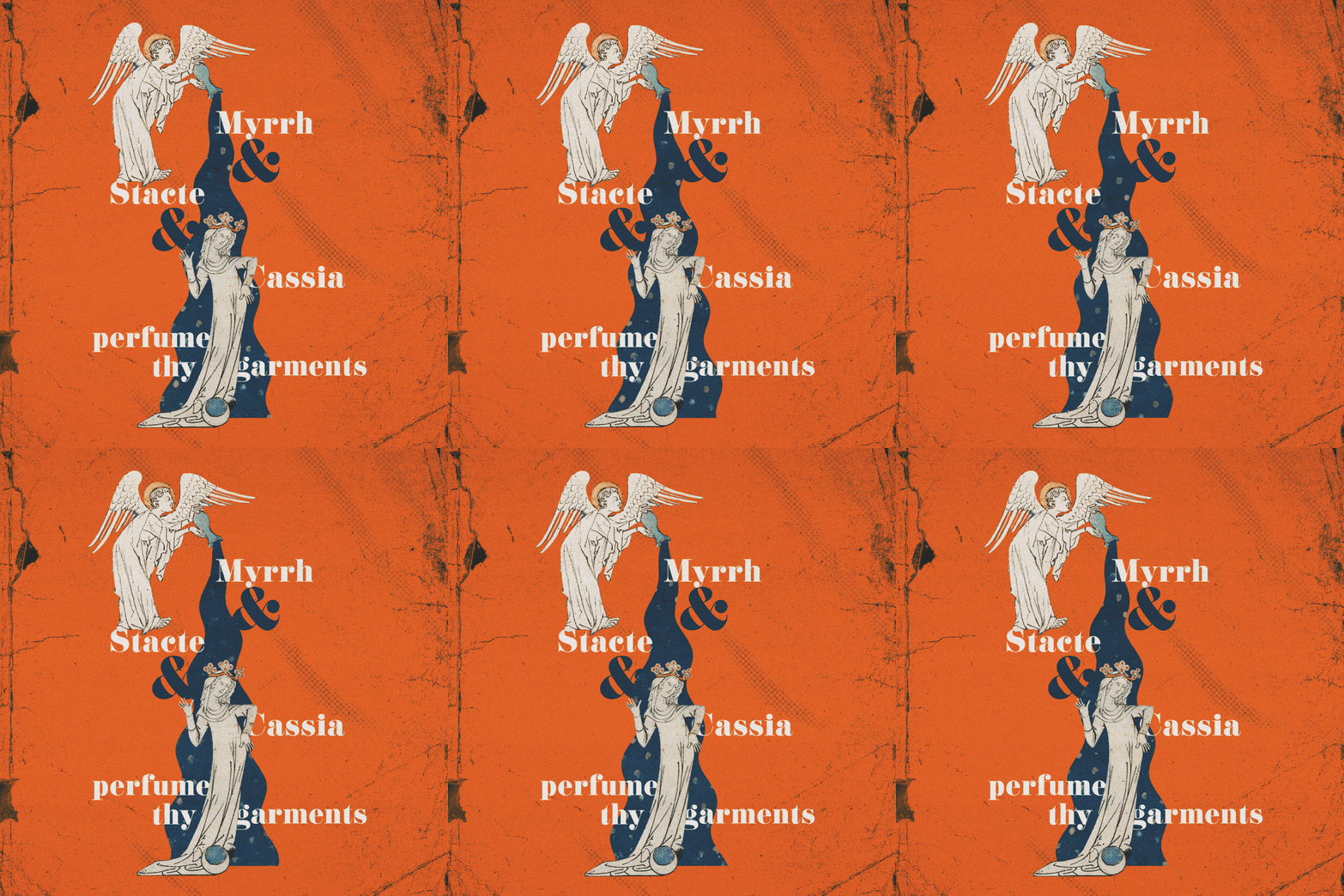
In this animation I had some of these things in mind, especially about the garments being the humanity of Christ. I thought it might be interesting to come at it a bit more abstractly; actually, not exactly abstractly, but rather from a less direct angle.
I was thinking of Christ’s Incarnation and how it obviously took place initially in the womb of the Blessed Virgin, who was herself free from all sin and thus would have—like her son—issued forth the pleasing aromas described in this verse. I thus thought it might be interesting to depict these virtues poured forth onto her both in anticipation of the Incarnation and because of it.
The figures in the design are from the Queen Mary Apocalypse, which is wonderful work with some striking imagery. The two figures are from different part of the work, but I wanted to bring them together for the animation.
I cut them both out in Photoshop (which was fortunately pretty easy) and brought them into After Effects. I then drew a simple inverted funnel shape and applied the Wave Warp effect to it to get the flowing wave shape. I had also found the starry background in the same Apocalypse and brought that in to use as a background for the pouring. I then used the wave shape as a matte and used LoopFlow to animate the starry background.
Finally I added a bit of wiggle hold to both of the figures and the animation was complete. I really liked this one even though it’s pretty simple.
Enjoy.
Myrrh and stacte and cassia perfume thy garments, from the ivory houses: out of which
(Psalm 44:9 DR)
View a higher quality version of this gif here: