

Psalm 50:7
come and wash away your sins
For behold I was conceived in iniquities; and in sins did my mother conceive me. (Psalm 50:7 DR)
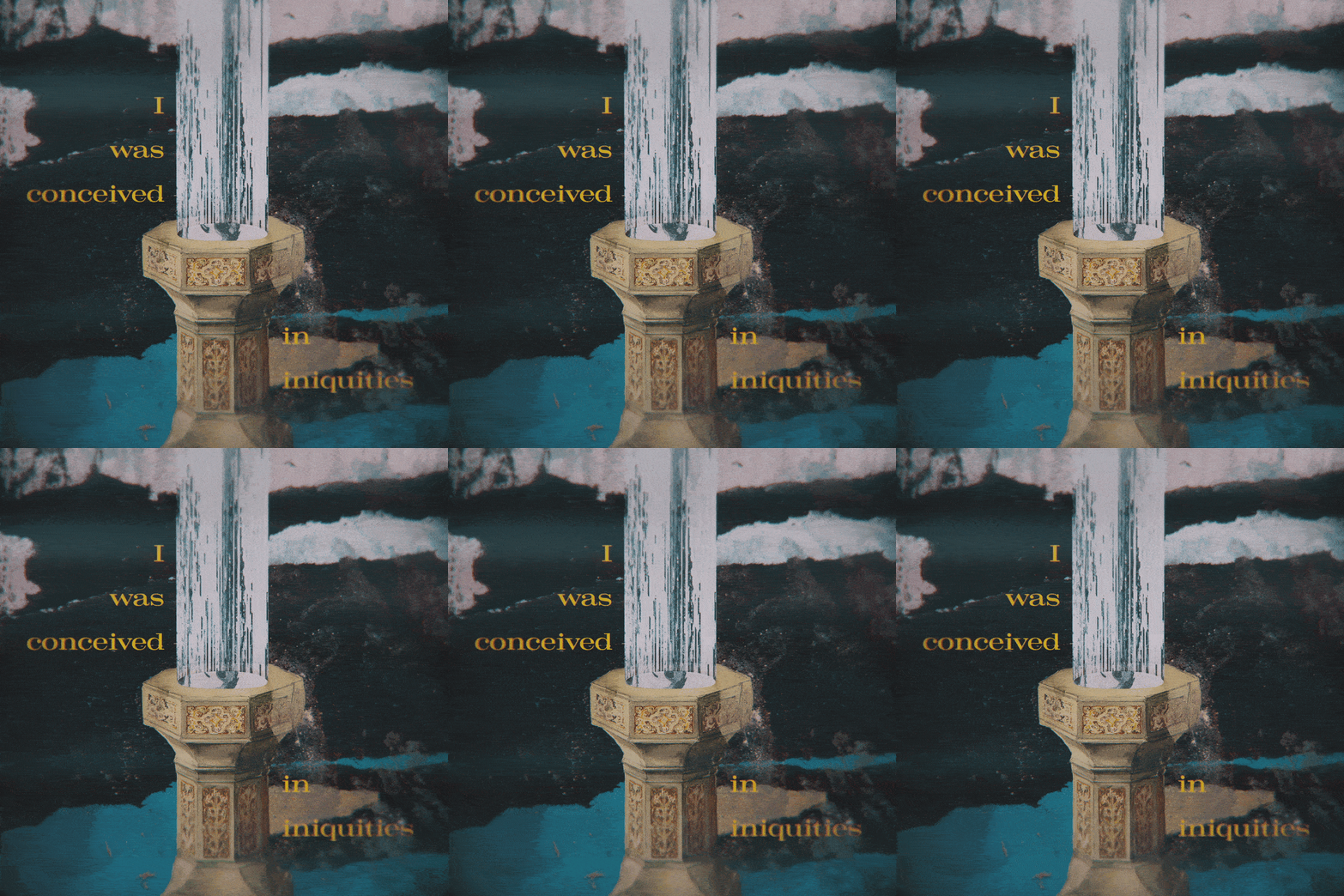
A mark of sincere contrition is a refusal to make excuses for one sins. For we as humans are masters at rationalizing or “nuancing” every decision we make—no matter how obviously wrong—to diminish or obviate our complicity in it. But when are truly contrite we will look our actions full in the face. At High Mass the priest prays during the Incensing the words of the Psalmist:
May this incense, which Thou hast blessed, O Lord, ascend to Thee, and may Thy mercy descend upon us. “Let my prayer, O Lord, be directed as incense in Thy sight: the lifting up of my hands as an evening sacrifice. Set a watch, O Lord, before my mouth, and a door round about my lips. May my heart not incline to evil words, to make excuses for sins.” (Psalm 140:2-3 DR)
In the previous passage the Psalmist acknowledged that his sin was ultimately against God, and strengthened the case against himself by exclaiming that his confession justifies the ways of God, Who is without sin. Now he goes on to make the case even stronger, for this sin is not a one-off event, but in fact characteristic of his state in this mortal life. In doing so he stands in for all of mankind:
David has taken upon him the person of mankind, and has heeded the bonds of all men, has considered the offspring of death, has adverted to the origin of iniquity, and he says, For, behold, in iniquities I was conceived. (St. Augustine, Expositions on the Psalms, 50, 10.)
In David’s case we know that his father was a righteous man, and thus he was not conceived in an iniquitous way. But as he recollects his life and sees all the sins and iniquities he has committed, he recognizes that even from birth he has had this bent towards sin, this need to be washed “yet more from my iniquity” (Psalm 50:4). He therefore prophetically looks forward to the sacrament of Baptism which washes away sin (cf. Acts 22:16), even that passed down from our first parents:
For we know both by the Baptism of Christ that sins are loosed, and that the Baptism of Christ avails the remission of sins. If infants are every way innocent, why do mothers run with them when sick to the Church? What by that Baptism, what by that remission is put away? An innocent one I see that rather weeps than is angry. What does Baptism wash off? What does that Grace loose? There is loosed the offspring of sin. For if that infant could speak to you, it would say, and if it had the understanding which David had, it would answer you, Why do you heed me, an infant? Thou dost not indeed see my actions: but I in iniquity have been conceived, “And in sins has my mother nourished me in the womb.” (ibid.)
Far from making excuses for his sins, the Psalmist is constructing a stronger case against himself. For not only did he commit the actual sins he is repenting of, but is also in his natural state alienated from God (cf. Colossians 1:21) and in fact, as St. Paul will go on to say, an enemy in his very mind towards God. The Vulgate has sensu, from sensus, which generally speaks to the faculties of perception, whether physical or intellectual. In respect to the latter it often has the sense of the habit of one’s thoughts or general disposition. What St. Paul is saying is that in our natural selves our minds are not naturally oriented towards God but rather towards evil which is manifested in the evil works we perform. Our intellect presents to the will what it perceives to be the good and thus moves the will to that “good” as a final cause. But if the faculty of the intellect is directed towards evil, it will present what is evil as “good” and thus move the will towards that evil. This is why St. Paul will elsewhere describe the need to have a transformation of the mind (cf. Romans 12:2) so that we can know what is truly good. This does not make the will some passive faculty that is only acted upon (which would be self-contradictory of what is meant by “will”). Instead there is a dynamic of will and intellect in which the will also moves the intellect, such as when we will to learn something and it is the power of the will which enables the intellect to apprehend the learning. The will therefore “moves all the powers of the soul to their respective acts,” as St. Thomas says (ST, I., Q.82, A.4).
This alienation from God from conception—what is theologically termed Original Sin—is the result of the privation of sanctifying grace and which punishment is death of body and soul. We might analogously term this a moral deformity, in that something for which we were made is lacking, like a bird being born without wings. Yet only analogously for a physical deformity does not imply guilt, whereas the moral deformity of original sin does. And just as above St. Augustine described how the Psalmist is taking upon himself the figure of “all mankind,” so St. Thomas explains the transmission of the guilt of original sin:
Therefore we must explain the matter otherwise by saying that all men born of Adam may be considered as one man, inasmuch as they have one common nature, which they receive from their first parents; even as in civil matters, all who are members of one community are reputed as one body, and the whole community as one man…
Accordingly the multitude of men born of Adam, are as so many members of one body. Now the action of one member of the body, of the hand for instance, is voluntary not by the will of that hand, but by the will of the soul, the first mover of the members. Wherefore a murder which the hand commits would not be imputed as a sin to the hand, considered by itself as apart from the body, but is imputed to it as something belonging to man and moved by man's first moving principle. In this way, then, the disorder which is in this man born of Adam, is voluntary, not by his will, but by the will of his first parent, who, by the movement of generation, moves all who originate from him, even as the soul's will moves all the members to their actions. Hence the sin which is thus transmitted by the first parent to his descendants is called “original,” just as the sin which flows from the soul into the bodily members is called “actual.” And just as the actual sin that is committed by a member of the body, is not the sin of that member, except inasmuch as that member is a part of the man, for which reason it is called a “human sin;” so original sin is not the sin of this person, except inasmuch as this person receives his nature from his first parent, for which reason it is called the “sin of nature,” according to Ephesians 2:3: “We . . . were by nature children of wrath.” (ST, II.I. Q.81, A.1)
St. Paul will contrast Adam and Christ in this manner in that the members of each share in the properties, so to speak, of each, much like the members of the body in the powers and acts of the soul:
For by a man came death, and by a man the resurrection of the dead. And as in Adam all die, so also in Christ all shall be made alive. (1 Corinthians 15:21-22 DR)
The Psalmist understands in himself the moral deformity that has existed from his birth, which guilt taints his soul and which privation of grace darkens his intellect and weakens his will. This recognition of his own disorder and helplessness is the sign of sincere contrition and betokens great hope, for as great as the loss of sanctifying grace in the soul is for our race, even greater is the grace found in our Lord who came to save us from our sins and Who washes away our guilt and sins in Baptism. That is why St. Paul states:
And where sin abounded, grace did more abound. That as sin hath reigned to death; so also grace might reign by justice unto life everlasting, through Jesus Christ our Lord. (Romans 5:20-21 DR)
For this animation I knew I wanted to do something with baptism, but I had some difficulty finding a good starting image. Then I came across some old sketches for baptismal fonts from the late 19th century that I thought might work nicely.
I brought one into After Effects and crated a shape to serve as matte for the bowl portion of the font. I brought in a watery sort of texture and applied a ripple effect to it and matted it to the bowl shape. I then duplicated that texture and drew some masks on it and applied Stretch to it to have the water cascading down from the top of the screen and used the same bowl shape as an inverted matte.
Enjoy.
For behold I was conceived in iniquities; and in sins did my mother conceive me.
(Psalm 50:7 DR)
View a higher quality version of this gif here: