

Psalm 5:1
soup and souls

Unto the end, for her that obtaineth the inheritance. A psalm of David. (Psalm 5:1 DR)
One of the most tragic stories in the Old Testament is that of Esau’s rejection of his birthright, and thus of his inheritance. In some ways we might sympathize with him, in that in the account in Genesis he claims to be at the point of death, and agrees to sell his birthright for a single meal. One might also wonder what kind of brother Jacob was to demand such a thing.
Nevertheless, the scriptures do not look kindly on this act; in the letter of Hebrews we read:
Looking diligently, lest any man be wanting to the grace of God; lest any root of bitterness springing up do hinder, and by it many be defiled. Lest there be any fornicator, or profane person, as Esau; who for one mess, sold his first birthright. For know ye that afterwards, when he desired to inherit the benediction, he was rejected; for he found no place of repentance, although with tears he had sought it. (Hebrews 12:15-17 DR)

What is interesting is that there is a clearly a spiritual dimension to this that is being looked at, rather than just the bare act itself. After all, it’s not clear that Esau had any right, as it were, to sell his birthright, nor Jacob to purchase it. Later on during Jacob’s famous deception scene the very need for the deception with Isaac indicates that—as far as Isaac was concerned—such a transaction had not taken place, or if it had it had no binding force, as Isaac was the one from whom the inheritance and blessing would flow forth.
George Leo Haydock in his commentary on this verse from Hebrews draws out a fascinating insight:
Bebelos, profane, like Esau who for a trifling meal could forfeit his right of primogeniture, and the honour of priesthood thereto attached. (George Leo Haydock)
In this reading the issue at stake isn’t a meal or whether Esau considered a birthright less valuable than his life; rather, it is that on the spiritual level he was being worldly-minded rather than spiritually-minded. He thus profaned his future priesthood by rejecting it.
In this opening dedication of Psalm 5 the Psalmist speaks of her that obtaineth the inheritance. St. Augustine naturally understands this as applying mystically to the Church:
The Church then is signified, who receives for her inheritance eternal life through our Lord Jesus Christ; that she may possess God Himself, in cleaving to whom she may be blessed, according to that, “Blessed are the meek, for they shall possess the earth.” (Matthew 5:5)… Wherefore it is the voice of the Church in this Psalm called to her inheritance, that she too may herself become the inheritance of the Lord. (St. Augustine, Expositions on the Psalms, 5, 1.)
The Church—and thus those within the Church—are called to obtain the inheritance, to persevere, to mind the things that are above, not the things that are upon the earth. (Colossians 3:2 DR) Unlike Esau who disdained his priesthood and put worldly cares above his spiritual vocation, those in the Church are strive to obtain what belongs to her by right, instead of shrinking back for relative trifles. Our sins are what we trade in our inheritance for, the things of this world that are like a meal which seems to satisfy in the moment but leaves nothing but regret and emptiness:
Oh, how many give up all right to a heavenly and eternal inheritance for even a mere trifling consideration! And how will they one day, with Esau, regret the same inflexibility on the part of God, their Father! (George Leo Haydock)
This animation was all done in After Effects. I brought in the church icon as a shape layer and merged it into an ellipse so they were both on one shape layer. I then set two keyframes on the layer one frame apart, setting different states for the layer. One was the ellipse in its normal state and the other in its active state with the pink color and the icon of the church.
Once this was setup, I applied this incredible expression which links up the keyframes on the layer to basically be in an if/else state depending on the location of a separate mask. The wonderful thing is that you can feather the mask and achieve interpolation.
Next I duplicated this layer many times and set up the grid, and finally created the Mask, ran a script to link the points of the mask to Nulls, and then parented those Nulls to another ellipse which acts as the selector.
After this it was just a matter of animating the selector and the state changes of all the layers with this expression automatically occur when the bounds of the feathered mask cross the pixel bounds of the layer, making what would be a fairly complex animation stupidly simple.
Enjoy.
Unto the end, for her that obtaineth the inheritance.
A psalm of David. (Psalm 5:1 DR)
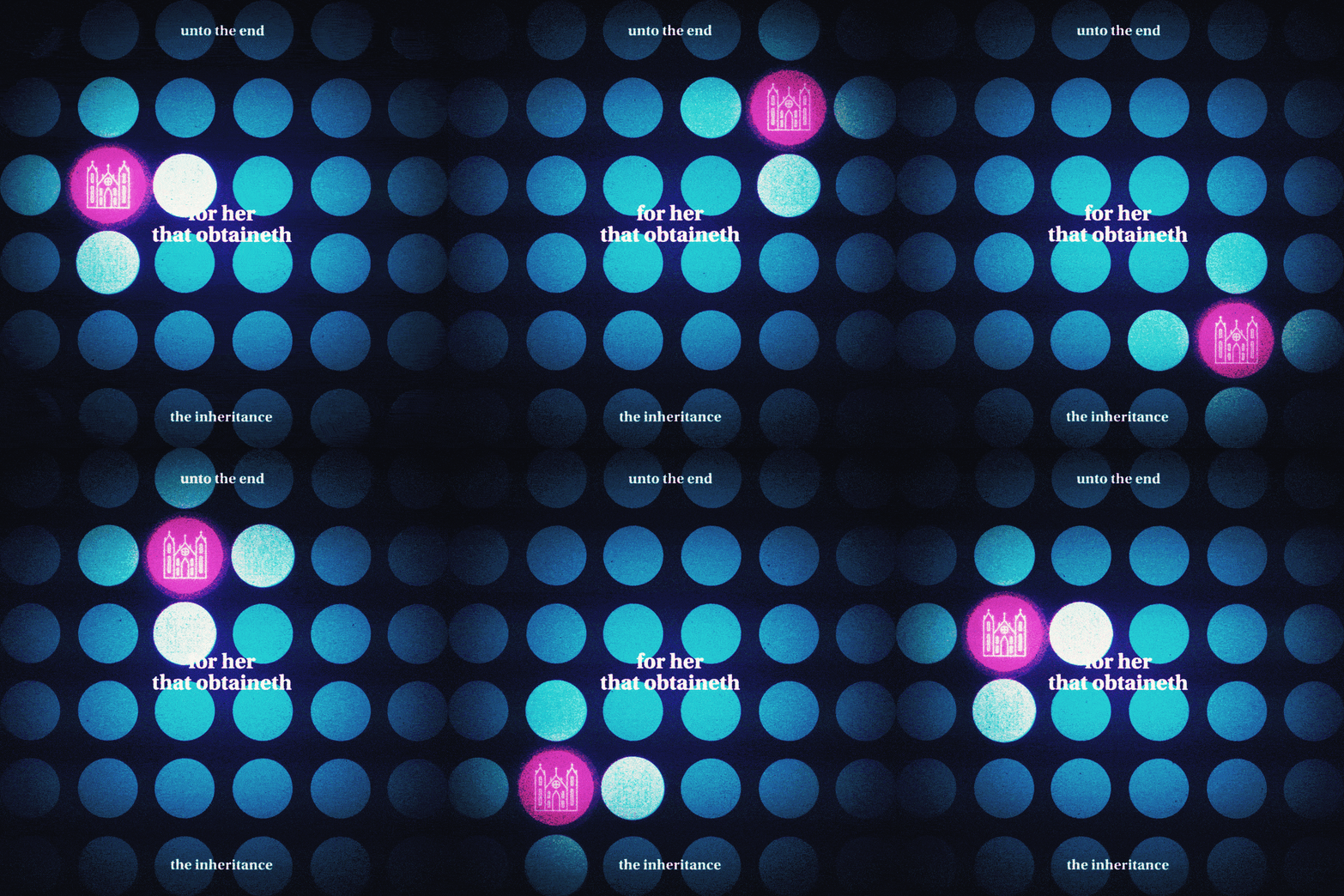
View a higher quality version of this gif here: