

Psalm 5:10
a horse that leads itself to water

For there is no truth in their mouth; their heart is vain.
(Psalm 5:10 DR)
It is usually advantageous to trade a good thing for an even better thing. Jesus has several parables that make this point—a merchant who sells everything for a priceless pearl, a man who buys a field containing hidden treasure, etc.
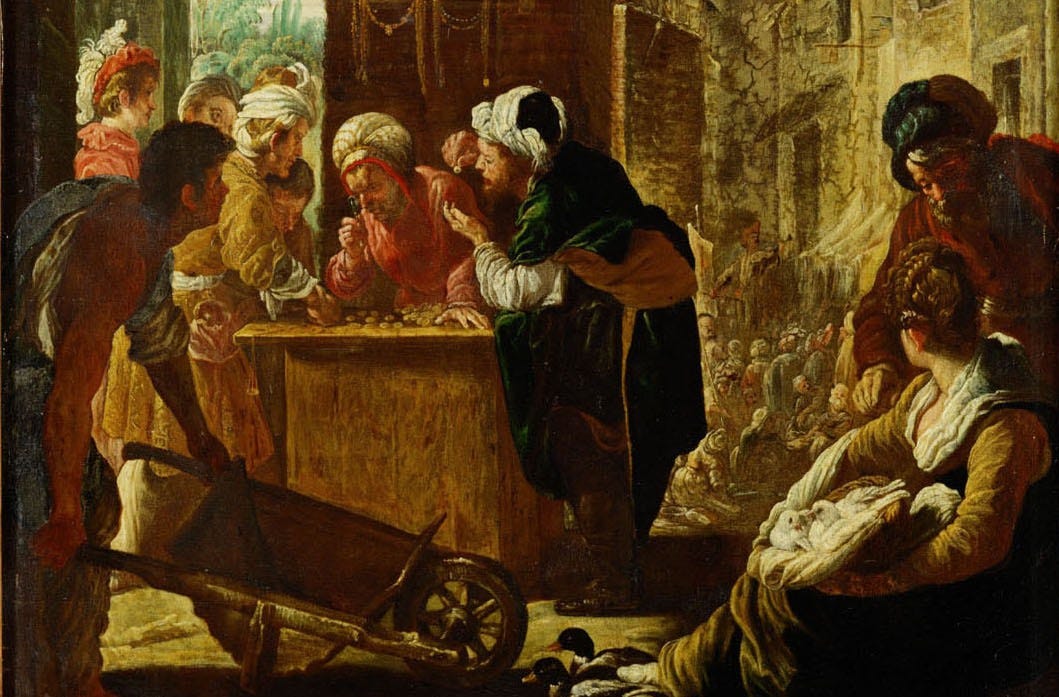
But much worse is when you have something that is a great good and end up trading it for something that is of lesser value. And while this seems irrational, we do it very frequently. One of the most valuable goods we have is time, a commodity we have by virtue of existence and which we cannot get more of at any price. But we will gladly trade that (along with money) for hours of mindless entertainment that is usually fairly boring anyway and whose “value” fades almost the moment is consumed. There are plenty of other examples, some more egregious than others. In some respects the situation determines the relative value of the trade, but we very often have terrible bargaining skills.
The worst possible situation is to trade a priceless thing for something that has no value whatsoever. And while it’s not a technical definition, it is a practical one for sin. In sin we trade our souls, our virtue, our sanctification, potentially an eternity of union with God for things that do nothing but harm and whose pleasure may be intense in the moment but which is like chaff in the wind.
In this Psalm verse the Psalmist bookends his cry for help and direction with the reason for this prayer: those around him are full of deceit and wish to lead him astray into worthless things. The words they speak are meant to deceive, or are at least set at a sort of default of deception. In this context God is literally the only one he can trust. But not only do they wish to deceive, but the things they desire are pointless and banal.
One of the fascinating aspects of sin is just how banal is actually is, but even more so how often we trade great goods for such trifling nothingness. And we are all guilty of it to one extent or another; for our race it is only a question of degree.
For the Psalmist the stakes couldn’t be higher; lies surround him, the worldliness of his enemies and his cohorts drags him down to world to tie him to its empty promises.
St. Robert Bellarmine notices this dynamic:
He assigns a reason for his praying for help against his insidious enemies, namely, their purpose of injuring him, and the difficulty of avoiding their stratagems. “There is no truth in their mouth,” he says, because, when they want to deceive, they terrify, seeking to make one avoid some trifling evil, that thereby they may be led into a greater one; when they want to deceive us in another shape, they allure by persuading us to go after some good of no value, and thereby lose one of great value. “Their heart is vain” within, and they are perverse without. They relish nothing, desire nothing, and can, therefore, speak of nothing but what is vain. [emphasis mine] (St. Robert Bellarmine, A Commentary on the Psalms, 5, 9-10.)
The problem too often, as C. S. Lewis once quipped, is that our desires are not too strong, but not strong enough. We are content with the trivial and the banal, rarely aiming for higher. This lack of desire (which is meant to aim for the good) leads us to be unable to draw anything good out of ourselves to give to others; as the axiom goes, from nothing nothing comes. Similarly, you cannot give what you do not have. Our Lord has a similar teaching which dovetails perfectly with this psalm verse:
A good man out of the good treasure of his heart bringeth forth that which is good: and an evil man out of the evil treasure bringeth forth that which is evil. For out of the abundance of the heart the mouth speaketh. (Luke 6:45 DR)
This was a very random animation, in that I didn’t have a preconceived plan beforehand. I had a vague notion of something and was digging through some public domain images when I happened upon an image of one of the first frame timelapses of horse locomotion. The technique was pioneered by Eadweard Muybridge and was accomplished (for faster things like running) by a series of cameras on a track that were rigged to shutter when string on the track were tripped.
.jpg)
The moment I saw this image of the horse carrying a bucket in his mouth, I thought it would be perfect. I don’t know why, but sometimes the right image just presents itself. I’m guessing the reason the horse is carrying the bucket is to demonstrate the various forces that result from the gait of the horse walking.
This one was really tedious to create. The original images aren’t great, and so I had to manually cutout all the various instances of the horse and do a lot of cleanup. I also did a separate pass where I isolated the bucket for all the frames.
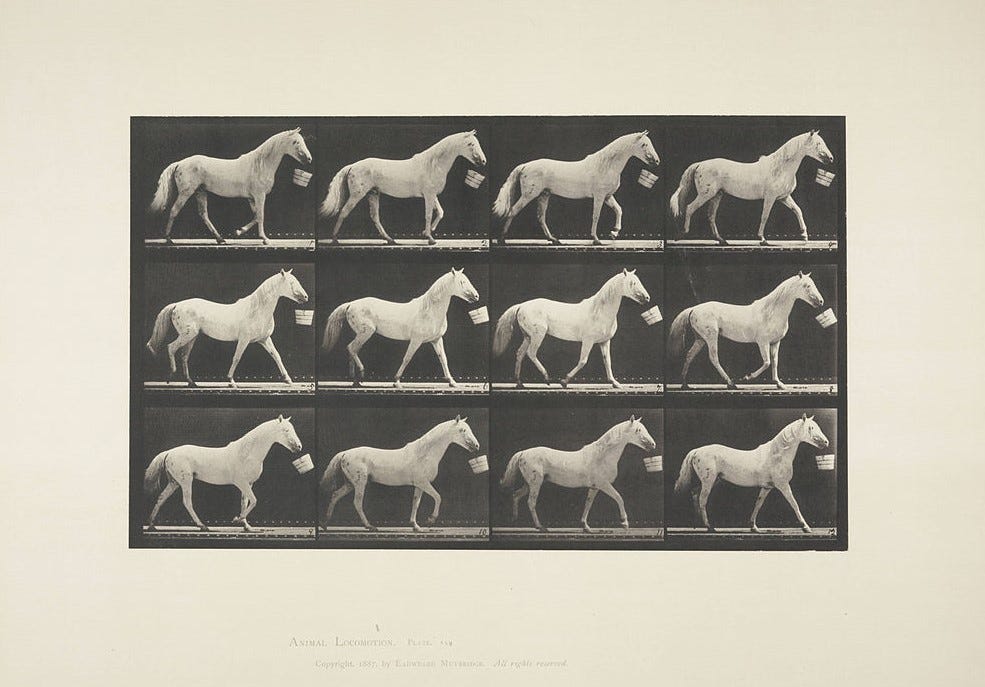
I then brought them into After Effects and set up a simple image sequence. It was the I realized that there is at least one position missing from this walk cycle, and perhaps two. Because of that I sped up the sequence both to keep it moving and interesting, but also to hid—as much as possible— the missing frame. It’s not perfect by any means, but it worked well enough for my purposes.
Next I worked on the bucket and eventually added in the coloration to make it stand out. I intentionally chose a darker background both for contrast and to blend in some of the image imperfections near the hooves, since the original was already pretty dark.
All in all I was fairly pleased with the result.
Enjoy.
For there is no truth in their mouth; their heart is vain.
(Psalm 5:10 DR)
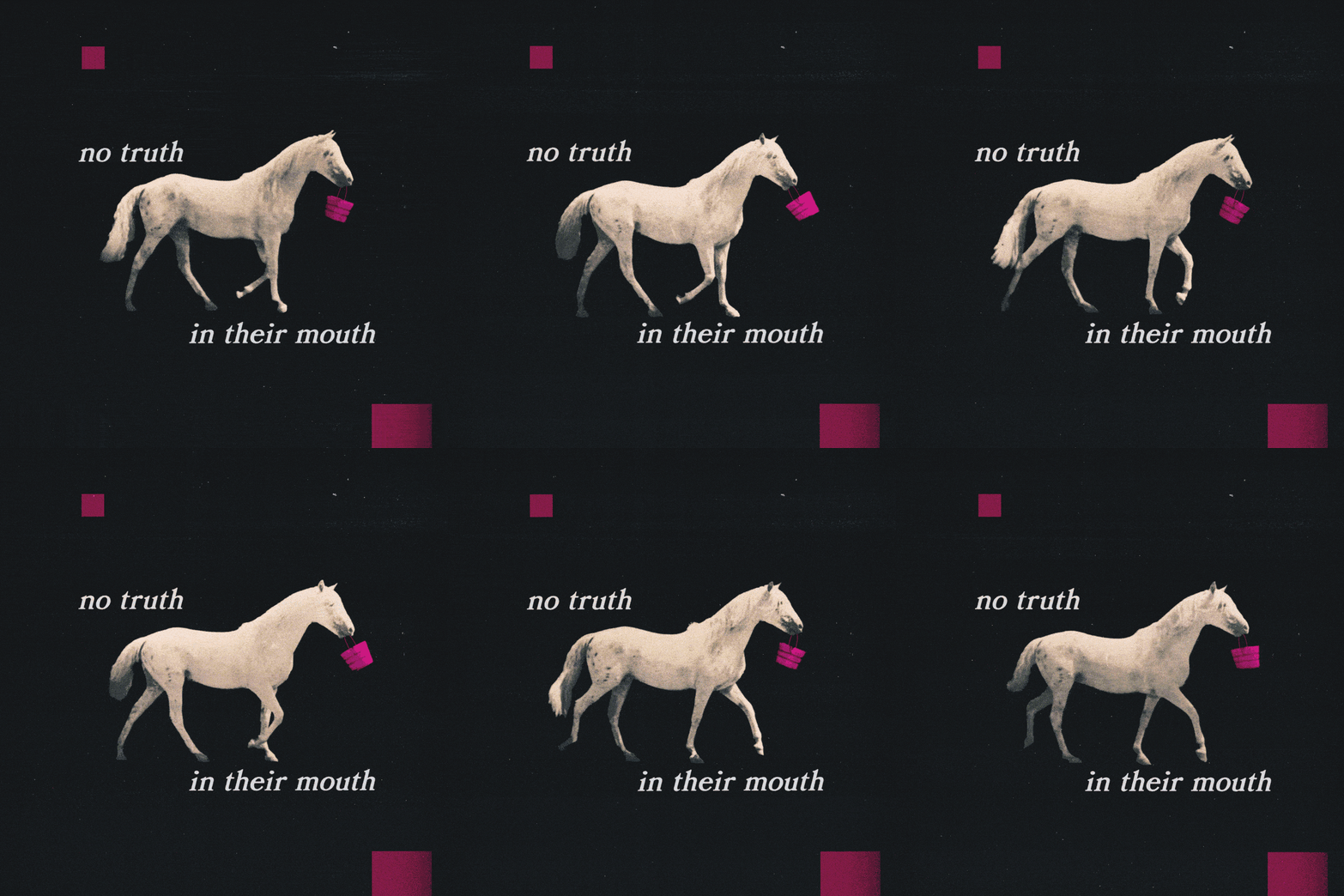
View a higher quality version of this gif here: