

Turn back the evils upon my enemies; and cut them off in thy truth. (Psalm 53:7 DR)
When I was younger I used to play a computer game called Scorched Earth. It seems extremely primitive by today’s standards, but it was a lot of fun. You controlled a tank or artillery unit positioned on some randomly generated terrain along with other enemy units, and the goal was to launch artillery at them and destroy them before they did the same to you. You could control the angle of your launcher, the power of the launch and also the type of ordinance used, the latter of which you could purchase with enough victories for more powerful ordinance.
Initially you had fairly weak shells to launch at your opponents, and so you had to be pretty accurate in your shots. You didn’t necessarily have to hit them directly; you could blast out the terrain under them so they might be damaged in a fall.
As you progressed you could purchase shields to protect from artillery, parachutes if you got shot out from under, and—of course—stupidly massive weapons to reign hellfire on your enemies.
But a complication of the game was wind, which—even though not terribly realistic—definitely affected the trajectory of your artillery. Sometimes it would be marginal and wouldn’t have much effect, while other times it was so powerful that it could cause your ordinance to come back upon you. This was especially problematic the more powerful your weapons, as even the slightest error when using something like the Baby Nuke could be disastrous for oneself. Not that this ever happened to me…
One of the tragedies of our sinfulness is that the wickedness we commit tends to come back upon us as a form of self-recompense. In our scheming and plotting to gain what we desire we often end up being so short-sighted that we do not recognize how the very things we do are just as likely to be done to us. The tragedy of war throughout our race’s history is a manifest example of this, as an affront requires a response, which then requires a greater response, and the escalation escalator is difficult to get off of before all-out war.
This is perhaps an obvious and extreme form, but the same is played out in the most banal of our sins. In our relationships with others we might say a hurtful word, thinking it will be so devastating that there can be no response, but this is of course never true, and only invites an equally—if not even more—hurtful retaliation. It is not without reason that our Lord speaks of how those that live by the sword will perish by the sword, and:
For with what judgment you judge, you shall be judged: and with what measure you mete, it shall be measured to you again. (Matthew 7:2 DR)
The Psalmist continues with his confidence in the Lord’s salvation, which—it should be noted—is not because he is immune from the evils his enemies intend but rather is spoken of in the midst of them. Thus, he speaks of the evils being turned back upon his enemies, which entails they are presently arrayed against him. The Vulgate has averte, for which English has avert as a cognate. There is thus the sense that the evils are travelling directly towards him, but that God will then turn back those evils so that they deviate from what they were intended for and back onto the ones who perpetuated them. Like launching a Baby Nuke into the wind in Scorched Earth, so the evils intended for the Psalmist will be turned around upon them.
St. Robert Bellarmine sees this as predicative rather than properly imprecatory; that is, David is prophesying the evils that will befall his enemies who seek his soul, rather than himself desiring this for them. We could say that this is the natural result of sin, that it becomes its own punishment, so to speak:
Such imprecations, as we have more than once remarked, are to be read as predictions; and so this reads in the Hebrew; and, in fact, it then and there turned up; for Saul, who was pursuing David, was now pursued by the Philistines; and thus, the “evils” that hung a short time before over David, were now pouring in upon Saul. (St. Robert Bellarmine, A Commentary on the Book of the Psalms, 53, 5.)
St. Hilary understands this as the recompense that God aims against sin, rather than against the sinner per se. That is, the evils that come back upon the acts of wickedness are the just recompense for them, but they are intended to destroy the sin rather than the sinner:
Let pure religion, therefore, have this confidence, and doubt not that amid the persecutions at the hand of man and the dangers to the soul, it still has God for its helper, knowing that, if at length it comes to a violent and unjust death, the soul on leaving the tabernacle of the body finds rest with God its upholder; let it have, moreover, perfect assurance of requital in the thought that all evil deeds return upon the heads of those that work them. God cannot be charged with injustice, and perfect goodness is unstained by the impulses and motions of an evil will. He does not awaken mischief out of malice, but requites it in vengeance; He does not inflict it because He wishes us ill, but He aims it against our sins. For these evils are universally appointed as instruments of retribution without destruction of life, such being the sternly just ordinance of that righteous judgment. But these evils are warded off from the righteous by the law of righteousness, and are turned back upon the unrighteous by the righteousness of that judgment. Each proceeding is equally just; for the righteous, because they are righteous, the warning exhibition of evil without actual infliction; for the wicked, because they so deserve, the punitive infliction of evil; the righteous will not suffer it, though it is displayed to them; the wicked will never cease to suffer it, because it is displayed to them. (St. Hilary of Poitiers, Commentary on Psalm 53, 10.)
The righteous who are chastised for their sin in the midst of their repentance end up not suffering the extent of that recompense because they turn away from it. Its terrors are displayed to them in that they can see the result of what sin brings in the soul, but in penance their righteousness shields them from its condemnation. The wicked, on the other hand, choose to identify with their sin, so to speak, and thus the recompense which is aimed at their sin ends up afflicting them.
When the Psalmist thus speaks of the Lord turning back these evils upon his enemies, he speaks as one who does not desire evil to them but who still sees how a love of evil brings one into the path of its own destruction. In David’s case King Saul lived by the sword and died by the sword, both literally and metaphorically. In his heart he could not root out his jealously of David, and that jealously led to paranoia and fear of usurpation on David’s part, even though David had done nothing but good to him. King Saul could not imagine that David served him out of goodness and love, for he only saw things through his own disordered desires and wickedness. This therefore caused him to approach everything as if it were a zero-sum game, a kill or be killed scenario. He launched ordinance into the wind to destroy his enemies, without recognizing that it would eventually come back upon him.
The flowering of the wicked in this world is thus like the glory of the grass of the field, which is here today and gone tomorrow. The righteous may seem to suffer unjustly, but their reward for light and momentary suffering is eternal, while the recompense for the transitory pleasures of evil is likewise eternal:
Turn away evil things unto mine enemies. So however green they are, so however they flourish, for the fire they are being reserved. In Your virtue destroy Thou them. Because to wit they flourish now, because to wit they spring up like grass: do not thou be a man unwise and foolish, so that by giving thought to these things thou perish for ever and ever. For, Turn Thou away evil things unto mine enemies. For if you shall have place in the body of David Himself, in His virtue He will destroy them. These men flourish in the felicity of the world, perish in the virtue of God. Not in the same manner as they flourish, do they also perish: for they flourish for a time, perish for everlasting: flourish in unreal good things, perish in real torments. (St. Augustine, Expositions on the Psalms, 53, 9.)
The artillery we launch by means of our sins might hit their targets, but with each lob into the wind we escalate the yield, and eventually it will come back upon our own heads. For while in our sinfulness we may escape the recompense at the hands of our enemies or those we persecute or wrong, there is a judgment prepared that will not be turned back. As St. Paul warns:
Be not deceived, God is not mocked. For what things a man shall sow, those also shall he reap. For he that soweth in his flesh, of the flesh also shall reap corruption. But he that soweth in the spirit, of the spirit shall reap life everlasting. (Galatians 6:7-8 DR)
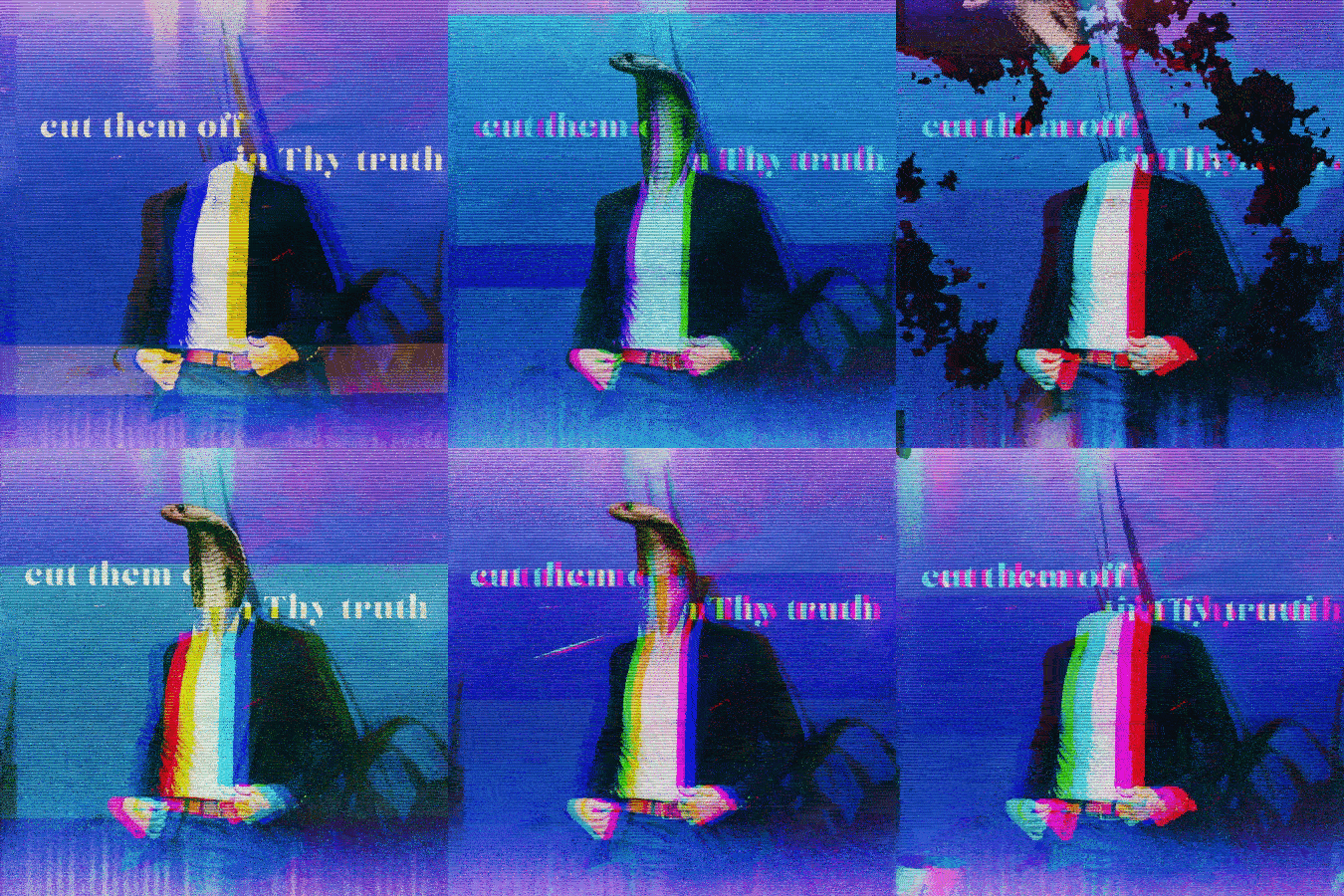
I found an image of the snake head and the guy in the suit and cut them out in Photoshop. In After Effects I scaled up the snake head to pop up out of the neck of the suit, which is admittedly a little weird, and then animated a simple shape to create the slice. I in the precomp of the snake head I masked out the head and then animated the head in the amin precomp being sliced off.
I used a simple dark red shape that I scaled and adjusted the vertices of and then applied Roughen Edges to created the dispersion affect, animating the parameters of the effect to make it eventually go away.
I then added in some color correction and glitch effects.
Enjoy.
Turn back the evils upon my enemies; and cut them off in thy truth.
(Psalm 53:7 DR)
View a higher quality version of this gif here:


