

Psalm 5:8
here comes the son

But as for me in the multitude of thy mercy, I will come into thy house; I will worship towards thy holy temple, in thy fear.
(Psalm 5:8 DR)
There is a fascinating vignette in Flavius Josephus’ history of the siege of Jerusalem in which the tenth Roman legion is camped east of Jerusalem upon the Mount of Olives. They have set up various artillery overlooking the temple, and would hurl massive anti-personnel rocks which wouldn’t scratch the temple but would shatter and rain down shrapnel on the defenders.
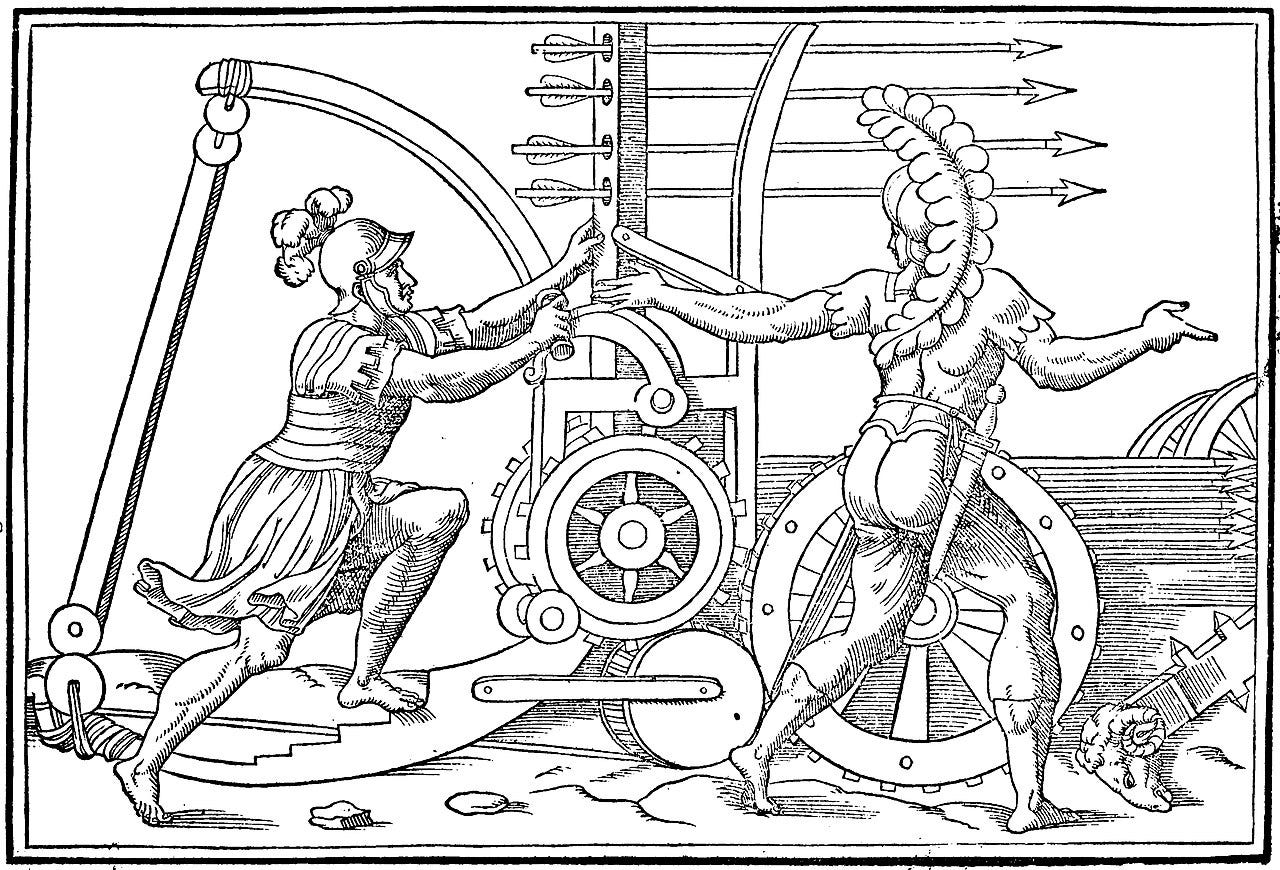
According to Josephus, these large stones were white and thus could be seen by the defenders (this distance was about 1/4 mile), both before they were fired and after:
As for the Jews, they at first watched the coming of the stone: for it was of a white colour; and could therefore not only be perceived by the great noise it made, but could be seen also before it came by its brightness… (Flavius Josephus, The Wars of the Jews, Book V, Chapter 6, 3.)
When the stone was hurled the watchmen on the walls would give an interesting warning:
…accordingly the watchmen that sat upon the towers gave them notice when the engine was let go, and the stone came from it, and cried out aloud, in their own country language, The Stone Cometh… (ibid.)
The footnote on this passage notes that the MSS of both the Greek and Latin agree that the actual rendition should be that The Son Cometh. The translator notes that he cannot fathom the reason for such a watchword, but goes on to explain that it is the best rendering of the original, as the only reason for assuming a correction in the early manuscripts would be if Josephus had written his first edition in pure Hebrew and if the Jews of the time had spoken pure Hebrew), in that the term for stone (eben) and son (ben) are clearly very similar. However, his first edition was in (in the translator’s term) Chaldean and the second in Greek, and offers evidence of the Romans using the Chaldean (i.e., first-century Aramaic) term bar for “son;” additionally in the previous sentence Josephus uses the Greek petros for stone and the separate term for the watchword.
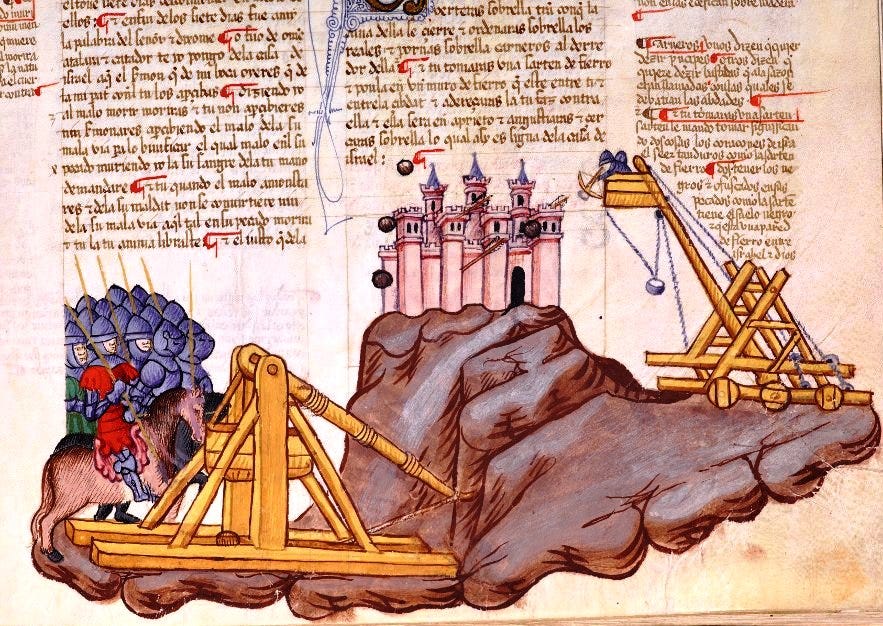
Ultimately the Romans caught on to the Jews’ stratagem and took to painting the son black to make it more difficult to see.
That the tenth legion is posted on the Mount of Olives east of Jerusalem and that the Son is launched from above the temple mount, combined with Jesus’ prophesying the destruction of the Temple and his own return from the heavens and from the east leads one to wonder—contrary to the translator of Josephus in the footnote—whether the watchword The Son Cometh is a mockery of the Christian expectation of the second coming. The translator finds this implausible; I find it the most plausible explanation.
After all, at this time the majority of Christians in Judea were Jewish. By 70 AD nearly 40 years had elapsed from the time of Jesus’ ascension, which is nearly a generation of Christians who had passed down his teachings, prophetic utterances and even warnings about the destruction and judgment to come.
So permeated was this belief that before the war started and the Romans began to besiege Jerusalem, most of the Christians heeded Jesus’ admonition to flee through the ministration of an oracle:
The people of the Church in Jerusalem were commanded by an oracle given by revelation before the war to those in the city who were worthy of it to depart and dwell in one of the cities of Perea which they called Pella. To it those who believed on Christ traveled from Jerusalem, so that when holy men had altogether deserted the royal capital of the Jews and the whole land of Judaea… (Eusebius, Church History, 3, 5, 3.)
(I don’t know this for certain, but it could be that this oracle is linked in some way with signs Josephus speaks of in respect to the war, as he relates in Book VI, Chapter 5, 3.)
The departure on the eve of battle would thus likely be seen by the non-Christian Jews as a form of treason or desertion on the eve of battle; thus, in my mind it is not at all unlikely that they would use the Christians’ belief in the second coming as a mocking watchword in their battle against the Romans.
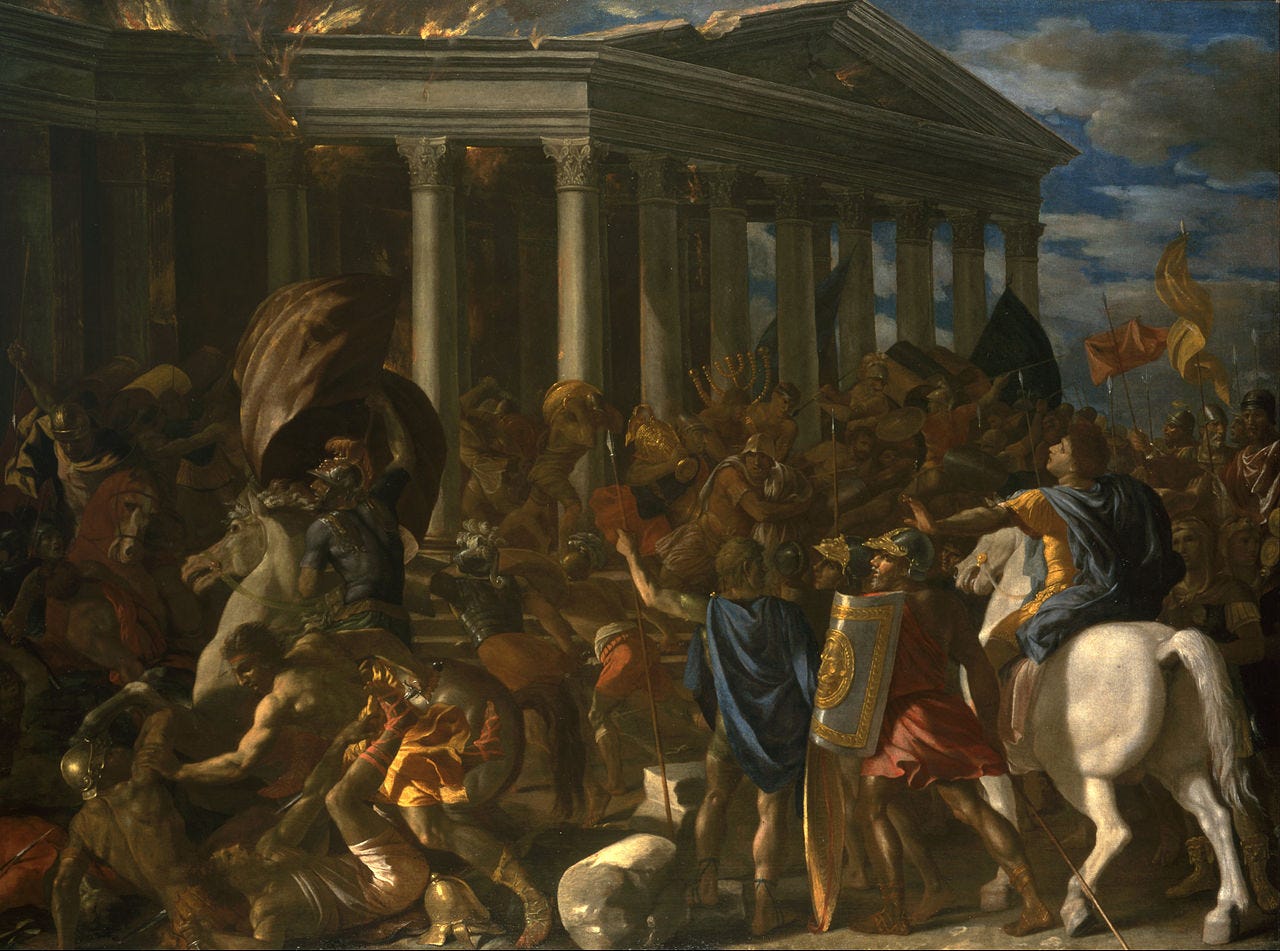
The temple would of course be destroyed, although not necessarily intentionally. Josephus relates that a rapacious Roman soldier initiated the blaze by tossing a torch through a window, and spends time noting Titus’ multiple attempts to compel his soldiers to extinguish the blaze, all to no avail. He eventually gave up and entered the inner temple to plunder it as far as possible and ordered it and the city to be destroyed, leaving only a few towers and a wall as a monument to Roman triumph and— in an interesting twist to bring things full circle— the tenth legion to garrison there.
St. Paul—writing before the destruction of Jerusalem— notes that the Son is the stumblingstone, referencing a prophesy from Isaiah:
But Israel, by following after the law of justice, is not come unto the law of justice. Why so? Because they sought it not by faith, but as it were of works. For they stumbled at the stumblingstone. As it is written: Behold I lay in Sion a stumblingstone and a rock of scandal; and whosoever believeth in him shall not be confounded. (Romans 9:31-33 DR)
Thus the foretelling of Jesus comes full-circle from the Old Testament prophesies to the destruction of the temple. Those who believed in Christ fled the destruction to come, believing in the stumblingstone, while those who rejected him stumbled upon him and were destroyed.
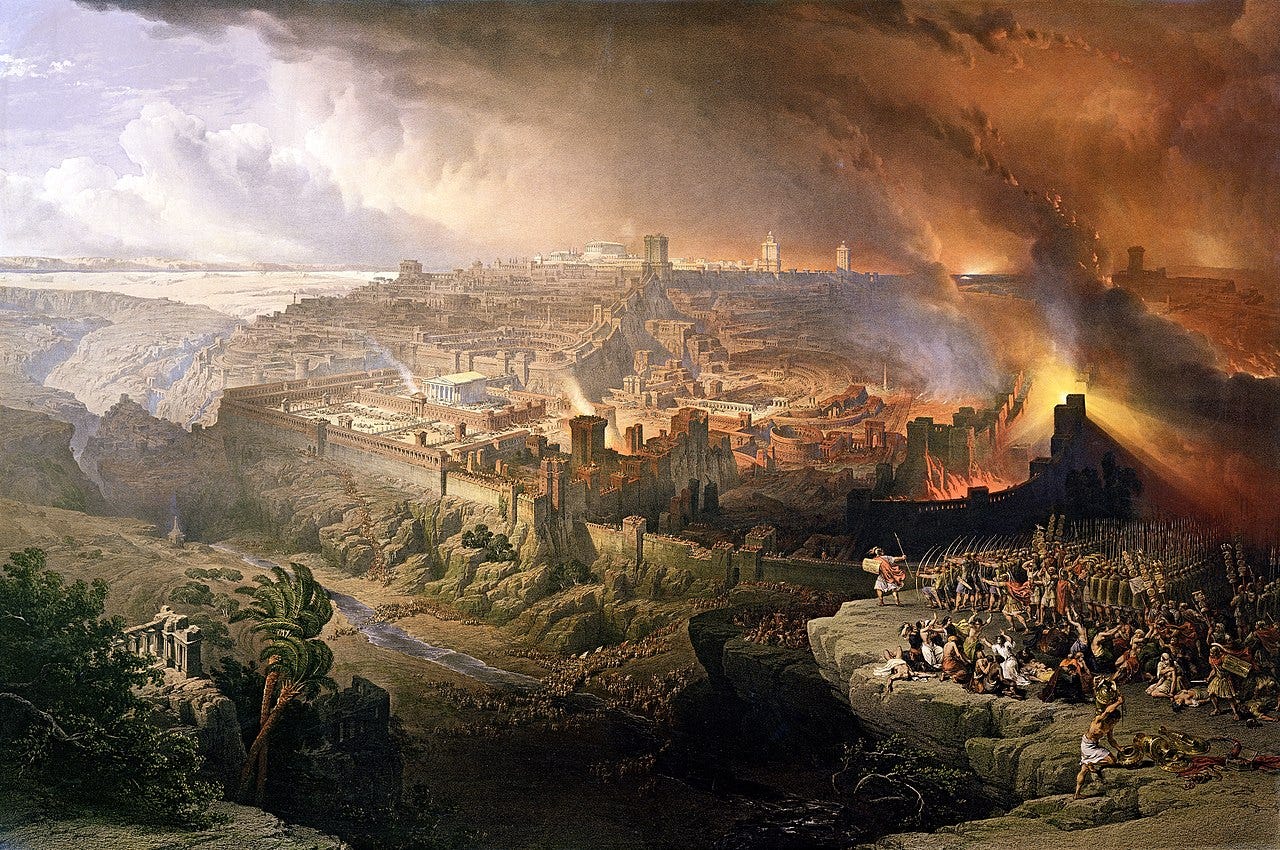
In this verse the Psalmist speaks of coming into the house of the Lord, the holy temple. It is interesting that he speaks of worshiping towards the holy temple, which is a liturgical posture—in Christian parlance, one might speak of liturgical east in terms of the church building itself, the new temple of the Lord.
St. Augustine understands the temple in a mystical sense, drawing on another Psalm:
Now that many men regenerated and perfected, are rightly called the multitude of God's mercy, who can deny; when it is most truly said, What is man that You are mindful of him, or the son of man that You visit him? I will enter into Your house: as a stone into a building, I suppose, is the meaning. For what else is the house of God than the Temple of God, of which it is said, for the temple of God is holy, [1 Corinthians 3:17] which temple you are? Of which building He is the cornerstone, [Ephesians 2:20] whom the Power and Wisdom of God coeternal with the Father assumed. (St. Augustine, Expositions on the Psalms, 5, 8.
St. Peter takes up this mystical understanding as well:
Be you also as living stones built up, a spiritual house, a holy priesthood, to offer up spiritual sacrifices, acceptable to God by Jesus Christ. (1 Peter 2:5)
Thus the Son is the cornerstone, and his body the Church are the living stones which comprise the edifice. The Son is both the stone that causes those who don’t believe to stumble, but also the stone upon which faith will never be disappointed. This is the temple towards which the Psalmist looks prophetically forward to as he gazes towards the temple and waits for the coming of the Son.
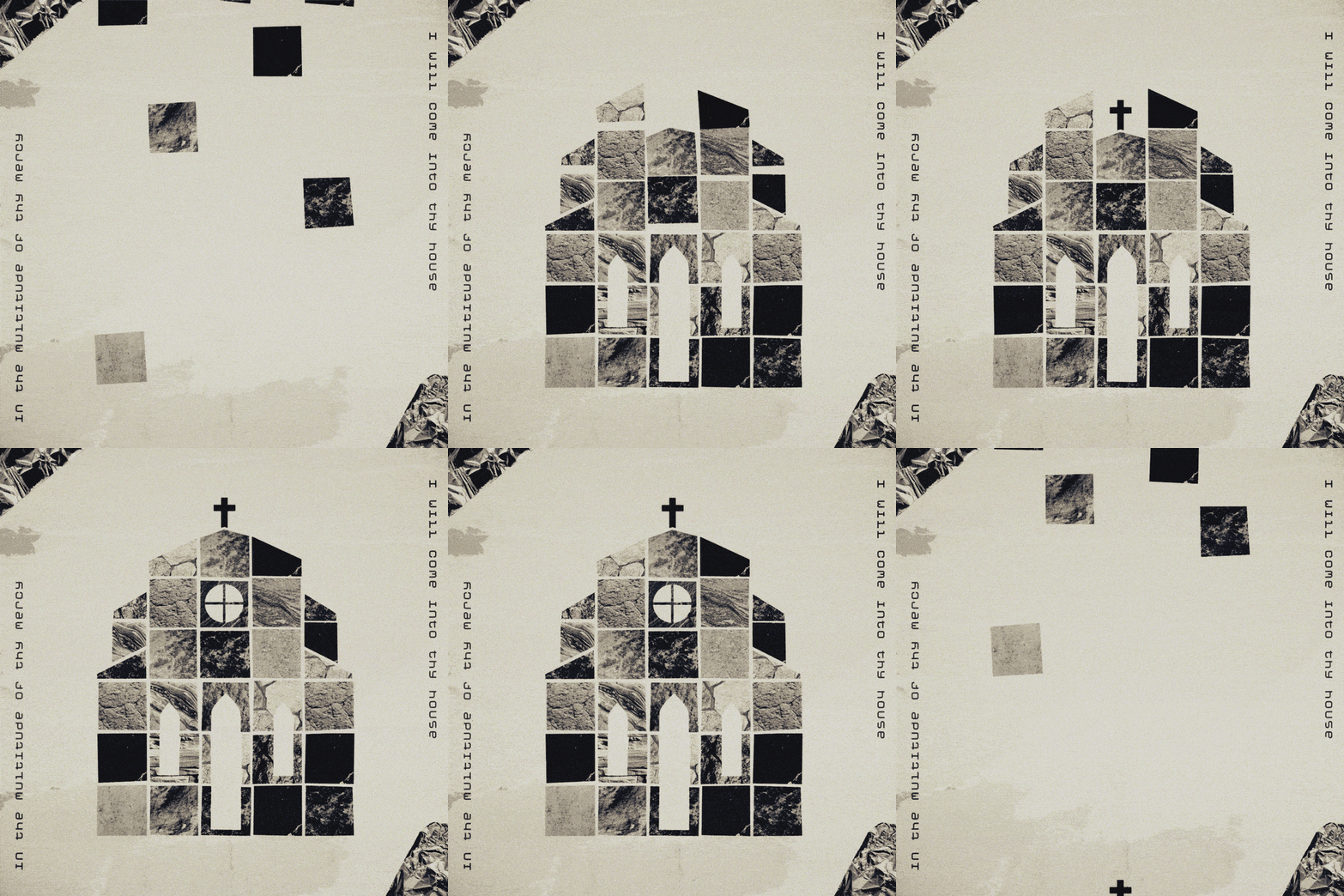
In this animation I wanted to emphasize the understanding of those with faith being brought into the temple as stones into a building, and so I went a bit more literal with this one.
I found a bunch of rock textures on Unsplash and brought them into After Effects and then drew out the edifice of the church with shape layers. I then put each of the individual stones into its own precomp and used mattes to reveal various rock textures in each precomp for variety.
Next I did a simple falling animation with the stones and used Lazy to offset the timing as needed. Finally I revealed the final two stones just for some compositional and animation variety, and that’s pretty much it.
Enjoy.
But as for me in the multitude of thy mercy, I will come into thy house;
I will worship towards thy holy temple, in thy fear.
(Psalm 5:8 DR)
View a higher quality version of this gif here: