

Psalm 60:1
it's only tedious until the end
Unto the end, in hymns, for David. (Psalm 60:1 DR)
In any endeavor the difference between meaningfulness and tedium in the work often lies in the end in mind. If you work at the same task over and over without purpose, it becomes mind-numbing and banal. But if there is a greater purpose driving the action, then even repetitive tasks can be joy-filled and meaningful. One can even work at something without ever seeing it come to fruition. Many of the great cathedrals built in the Middle Ages were funded by and worked on by people who would never live to see them completed and knew this would the case. Yet the end was greater than themselves which allowed such sacrifice and made their efforts both meritorious and fruitful.
Things like the Divine Office also savor of this quality. If it were merely words to be chanted or recited it would quickly become tedious, as one goes over largely the same material week by week. Yet because the Psalms are so rich in depth and because the end of the Office is to render worship to the Lord, what might otherwise be tedious can become a delight. The structure of the Office might seem constraining as it largely obviates spontaneity (to be sure, a rather dubious value), but this structure gives form to prayer and focuses the mind and heart on the end for which the prayer is offered, to give praise and to render homage to the King of Kings.
The hymns of the Office—while probably not what the Psalmist has in mind—nevertheless point towards this end. They are metrical in structure (which makes a hymn to be a hymn), and while that structure limits the expression possible (given the constraints of meter), it also enables a more focused prayer. The words and expressions chosen have to be judiciously chosen to both give voice to the idea and so so within the meter and structure of the hymn. This intentionality befits the end unto which it is directed, since intentionality presupposes an end.
The Psalmist speaks of this end in the title or superscription of this Psalm, which St. Augustine interprets as referring to Christ and to His Body. Psalms with such a title thus give voice to the Body of Christ unto its Head:
“Unto the end,” to wit unto Christ....But the voice in this Psalm (if we are among the members of Him, and in the Body, even as upon His exhortation we have the boldness to trust) we ought to acknowledge to be our own, not that of any foreigner. (St. Augustine, Expositions on the Psalms, 60, 1.)
In this manner the Psalm is about Christ as the end as seen through the prayers of His people, His Body, the holy Catholic Church. That is, as we see the cry of the Church to her Head we see Christ by means of His Body because this prayer is directed unto that end. This is the depth of the mystery of the Mystical Body of Christ, for the Church is not merely associated with Christ in a theoretical manner or by means of a legal definition but rather as analogously close as body and soul. The body is not the soul but neither can the body live without the soul; similarly the Church is not Christ but also does not exist without our Lord vivifying her and permeating her just as the soul does the body. The prayers she offers to her Lord are thus not externally given to the Lord but well up from within, as it were, as intimately as the soul understands and “feels” the body. Thus St. Paul’s somewhat obscure words come to light:
Likewise the Spirit also helpeth our infirmity. For we know not what we should pray for as we ought; but the Spirit himself asketh for us with unspeakable groanings. And he that searcheth the hearts, knoweth what the Spirit desireth; because he asketh for the saints according to God. (Romans 8:26-27 DR)
This is especially evident in the Holy Sacrifice of the Mass, the greatest and deepest prayer of the Church because it is in reality our Lord the Great High Priest Who offers the Mass. The prayers of Mass thus enter into our Lord’s one sacrifice unto the Father and unite the Church and her members with our Lord’s Passion and Death and thus also with His glorious Resurrection. At Mass many of the words are identical from day to day and week to week, but rather than tedium they are resplendent because they accompany the sacrifice of our Lord which He offers to the Father for the salvation of the world and His bride, the Church.
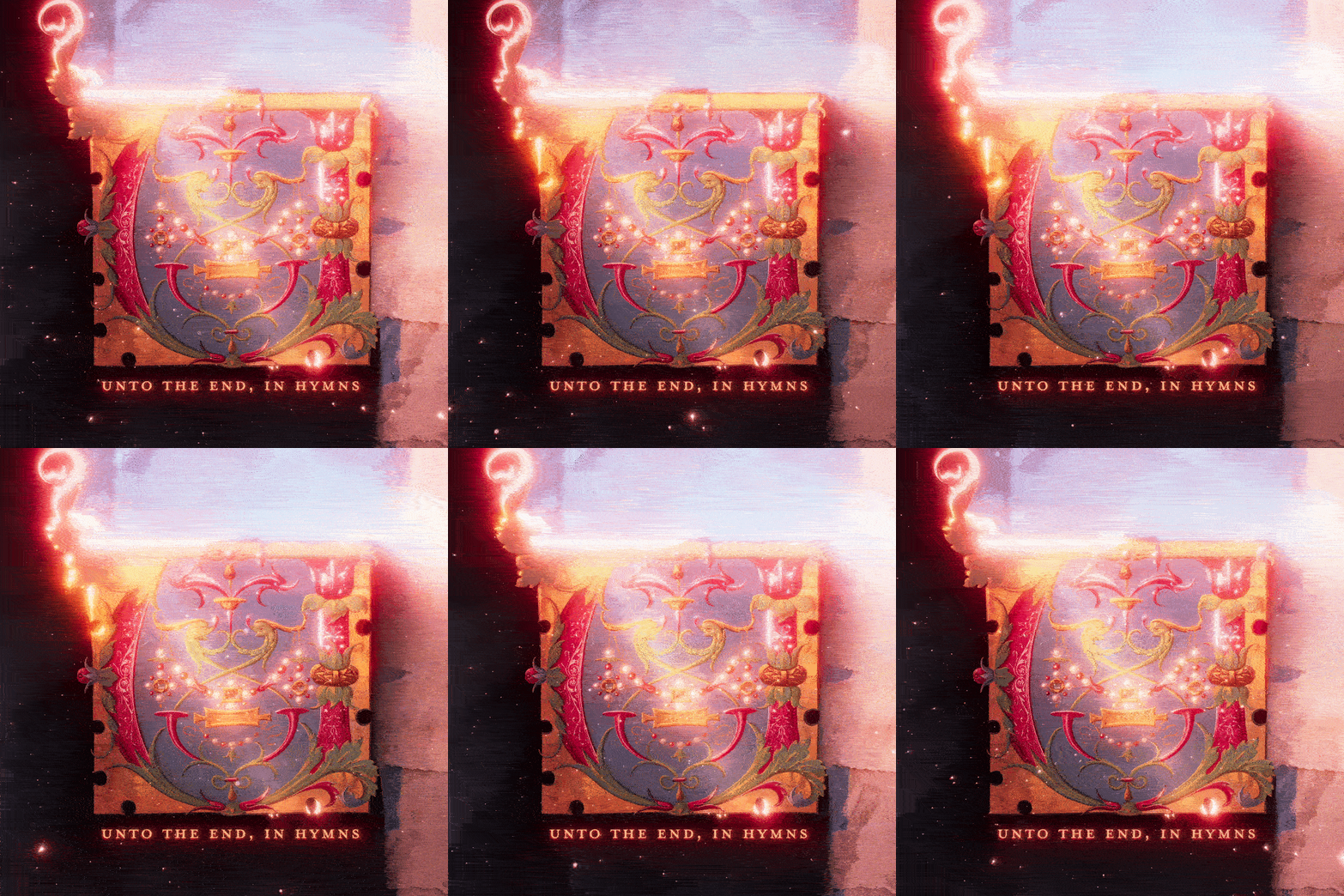
For this animation I found a really nice initial of a “U” from a medieval manuscript that I thought might work nicely. In After Effects I precomped it and applied Shadow Studio to it to give it some separation from the background. I added in a light and made the initial 3D so it would interact with the light. I also linked the source point of the shadows to the light so they would follow the light source like shadows do.
I added in some light sweep on the precomp of the U and also linked them to the light to have them move with the light and then added a looping wiggle expression to the light to create some movement.
I added in a Solid and applied Trapcode Particular for some floating particles and applied a lot of glows using Deep Glow. I finally added in some background textures and color correction.
Enjoy.
Unto the end, in hymns, for David.
(Psalm 60:1 DR)
View a higher quality version of this gif here: