

Psalm 60:5
sojourners and permanent residents
In thy tabernacle I shall dwell for ever: I shall be protected under the covert of thy wings. (Psalm 60:5 DR)
If you’ve ever moved from place to place a lot, it is sometimes hard for any place to feel like a home. The temporary nature of travel often precludes any sense of permanence, especially if the time in between is very short.
The Psalmist speaks as someone whose people had a history of sojourning. From Abraham’s travels to migration down to Egypt and the subsequent escape from the same and the journey of a generation in the desert, the Psalmist’s people were no strangers to being sojourners. The Tabernacle itself—which was the symbol and location, as it were, of God’s presence with His people—was an inherently mobile structure which journeyed with them in the desert and into the Promised Land. Even after the conquest of the Promised Land centuries of a more “permanent” status the Tabernacle retained this mobile aspect.
Thus even though settled in the Promised Land for some time, there was this fundamental character of being sojourners which still marked God’s people.
The Psalmist is within this context and recognizes that the quasi-permanence of living in the land God promised to Abraham is not the end of the sojourning nor is the place where he ultimately will find his “home.” Ironically, it is within the still mobile Tabernacle that he now finds permanence; a temporary structure in which he will dwell forever.
The Septuagint captures some of this tension in its use of the term παροικήσω which can mean both to be a sojourner or a permanent resident. It principally means to “inhabit” but leaves the nature of that habitation ambiguous. One can inhabit a place as a sojourner or as a permeant resident.
Most Latin translations (including the Old Latin, Vulgate and St. Jerome’s translation from Hebrew) employ either inhabitabo or habitabo which, as the cognate suggests, means to dwell or inhabit, which a far greater suggestion of permanent residence. Thus the Douay-Rheims renders this as “dwell.”
St. Augustine seems to be aware of the Septuagint’s potential rendering of this (or perhaps has a different Old Latin translation) as sojourner as he elaborates on this passage:
“A sojourner I will be in Your tabernacle even unto ages” [Psalm 60:4]. You see how he, of whom we have spoken, is he that cries. Which of us is a sojourner even unto ages? For a few days here we live, and we pass away: for sojourners here we are, inhabitants in Heaven we shall be. (St. Augustine, Expositions on the Psalms, 60, 5.)
He then compares this to Psalm 38 where the Psalmist speaks of being a sojourner as all his fathers were so as to emphasize the distinction between our sojourning here in this temporary home and our dwelling forever in heaven.
However, he then goes on to quote the alternate rendering of this passage:
Here therefore sojourners we are; there the Lord shall give to us mansions everlasting: “Many are”, He says, “the mansions in My Father's house.” [John 14:2] Those mansions not as though to sojourners He will give, but as though to citizens to abide for everlasting. Here however, brethren, because for no small time the Church was to be on this earth, but because here shall be the Church even unto the end of the world: therefore here He has said, “A dweller I will be in Your tabernacle even unto ages.” (ibid.)
The distinction he seems to see here is that between the Tabernacle of the Old Covenant and the Church of the New Covenant which he finds embedded in the words of this Psalm. For though the Psalmist speaks of dwelling in the tabernacle forever, the tabernacle is not eternal and thus cannot be an eternal dwelling.
One might object that the Psalmist is being poetic, but St. Augustine rather sees him as being prophetic: when he speaks of this eternal dwelling, he is referring to the Church which will endure forever. The tabernacle thus serves as a shadow of what is to come (cf. Hebrews 10:1) and the sojourning that characterizes this life will give way to the habitation that is eternal. This is why St. Augustine links this passage to the passage from John 14:2 about the mansions in the Father’s house, as the Church fulfills the prophetic utterance of the Psalmist.
The second half of this passage buttresses such a reading, for the Psalmist speaks of being protected under the covert of the Lord’s wings. This protection is not merely temporal or physical protection from danger or evil, but ultimately from temptation and falling into sin. However, the Old Covenant and its sacrifices were incapable of dealing with sin in such a manner. St. Paul elaborates on this:
For it is impossible that with the blood of oxen and goats sin should be taken away. Wherefore when he cometh into the world, he saith: Sacrifice and oblation thou wouldest not: but a body thou hast fitted to me: Holocausts for sin did not please thee. Then said I: Behold I come: in the head of the book it is written of me: that I should do thy will, O God. In saying before, Sacrifices, and oblations, and holocausts for sin thou wouldest not, neither are they pleasing to thee, which are offered according to the law. Then said I: Behold, I come to do thy will, O God: he taketh away the first, that he may establish that which followeth. In the which will, we are sanctified by the oblation of the body of Jesus Christ once. (Hebrews 10:4-10 DR)
St. John more succinctly summarizes:
He that committeth sin is of the devil: for the devil sinneth from the beginning. For this purpose, the Son of God appeared, that he might destroy the works of the devil. Whosoever is born of God, committeth not sin: for his seed abideth in him, and he can not sin, because he is born of God. (1 John 3:8-9 DR)
The Church—through which the graces of God come to man—becomes the source of that protection, and the sacraments are effective remedies against temptation and sin. Grace did not come through the Old Covenant sacrifices so as to conquer sin but do come through the one sacrifice of our Lord and Savior Jesus Christ, the great High Priest who offers that self-same sacrifice to the Father at every Mass. By sticking fast to the Church—which is the mystical Body of Christ—we are united to our Lord and preserved from sin if we cooperate with the grace He offers us:
Behold the reason why we are in safety amid so great temptations, until there come the end of the world, and ages everlasting receive us; namely, because we are covered up in the veiling of His Wings. There is heat in the world, but there is a great shade under the wings of God. (St. Augustine, Expositions on the Psalms, 60, 5.)
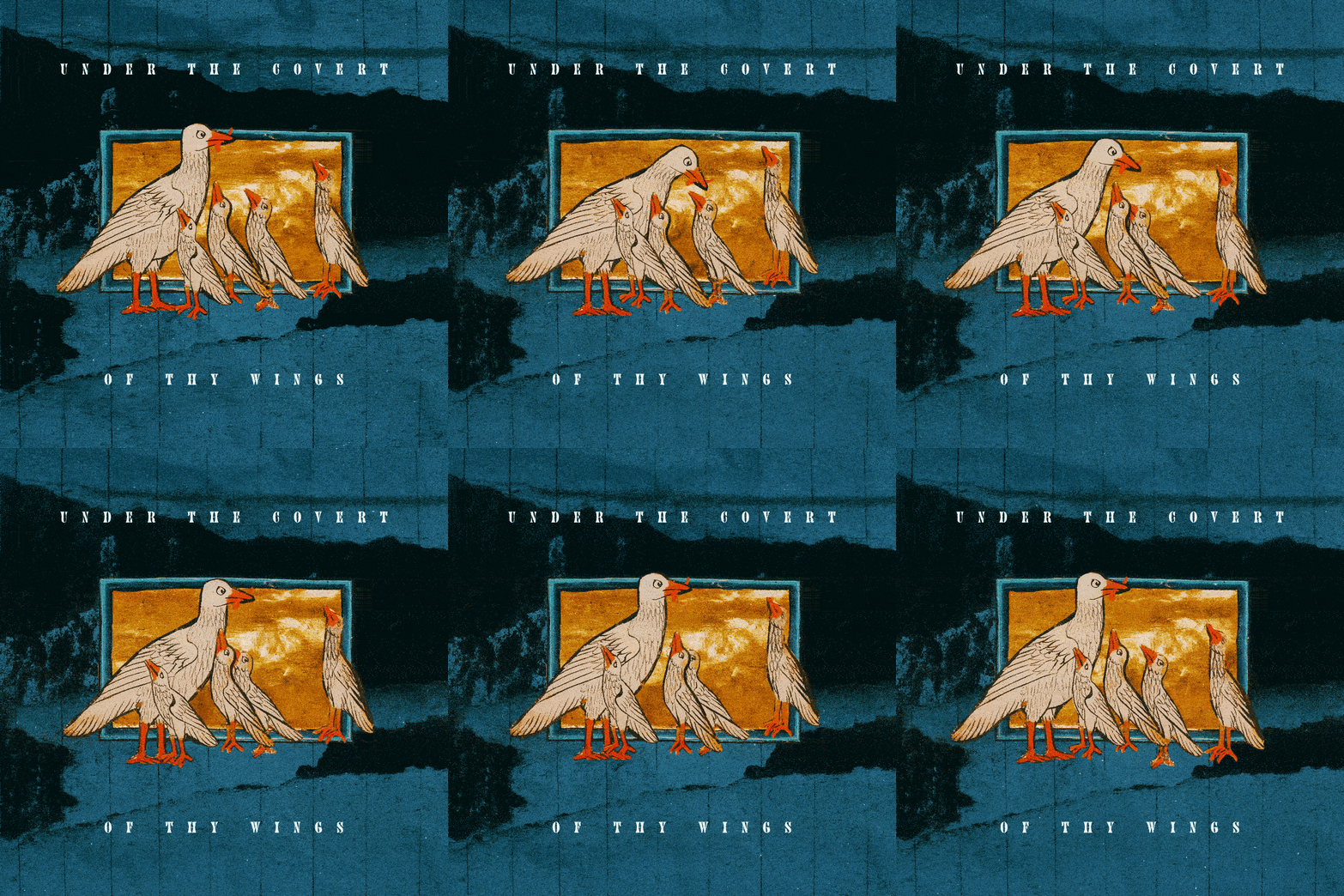
In this animation I found these fun birds from an old medieval manuscript and isolated them in Photoshop. In After Effects I precomped each one and animated them moving in slightly ways, the chicks hopping up and down to get the worm and the mother trying to choose who to feed.
I also cut out this gold background which was in the original miniature and reincorporated it to be a nice background.
Enjoy.
In thy tabernacle I shall dwell for ever: I shall be protected under the covert of thy wings.
(Psalm 60:5 DR)
View a higher quality version of this gif here: