

Psalm 60:6
receiving the inheritance
For thou, my God, hast heard my prayer: thou hast given an inheritance to them that fear thy name. (Psalm 60:6 DR)
The question of inheritance forms the backdrop of many interesting episodes in the Scriptures. Abraham was promised by God that his descendants would possess the land of Canaan (cf. Genesis 12:7), which is equivalent to them receiving it as an inheritance from him. Jacob deceived his father Isaac to receive the greater part of the inheritance, for while the narrative focuses largely on the blessing of the birthright, wrapped up in this is the inheritance to be gained as part of that blessing.
To provide an inheritance to one’s children was considered a mark of God’s blessing on the righteous as well as a sign of the prudence and industry of the man leaving the inheritance:
The good man leaveth heirs, sons, and grandsons: and the substance of the sinner is kept for the just. (Proverbs 13:22 DR)
Under the law of Moses inheritance laws were codified, with one particular stipulation being that inheritance could not pass from one tribe to another, as tribes were considered to be large extended families and because it was understood that the Lord had divided the tribes as they were (cf. Numbers 36:8-9). This is why inheritance would pass to the daughters of childless men, or to his brothers, or finally to his nearest kinsman (cf. Numbers 27:8-11) and also why widows or orphaned daughters who received the inheritance in such situations were required—if they married or remarried—to do so within the same tribe (cf. Numbers 36:6-9). A man was not permitted to show favoritism to the son of a favorite wife; if he had two wives and the firstborn was of the unloved wife, that firstborn son still possessed the birthright (cf. Deuteronomy 21:15-17).
The nature of this inheritance is that it was expected by both father and son that the latter should receive an inheritance. It is in this context that our Lord’s parable of the Prodigal Son makes sense in that the younger son demands his inheritance and the father grants it (cf. Luke 15:12). The father was not obligated to do so before his death, but that the son was in some sense owed an inheritance would not have been an odd concept to our Lord’s hearers. Similarly, in the parable of the wicked tenants they kill the only son so as to receive the inheritance, which means—according to the law of Moses—that they must have been close kinsman of the owner of the vineyard, as that would be the only possible means by which they could eventually receive it as an inheritance (cf. Matthew 21:38).
The Psalmist speaks within this entire milieu of inheritance when he frames the hearing of his prayer as the reception of an inheritance from the Lord. However, it is worth noting—as St. Augustine does—that this sort of inheritance by its very nature transcends an ordinary inheritance since the latter requires the death of the father:
Let us continue therefore in the fear of God's name: the eternal Father deceives us not. Sons labour, that they may receive the inheritance of their parents, to whom when dead they are to succeed: are we not labouring to receive an inheritance from that Father, to whom not dying we succeed; but together with Him in the very inheritance for everlasting are to live? (St. Augustine, Expositions on the Psalms, 60, 6.)
On the other hand, St. Paul speaks of how the obtaining of this inheritance was accomplished through a death, that our Lord and Savior Jesus Christ:
And therefore he is the mediator of the new testament: that by means of his death, for the redemption of those transgressions, which were under the former testament, they that are called may receive the promise of eternal inheritance. For where there is a testament, the death of the testator must of necessity come in. For a testament is of force, after men are dead: otherwise it is as yet of no strength, whilst the testator liveth. (Hebrews 9:15-17 DR)
Our Lord—as the Only Son of the Father—is by eternal right (as it were) the Possessor of this inheritance. But through His death those who are brought into the family of God (cf. Ephesians 2:19) receive that eternal inheritance. Those who are in the Church are part of the mystical Body of Christ, being made sons of God and thus share in that inheritance by virtue of their union with the Eternal Son (cf. John 1:12). Our Lord’s mediation of the new covenant through His death brings us peace and reconciliation with the Father (cf. Romans 5:10), which as sons gives us a portion in that eternal inheritance:
The Son became Mediator between the Father and us. The Father willed not to leave us this inheritance, but was angry against us, and was displeased [with us] as being estranged [from Him]; He accordingly became Mediator between us and Him, and prevailed with Him. And what then? How did He become Mediator? He brought words from [Him] and brought [them to us], conveying over what came from the Father to us, and adding His own death thereto. We had offended: we ought to have died: He died for us and made us worthy of the Testament. (St. John Chrysostom, Commentary on Hebrews 9:15)
The Psalmist speaks on the literal level of the inheritance that the Lord promised to Abraham and which his people then currently possessed, but the prophetic nature of the Psalms carries the words beyond to the eternal inheritance of which the Promised Land was a type. The prayer of the Psalmist being heard is signified and secured by the possession of that earthly inheritance which provides his confidence in the Lord; even more so is our confidence in our Lord Jesus Christ who has secured for those whom He calls (cf. Ephesians 1:11-14) to that eternal inheritance:
For if God has an everlasting inheritance for his children that fear him, will he not protect them on their journey thereto? What father ever despised or deserted his deserving children? “And if God be for us, who is against us?” We are absolutely sure and certain of the eternal inheritance in heaven, and God’s protection in this world, if we truly fear him. (St. Robert Bellarmine, A Commentary on the Book of the Psalms, 60, 5.)
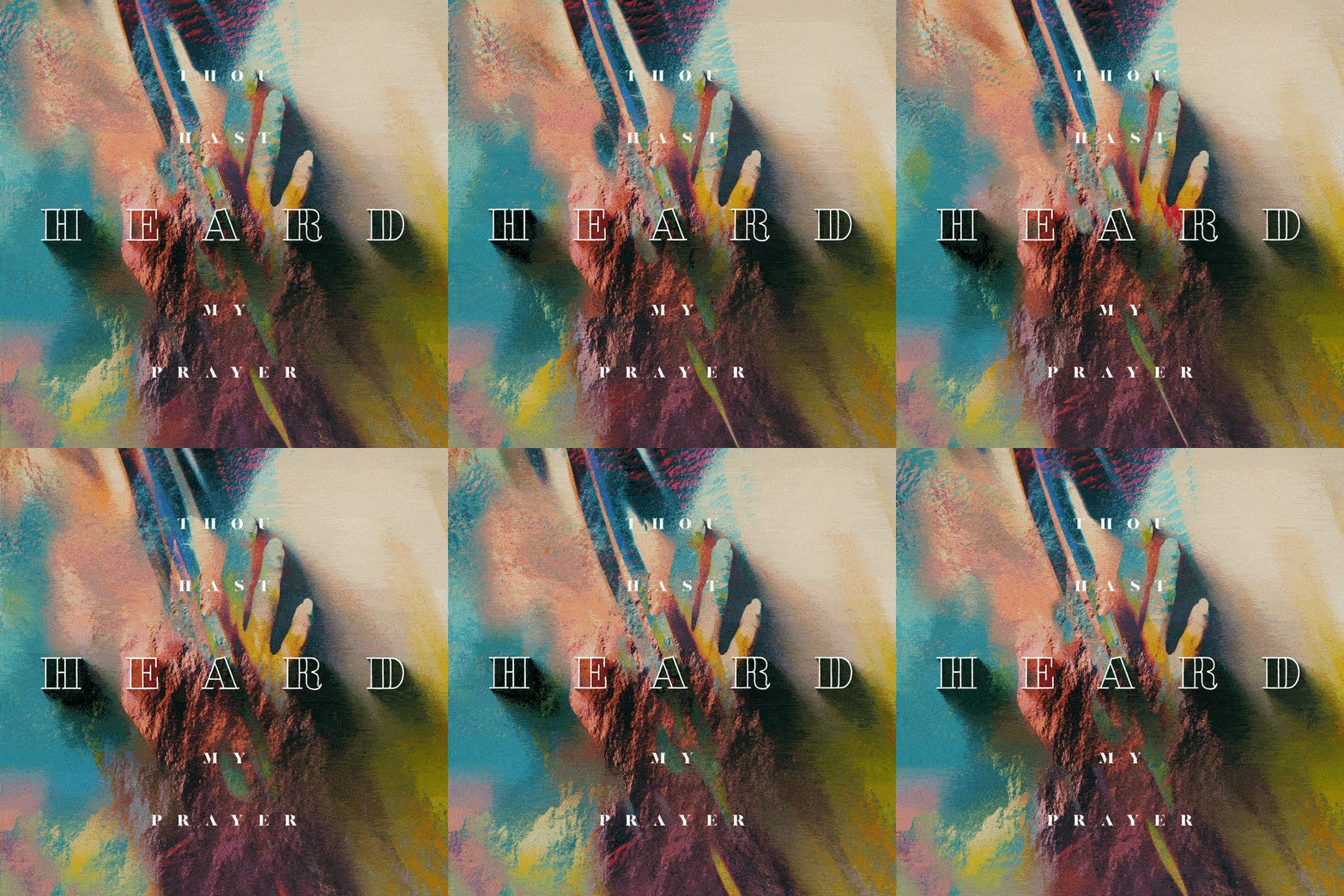
I wanted to focus on the prayer aspect of this passage, and so I found this great image of a hand being lifted heavenward. I isolated it in Photoshop and brought it into After Effects.
At that point I didn’t have a clear idea of where I was going, but then I started layering a bunch of disparate textures on top and experimenting with blend modes and I really liked the coloring and the way the textures interacted. I used loopFlow on some of them to created some movement and added a bit of Wiggle Hold to the hand.
Enjoy.
For thou, my God, hast heard my prayer: thou hast given an inheritance to them that fear thy name.
(Psalm 60:6 DR)
View a higher quality version of this gif here:
*Update: In the initial version of this post I had a brief section connecting the passing of inheritance to the nearest kinsmen to those who are incorporated into the Church. As I reread it immediately after publishing I was concerned that it wasn’t clear enough and could be infelicitous language that could potentially be misconstrued as implying that this inheritance passes from Christ as if He no longer possesses it, which is certainly not accurate. That absolutely wasn’t my intention, and I have updated the post to reflect that, which is why it will appear different (and now hopefully more clear) from the original version. My apologies for any potential confusion.