

Psalm 6:2
repentance unto life
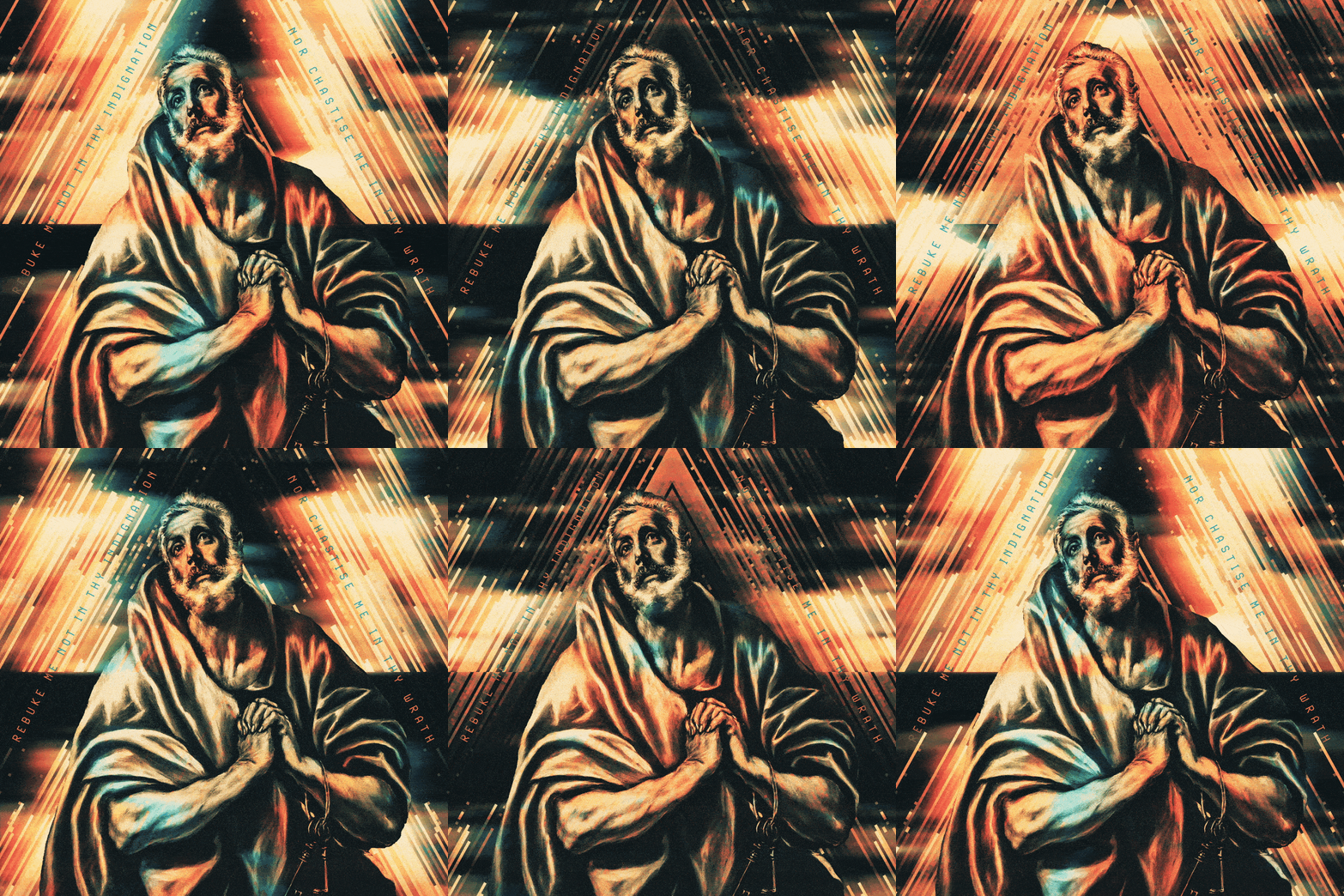
O Lord, rebuke me not in thy indignation, nor chastise me in thy wrath. (Psalm 6:2 DR)
In view of the coming Day of Judgment when the hidden things of darkness will be brought to light (cf. 1 Corinthians 4:5), the Psalmist recognizes his sin and iniquity and pleads for mercy. He does not necessarily ask to be excused from any punishment, but rather that he will be spared from final damnation, God’s present justice being a healing remedy for his unrighteousness.
It is because he hates his sin rather than fearing punishment that he can hope for clemency, for the souls in perdition are longer capable of hating their sin but rather can only despise their pains:
This happens in this world, when the sinner is struck with blindness and obstinacy, so that sin becomes the punishment of sin; and in the other world, when the soul is consigned to hell’s flames; stricken with such horror, and fearing the abyss of the judgments of God, he does not say against the scourge of punishment which, instead of separating from, rather brings us nearer to God; but he dreads the supreme evil and misfortune of being abandoned to the desires of his heart, to his ignominious passions, to obduracy, and blindness, and finally to eternal separation from God. (St. Robert Bellarmine, A Commentary on the Book of the Psalms, 6, 1.)
In this present life we can still turn our hearts and minds and wills to God in contrition, hoping for chastisement as a father chastises a son, rather than as a judge does a criminal. In justice and charity the soul becomes so united to God and desirous of His justice that it hopes for punishment in this life rather than to avoid it, which would be the greater punishment for what it portends for the future life:
Not to be punished here on earth after I have offended Thee would be to me the greatest punishment. I beg Thee, then, to punish me here below, in order that I may amend, and may avoid eternal death. (St. Alphonsus Liguori, The Divine Office, Explanation of the Psalms and Canticles, 42.)
There is a fine parallelism created by the Psalmist between the two lines, for the “rebuke” (arguas) is paralleled by the “chastisement” (corripias), just as “indignation” (furore) by “wrath” (ira). St. Augustine sees in this Psalm the prayer of the Church, which is why these threats of punishment are remedial in tending towards repentance rather than final condemnation. He spends some time considering the various shades of meaning of the Latin words here, comparing them with their Greek originals, noting that there are differences in some Latin manuscripts regarding the ordering of the relative severity of terms) (cf. Exposition on the Psalms, 6, 3.)
The parallelism of this verse is evident in the structure, as the latter half of the verse expands upon the first. In this case to rebuke is perhaps the opposite side of chastisement, for to rebuke has its focus on the one doing the rebuking, while chastisement is the outflow of the rebuke as its effects are seen and experienced in the object of that rebuke. The ordering here—while not necessarily essential—nevertheless has a logical progression from the Judge and Lawgiver to the transgressor.
St. Augustine ultimately concludes that ordering is less essential than what it conveys, which is the emotional import of the expression; that is, these terms express an emotional state from when arises the actions. However, he takes care to remind his readers that God does not act from emotional disturbance but rather from perfect tranquility of will; in fact, God’s “mind” and “will” are not separate things. It is not the case that God sees something and reacts serenely to it as if coming upon new information and then deciding what to do. Instead, to speak of God’s “anger” or God’s “wrath” is our limited way of describing the effects of God’s will in relation to temporal acts. It is because of this that St. Augustine concludes that this “anger” spoken of in this passage is directed towards amendment of life:
Yet this emotion must not be attributed to God, as if to a soul, of whom it is said, “but Thou, O Lord of power, judgest with tranquillity.” [Wisdom 12:18] Now that which is tranquil, is not disturbed. Disturbance then does not attach to God as judge: but what is done by His ministers, in that it is done by His laws, is called His anger. In which anger, the soul, which now prays, would not only not be reproved, but not even chastened, that is, amended or instructed. (St. Augustine, Exposition on the Psalms, 6, 3.)
St. Augustine reasons that the only reason to pray for clemency in the midst of chastisement is that it is meant to reprove us unto repentance and salvation. St. Paul’s words are in the background here:
For other foundation no man can lay, but that which is laid; which is Christ Jesus. Now if any man build upon this foundation, gold, silver, precious stones, wood, hay, stubble: Every man's work shall be manifest; for the day of the Lord shall declare it, because it shall be revealed in fire; and the fire shall try every man's work, of what sort it is. If any man's work abide, which he hath built thereupon, he shall receive a reward. If any man's work burn, he shall suffer loss; but he himself shall be saved, yet so as by fire. (1 Corinthians 3:11-15 DR)
St. Augustine draws on this passage to conclude:
Now in the day of judgment all are “reproved” that hold not the foundation, which is Christ. But they are amended, that is, purged, “who upon this foundation build wood, hay, stubble. For they shall suffer loss, but shall be saved, as by fire.” What then does he pray, who would not be either reproved or amended in the anger of the Lord? What else but that he may be healed? For where sound health is, neither death is to be dreaded, nor the physician's hand with caustics or the knife. (St. Augustine, Exposition on the Psalms, 6, 3.)
In this life we can still turn to the Lord in contrition and repentance, accepting with gratitude the chastisements we deserve so as to avoid the eternal condemnation due to our sins. Even the severe pains of Purgatory are an incredible mercy in which our dead works are purged away, reparation made and hearts completely reoriented to our Lord so as to finally attain unto the Beatific Vision.
In this animation I found an excellent image of a contrite St. Peter following his denial of our Lord that I thought would be a fitting illustration of this Psalm. St. Ambrose in his Hexaemeron speaks of how St. Peter “washed away his sins with his tears,” which is in keeping with the import of this Psalm.
I cut out the figure in Photoshop and brought it into After Effects. I then precomped a background image and applied Pixel Sorter 3 to it, dropping down the resolution of the Strips to get a more pixelated look. I then animated that and applied the Kaleida effect to get the particular framing.
I finally added some glows to everything and played around with some blending modes to create the final look.
Enjoy.
O Lord, rebuke me not in thy indignation, nor chastise me in thy wrath.
(Psalm 6:2 DR)
View a higher quality version of this gif here: