

Psalm 62:11
when the fox guards the henhouse
They shall be delivered into the hands of the sword, they shall be the portions of foxes. (Psalm 62:11 DR)
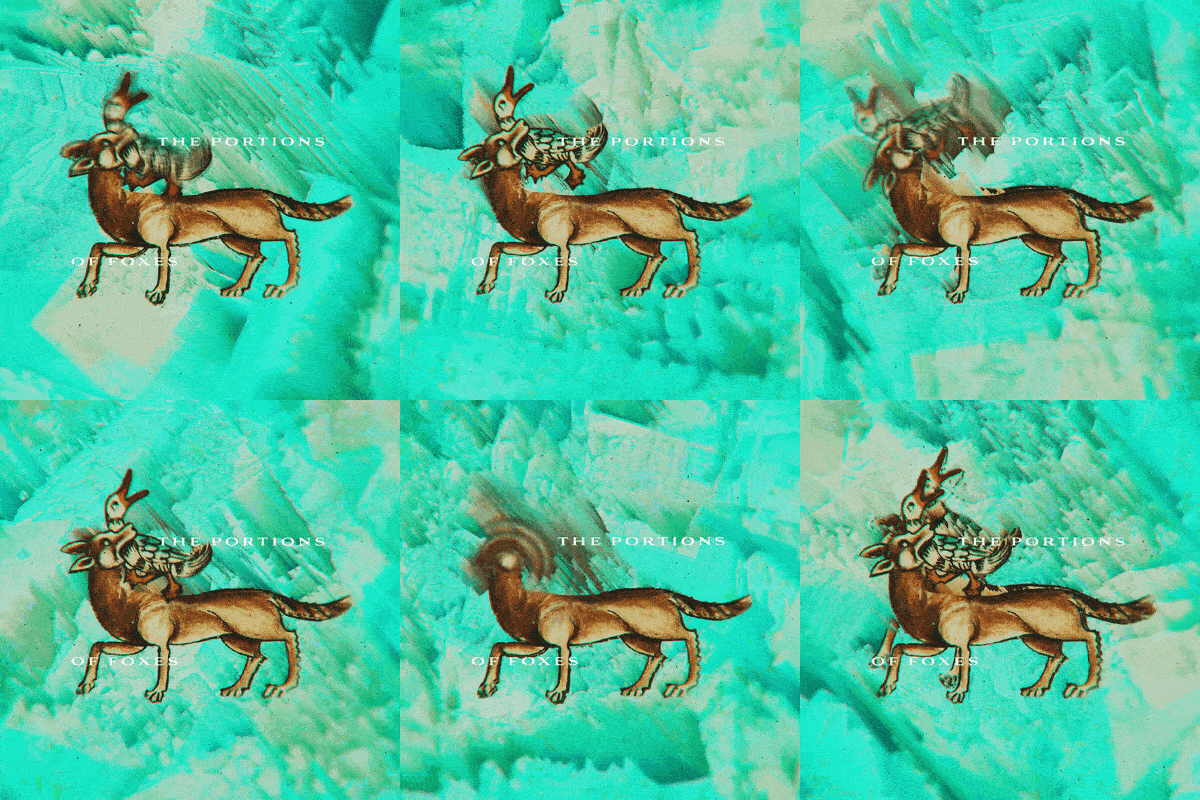
In the neighborhood where I live there are often lots of rabbits, which invariably means that there tend to be many foxes. During my early morning walks it is not uncommon to see foxes prowling around, often in little packs of two or three. Sometimes they like to try and beat up on cats, and other times they hiss at me for disrupting their stalking. They are generally cowardly and will run away as I approach, looking back with what seems to me a certain disdain. Yet every so often the beast within will override natural fear, for even if I am within a couple feet of their prey it as if I do not exist. That feral look in the eye is unsettling, even in something as non-threatening as a fox. I always know that there are foxes about even if I cannot see them, as the screams of rabbits in their death throes early in the morning is pretty unmistakable.
This penultimate passage of this Psalm continues to describe the fate of those who are seeking the life of the Psalmist, which sets up an interesting juxtaposition. For while the Psalmist seems to be the one in the midst of extremities in the desert, it is his enemies who are in the greatest danger, for they will soon receive the recompense for their injustice.
In the literal sense the Psalmist is describing King Saul and his men who are hunting after David to put him to death, and here David prophesies the ultimate demise of Saul (cf. 1 Samuel 31). King Saul’s violent end in battle thus anticipates our Lord’s words to St. Peter:
Put up again thy sword into its place: for all that take the sword shall perish with the sword. (Matthew 26:52 DR)
There is a further juxtaposition, for David refused to slay King Saul with the sword when he had the chance since he knew that Saul was the Lord’s anointed; David too was also the Lord’s anointed, yet Saul sought his life for this very reason. David thus refused to take for himself what he had been promised at the expense of laying his hand on the Lord’s anointed, whereas King Saul tried to hold on to what had been taken from him for his disobedience by slaying the Lord’s anointed with the sword.
This idea is further developed in the expansion of the second half of this passage. Foxes are often characterized as “sly” or “crafty;” the Latin vulpes is used both literally for a fox and figuratively for craftiness. In this manner the Psalmist speaks of his enemies ironically falling into their own trap, so to speak. That is, they seek in their own craftiness to entrap him and kill him, but end up being undone by something even craftier. Foxes are also opportunistic in their craftiness and will outright hunt for food, sneak into chicken coops, as well as scavenge from larger predators.
The upshot of the Psalmist’s words here is that those who seek after him think they can—in their natural wisdom and planning—overtake and destroy him, but this hubris blinds them to the danger which follows them like a fox stalking in the darkness.
The spiritual sense of this passage thus can perhaps be taken as a warning against pride and all the other snares of the evil one. The devil has been compared to a prowling lion (cf. 1 Peter 5:8) which overwhelms by its sheer power and strength, but is also that ancient serpent (cf. Apocalypse 12:9). Somewhere in between the craftiness of a serpent and the power of a lion lies—we might say— the diabolical mean of the fox.
After all, the demons are opportunistic in their temptations of us, using our weaknesses to lure us into sin and lull us into complacency. In our hubris we can imagine we are strong and have a good grip on virtue and can resist all temptation, but this is the lie of the evil one who wants us to feel safe in the henhouse, so to speak, where we become easy kills. St. Paul thus warns the Corinthians:
Wherefore, he that thinketh himself to stand, let him take heed lest he fall. (1 Corinthians 10:12 DR)
St. Paul goes on to make an even stronger statement:
Let no temptation take hold on you, but such as is human. And God is faithful, who will not suffer you to be tempted above that which you are able: but will make also with temptation issue, that you may be able to bear it. (1 Corinthians 10:13 DR)
The Vulgate here (and the Douay-Rheims following it) explicitly renders this in the imperative, whereas many other English translations translate it without the imperative as more of s statement of fact, such as “No temptation has taken hold of you…” Cornelius a Lapide explains how the imperative sense is understood:
When, as is often the case, any temptation of those which I have mentioned, or any other, attacks your minds, do not take it in and foster it, so as to let it grow imperceptibly in power, and to become at last unconquerable: for it is impossible to exclude altogether human and light temptations so as to never feel them. (Cornelius a Lapide, Commentary on 1 Corinthians 10:13, 1.)
To be tempted and to fell the lure of temptation is something inescapable in the human state. However, the way in which we respond to temptation is of immense importance. When temptation comes we can sort of play around with it, indulging it in our minds, and in a very human way see just how close to the line we can get. We might think we are bein virtuous in not succumbing, but every foothold we give to temptation makes it harder to resist, and the longer we play around with it the more we turn our wills towards it until we have—seemingly unawares—actually chose it. This progression from temptation to sin (cf. James 1:14-15) can be subtle if we are not sober-minded and reject temptation at the earliest possible moment. This rejection entails a turn to grace to overcome it, which is what St. Paul exhorts when temptation arise, for grace can overcome any temptation:
It is in the power of each Christian to obtain sufficient help to overcome all temptations and all sins; for God pledges His word to them to this, and He is One to be trusted, as the Apostle says here. His meaning is: no temptation can take you, except on your own side and by your own negligence; for on God’s side I pledge myself that God, who is faithful, will perform what He has promised, and will not suffer you to be tempted above that you are able, i.e, will not allow you to be tempted, except by human temptation. Understand, however, that this is if you seek His grace and help, as is right, and co-operate with Him. (Cornelius a Lapide, Commentary on 1 Corinthians 10:13, 7.)
We cannot hope to outwit the snares of the devil by means of our own intellects, as the angelic intellect—even the fallen angelic intellect—is far above our own. Apart from God’s grace it is impossible to avoid sin, which is why indulging temptation in any way is a slippery slope into sin. It is not that the temptation is in and of itself unable to be overcome simpliciter, but rather that the more we indulge temptation the less we turn to grace. Our Lord exhorts us to prayer to conquer temptation:
Watch ye, and pray that ye enter not into temptation. The spirit indeed is willing, but the flesh weak. (Matthew 26:41 DR)
We must therefore take heed against pride and overconfidence, relying on God as the Psalmist did rather than in our own strength as his enemies did, those men who deemed themselves wise in their own eyes but became the portions of foxes:
If men do not put upon their beasts more weight than they can bear, much less will God put on men more temptations than they can bear. Again, if the potter bakes his vessels in the fire until they are perfected, and does not remove them before they are properly baked and of the right consistency, and again does not leave them in too long, lest they be burnt too much and so become useless: much more will God do the same with us, trying us with the fire of temptations until we are purified and perfected; but beyond that point He will not suffer us to be scorched and consumed with temptation. (St. Ephrem, de Patientia.)
In this animation I kept it pretty literal, but still wanted to have a little fun with it. I found this drawing in the margins (marginalia) of the 14th century Gorleston Psalter which shows a fox hunting a goose. Amusingly, in the original manuscript (or perhaps it was wryly added later) is the middle English work “queck,” which would later become quack.
I cut out the fox and goose in Photoshop and then isolated the fox’s head and the goose from the fox’s body and then use Generative Fill to replace the missing pixels.
In After Effects I precomped both layers and set up a wiggle expression linked to some expression sliders to control the head shaking. In the main composition I used the Puppet Tool in the precomp to allow the fox to raise on its hind legs. I added in a texture in the background and used wiggle hold on both position and rotation to randomly generate positions and rotations every six frames, and then used Pixel Sorter 3 to modify the look. I finally added in some text and di some color correction.
In retrospect I kind of wish I had added in the “queck” for some fun. Maybe someday.
Enjoy.
They shall be delivered into the hands of the sword, they shall be the portions of foxes.
(Psalm 62:11 DR)
View a higher quality version of this gif here: