

Psalm 62:7
pray without ceasing
If I have remembered thee upon my bed, I will meditate on thee in the morning: (Psalm 62:7 DR)
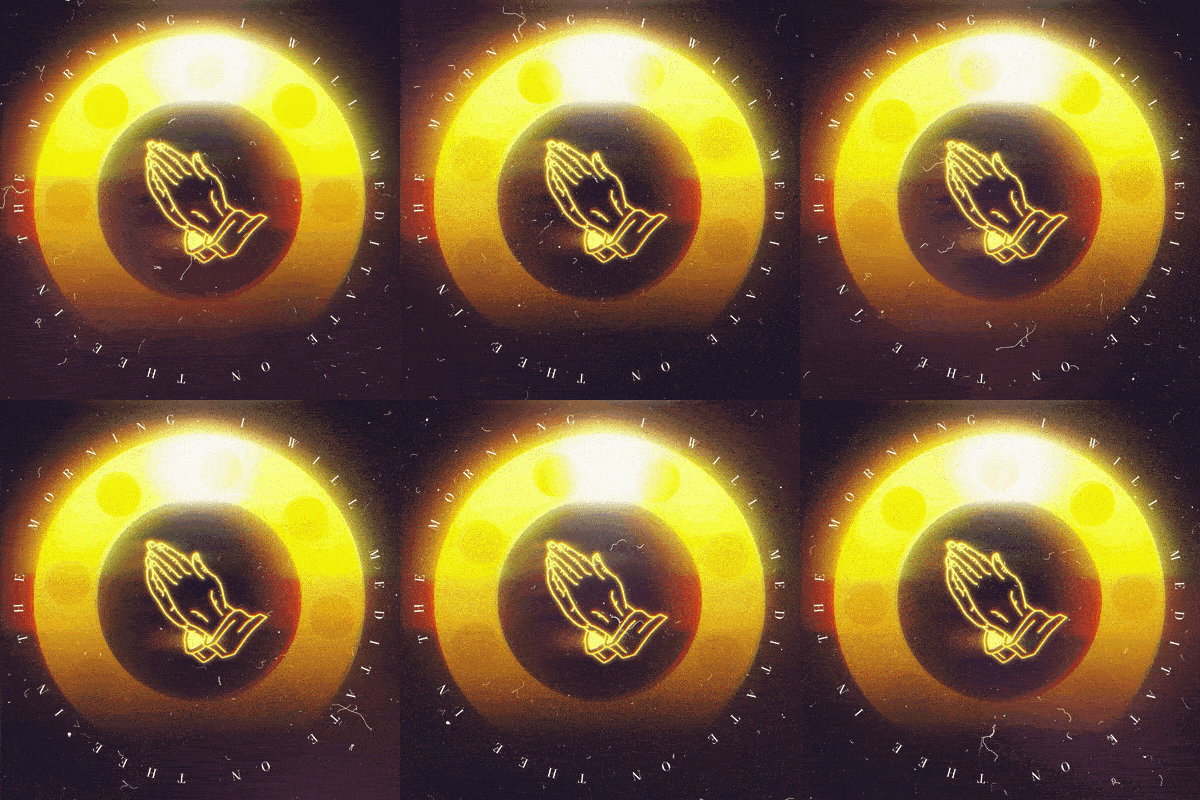
With humans you can often discern where their priorities lie by examining what they put their time and effort into. This is not always evident in terms of sheer quantity, but rather by means of consistency and sacrifice. That is, what other things (even other good things) are given up to devote to making sure X or Y happens.
And given that the nature of our embodied selves is conditioned to some extent by the movements of times and seasons, the actions we take at the beginning and end of the day have a certain punctuated essence to them. In other words, what we do immediately upon rising and before retiring to sleep can set the course and bring to completion all the events contained therein.
In the modern context this is—rather unfortunately—probably dominated by the tyranny of screens. It is effortless to check news or whatnot immediately upon waking and doomscrolling YouTube before going to bed. And while such actions may not be bad in and of themselves, they do at the very least set a tone for both the work of the day and the rest of the night by turning our thoughts towards what others want us to see or think and—if we’re honest—what tech oligarchs desire us to see and think thanks to tyranny of their algorithms, unless one imagines they program with angelic intentions.
For the Catholic there has been the longstanding tradition of prayer (gasp!) punctuating the morning and evening so that one’s thoughts are turned to God during these moments of transition in the day. This is particularly noticeable in the Divine Office which from ancient times had set periods of prayer throughout the day, two of which were at dawn (Lauds) and before sleep (Compline).
The term Lauds was probably derived from the term laudate (praise) which is prevalent in the last three Psalms (148, 149, 150) of the Psalter which were said in this Office every day prior to the reforms of Divino Afflatu. The upshot of Lauds is that first thoughts for the Christian upon rising are to give thanks for the day which has been graciously given by God and to plead for His mercy and grace throughout the day. Many of the hymns of Lauds take on this character and draw imagery from the rising sun to create a metaphor of the light of Christ rising in the hearts of those in prayer to banish the darkness of sin.
The term Compline in Latin is completorium, from compleo (complete) and -torium, which indicates the place (e.g., scriptorium = writing (scribo) place). It is one of the later liturgically defined Offices, probably receiving its structure from St. Benedict. Prior to Divino Afflatu Compline was largely invariable save for the final Marian antiphon, reciting Psalms 4, 90 and 133 every day. Psalm 90 is an especially apropos Psalm prior to retiring to sleep, beginning with a profound expression of confidence in the Lord’s protection:
He that dwelleth in the aid of the Most High shall abide under the protection of the God of Jacob. (Psalm 90:1 DR)
The hymn at Compline—Te lucis ante termninum—is also a beautiful expression of hope and faith in the Lord as well as a pleading for protection against the assaults of the devil.
And while the Psalmist did not have the Divine Office in his time, his words in this passage give expression to what would form the rationale for its development in Catholic history.
He punctuates both evening and morning with prayer, which demonstrates that this recourse to prayer and meditation is not something he tries to fit into his day but rather acts as a sort of framework for everything else. He sees both sleep and rising as actions which take place within this framework of prayer, rather than prayer happening to occur at these moments. It is a subtle shift but makes a crucial difference, for prayer becomes the reasons for these actions. He turns his thoughts and will towards the Lord both at night and in the morning and understands the rest of his life as enabling this and being conditioned by this.
St. Augustine draws out an important point here, that if we cannot bring ourselves to think of God when we are at rest, we will certainly not do so when we are working or engaged in other activities:
His “bed” he calls his rest. When any one is at rest, let him be mindful of God; when any one is at rest, let him not by rest be dissolved, and forget God: if mindful he is of God when he is at rest, in his actions on God he does meditate. For the dawn he has called actions, because every man at dawn begins to do something. What therefore has he said? If therefore I was not mindful on my bed, in the dawn also I did not meditate on You. Can he that thinks not of God when he is at leisure, in his actions think of God? But he that is mindful of Him when he is at rest, on the Same does meditate when he is doing, lest in action he should come short. (St. Augustine, Expositions on the Psalms, 62, 12.)
The challenge, then, is to form our minds and hearts to be diligent in prayer so that we can heed St. Paul’s admonition to “pray without ceasing” (1 Thessalonians 5:17), which—while it may not mean every literal second of one’s life—certainly means that the totality of one’s desires and efforts are affixed on God. Nor should this seem strange. We rest at night and get up in the morning on a regular basis so that we can go about the activities and work of the day; the morning and night punctuate and frame this intention, as it were. Prayer functions in a similar manner in that it begins with that inward intention and desire in the heart for God through which all other things are filtered.
The prayers of morning and night that the Psalmist speaks of thus serve as proxies of sorts for this continual longing, both while awake and at rest. In this way our prayer can be unceasing:
For it is your heart's desire that is your prayer; and if your desire continues uninterrupted, your prayer continues also. For not without a meaning did the Apostle say, “Pray without ceasing.” [1 Thessalonians 5:17] Are we to be without ceasing bending the knee, prostrating the body, or lifting up our hands, that he says, “Pray without ceasing?” Or if it is in this sense that we say that we “pray,” this, I believe, we cannot do “without ceasing.” There is another inward kind of prayer without ceasing, which is the desire of the heart. Whatever else you are doing, if you do but long for that Sabbath, you do not cease to pray. If you would never cease to pray, never cease to long after it. The continuance of your longing is the continuance of your prayer. (St. Augustine, Expositions on the Psalms, 37, 13.)
For this animation I knew I wanted an icon of prayer hands, and so I brought this vector into After Effects. I wanted to somehow illustrate the continual nature of prayer both morning and evening, so I created an ellipse and then used a Repeater to create the radial set of ellipses. I used some gradients and matte to have the constantly rotating ellipses change as they reached the apex, which I guess would be “morning.”
I then added in some glows and color correction and noisiness for visual interest.
Enjoy.
If I have remembered thee upon my bed, I will meditate on thee in the morning:
(Psalm 62:7 DR)
View a higher quality version of this gif here: