

Psalm 6:6
confession when you can
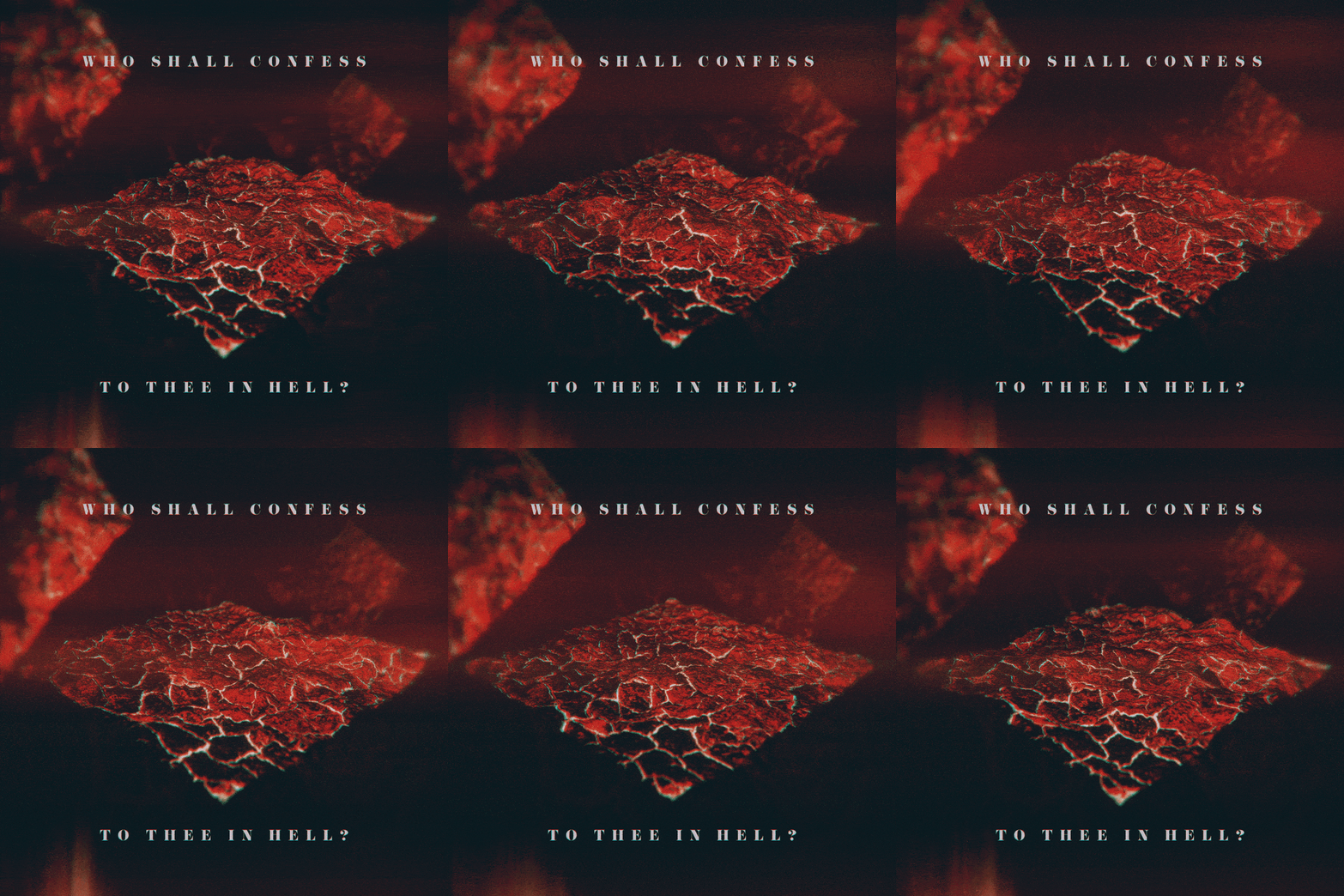
For there is no one in death, that is mindful of thee: and who shall confess to thee in hell? (Psalm 6:6 DR)
As the Psalmist multiplies his “arguments” as to why God should show him mercy, he lights upon the ultimate argument: if he is dead, his prayers and righteousness are of no avail. King Hezekiah’s prayer for healing—which draws on the same language as this passage—picks up the “argument” that where the Psalmist leaves off:
For hell shall not confess to thee, neither shall death praise thee: nor shall they that go down into the pit, look for thy truth. The living, the living, he shall give praise to thee, as I do this day: the father shall make thy truth known to the children. (Isaiah 38:18-19 DR)
This is certainly implied by the Psalmist’s words, the idea being that the confession that God desires from him cannot be brought forth in hell. But what is the manner of death and hell that the Psalmist has in view? Both St. Augustine and St. Robert Bellarmine consider what sense hell takes on in this passage.
St. Augustine notes that the rich man in Jesus’s parable (cf. Luke 16:19-31) was in hell yet still confessed and was in some respect still mindful of God, entreating Abraham to send Lazarus to his bothers so that they might repent. This causes him to consider that hell is being used by the Psalmist as a means of describing the blindness of sin:
It may be understood also, as if the Psalmist calls sin, that is committed in contempt of God's law, death: so as that we should give the name of death to the sting of death, because it procures death. “For the sting of death is sin.” [1 Corinthians 15:56] In which death this is to be unmindful of God, to despise His law and commandments: so that by hell the Psalmist would mean that blindness of soul which overtakes and enwraps the sinner, that is, the dying. “As they did not think good, the Apostle says, to retain God in their knowledge, God gave them over to a reprobate mind.” [Romans 1:28] From this death, and this hell, the soul earnestly prays that she may be kept safe, while she strives to turn to God, and feels her difficulties. (St. Augustine, Expositions on the Psalms, 6, 6)
In other words, since sin darkens the intellect and occludes the vision of God from the soul, it serves as a figure of hell since in hell the unjust are forever cut off from the Beatific Vision. Sins committed in this life are thus a foretaste of that darkness and pain and in that sense serve as the motivation for the penitential prayer of the Psalmist. He understands that in his sin he is lost in darkness, and that he is in need of God’s grace and protection to ultimately persevere in faith.
St. Bellarmine takes a more literal reading and draws from the parallel prayer of Hezekiah to demonstrate that the hell of the damned is in view here:
But I consider that the passage should be understood to mean everlasting death and the hell of the damned. For, though Ezechias feared the death of the body, he feared also the death of the soul, and, therefore, in his thanksgiving to God, he sang the canticle, because he felt that the restoration of his bodily health was a sort of intimation to him, that God in his goodness had remitted his sins, and delivered him from the danger of hell, and therefore, he says: “But you have rescued my soul that it may not be lost: you have cast all my sins behind your back, because hell will not confess to thee, nor death praise thee; they who descend into the lake will not expect thy truth.” All these arguments would be of no weight, were the death of the body alone in question here. (St. Robert Bellarmine, A Commentary on the Book of the Psalms, 6, 5.)
For St. Bellarmine, the moral to be drawn from Hezekiah’s prayer is the evidence that both passages are about more than a poetic description of physical death. Nor is this in contradiction to St. Augustine’s reading, for as is often true, they sometimes see the same object from different sides.
St. Augustine considers confession in the broadest possible sense and thus has the rich man in hell making a confession even if it was of no avail. However, the point of confession is not merely the relating of doctrinal realities but the application of them to one’s heart and moral life; thus our Lord warns that not all who call him Lord will enter the kingdom of heaven:
Not every one that saith to me, Lord, Lord, shall enter into the kingdom of heaven: but he that doth the will of my Father who is in heaven, he shall enter into the kingdom of heaven. (Matthew 7:21 DR)
The rich man made a confession, but that confession did not arise from contrition; that is, he was sorry for the state in which he found himself, rather than for the sins he had committed.
It is this latter sense of confession that ties the readings together into a seamless whole. As aforementioned, for St. Augustine hell stands in for the blindness of sin that prevents the soul from seeing God, since in the damnation of hell the Beatific Vision is forever occluded. St. Bellarmine looks at the same thing from the obverse, understanding that the confession that leads to repentance and union with God is impossible in hell, and this is what the blindness of sin leads to, which is why the passages use physical death as a metaphor for spiritual death.
From which ever angle the passage is understood, the Psalmist’s words are poignant, for his confession occurs as he voices this plea for mercy. As long as we have breath, we can turn to the Lord in contrition and repentance and receive mercy and ask for assistance to do His will.
I suppose this animation was kind of on the nose, so to speak. I found some lava images and brought them into After Effects and used them as texture maps for instances of Trapcode Mir. I tried to give it a bubbly, roiling effect and then spaced the instances in Z space for some nice depth of field. I finally added some glows and chromatic blur and further color correction.
Enjoy.
For there is no one in death, that is mindful of thee: and who shall confess to thee in hell?
(Psalm 6:6 DR)
View a higher quality version of this gif here: