

Psalm 67:1
a song by any other name
Unto the end, a psalm of a canticle for David himself. (Psalm 67:1 DR)
Sometimes the greatest truths are so glorious that the sheer grandeur of them can create obscurity, much like the brilliance of the sun is occluded by its brightness not because it becomes therefore hidden, but rather that we are not able to directly gaze at its brilliance. The fault, if there is one, lies in our incapacity to behold, and in the case of the sun if we do not find other means to perceive it, continuing to stare into its fullness creates even greater obscurity, as we go blind and thus become less able to perceive.
In may ways the Scriptures can present themselves to us in this manner, their obscurity being a product of our dullness. Psalm 67 in particular can be a challenging Psalm, in that its meanings are often occluded by seemingly impenetrable imagery. St. Robert Bellarmine labels this Psalm “The Glorious Establishment of the Church of the New Testament, Prefigured by the Benefits Bestowed on the People of Israel.” Not the catchiest title, to be sure, but his time was also mercifully not enslaved to click-bait and tweets. However, that this Psalm is dealing heavily in pre-figurement and thus in typology ensures that it will in many places seem obscure and require more than just staring at the words.
Even the superscription (which is often passed over) has a certain measure of obscurity. As has been seen in other Psalms, when the Psalmist uses the term (or a variation thereof) unto the end, he is signaling (whether he was aware of this or not) the prophetic import of what is to follow. The end, after all, is not a conclusion but rather a consummation, a perfection of something. St. Augustine reminds his readers that this end is Christ:
But in many Psalms already we have reminded you what is “at the end: for the end of the Law is Christ for righteousness to every man believing:” [Romans 10:4] He is the end which makes perfect, not that which consumes or destroys. (St. Augustine, Expositions on the Psalms, 67, 1.)
However, we run into the first major obscurity, namely why the Psalmist titles this “a psalm of a canticle.” This might seem unimportant, and perhaps is not as important as what follows, but it raises the question: why a “psalm of a canticle” instead of just a psalm or just a canticle? Is there a significant difference intended here that couldn’t be conveyed by either psalm or canticle? Given the inspiration of the text, it would seem that there must be some intention behind it beyond a stylistic choice.
St. Augustine himself seems somewhat flummoxed by this, for he adroitly declines to comment upon it at any length beyond noticing it:
Nevertheless, if any one endeavours to inquire, what means, a Psalm of a Song: why not either Psalm or Song, but both; or what is the difference between Psalm of Song, and Song of Psalm, because even thus of some Psalms the titles are inscribed: he will find perchance something which we leave for men more acute and more at leisure than ourselves... (ibid.)
I am not certain if any other commentators took him up on this, and since I am certainly not more acute (although I likely have more leisure), I will not presume to give any form of definitive explanation.
That being said, I would surmise that there is a tight connection to this end with which the Psalmist has in mind, that through the expansion in thought by means of the parallelism we are seeing here an intensification through the stacking of psalm and canticle together. Much like Canticle of Canticles, a psalm of a canticle perhaps points to the perfection of the end aforementioned, and since this intensification points to perfection, we see that prophetic aspect all the more clearly since—as St. Augustine alluded to earlier—Christ is the end which makes perfect.
Another potential interpretation which flows from St. Bellarmine’s inscription is that the Psalm is that which perfects the Canticle or that the Psalm is the fulfillment of the Canticle, much like the Church is the fulfillment of God’s promises to His people in the Old Covenant.
One further thought is that perhaps the distinction is that the Psalms—as prophetic—look forward to Christ, and thus to God acting in the future, whereas Canticles are more of a rehearsal of what God has done for his people. In this sense the typological aspect is brought forward as God’s acts and promises in the past are not locked into that moment but have a forward-looking meaning, as it were, and prefigure an end that goes beyond one moment in history to find it fulfillment in the One who perfects that end. In this way there is a real distinction between the Psalm and the Canticle but yet a equally real unity.
Whatever the distinction between these, the Psalmist directs his gaze towards our Lord Jesus Christ and the establishment of His Church, the fulfillment of all that is to be described in this Psalm.
This animation was equally fun and tedious. I found this excellent example of an initial B from the beginning of Psalm 1 (Beatus vir) which was a common practice in illuminated Psalters. One will often find David holding a harp or some sort of stringed instrument, but in some he is hammering bells, such as this one. I’ve even seen some where he is playing an organ.
I isolated the B from the rest of the page and got to work separating the figure of David from the background in Photoshop. After doing so I used the Generative Fill to fill in the pixels in the hole, which worked admirably.
Next I isolated his head and both arms, which was rather laborious, and again used Generative Fill to both fill in missing pixels and add in ones that I needed for the extensions on the arms. I also separated the bells and followed the same process. I have to say I’m impressed at Generative Fill, as it handles these situations remarkably well and saves a lot of clone stamping.
In After Effects I precomped all the pieces and used the Puppet Tool on the figure of David. I added some pins near where the arms would attach as well as near the upper torso and used PuppetTools 3 to link the pins to Nulls. I then parented the arms to the shoulder nulls to keep them with the body. as I moved it.
The rest was basically just animating the various pieces to create the movement which was kind of fun, and I really liked how it turned out.
Enjoy.
Unto the end, a psalm of a canticle for David himself.
(Psalm 67:1 DR)
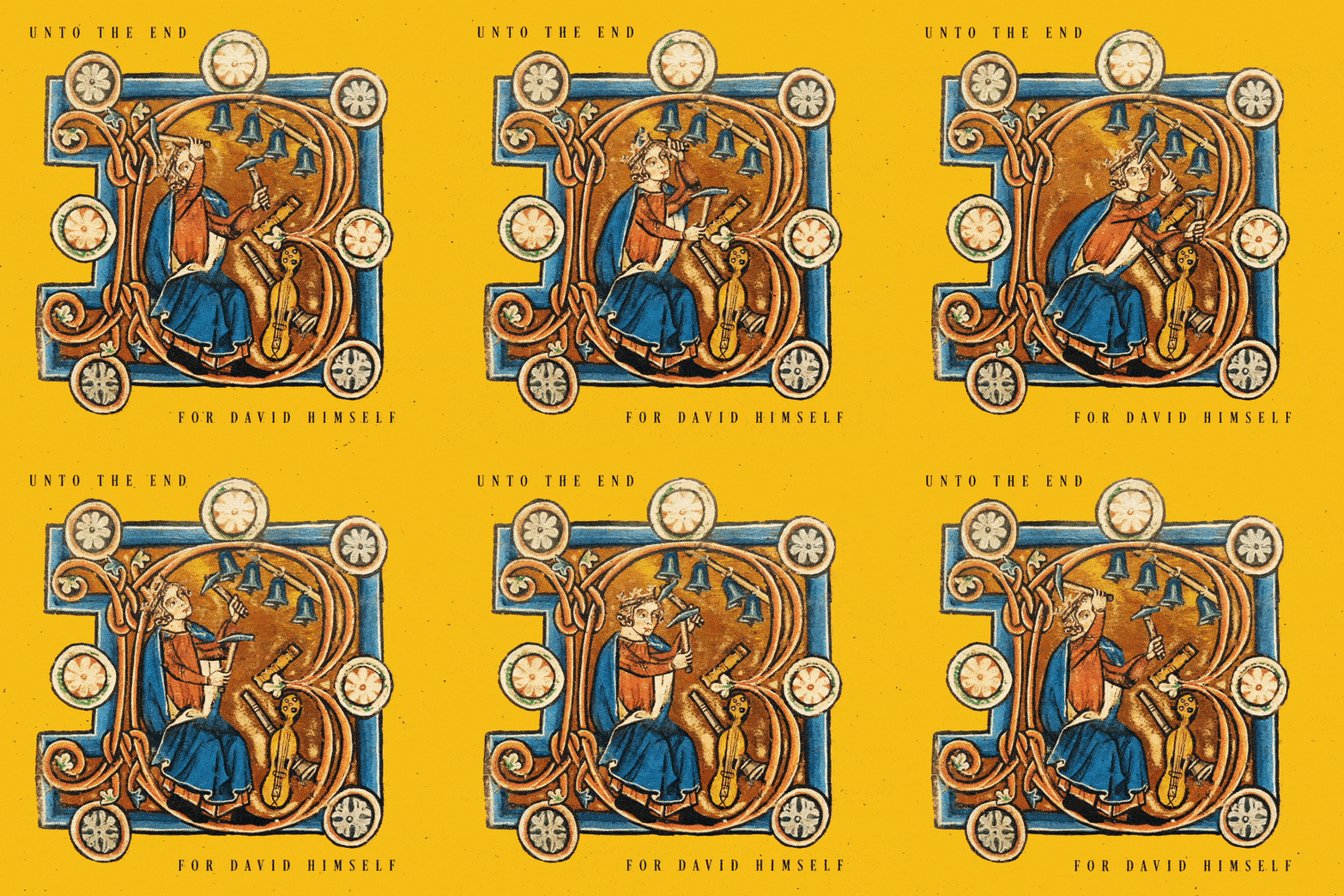
View a higher quality version of this gif here: