

Psalm 67:21
the death of death
Our God is the God of salvation: and of the Lord, of the Lord are the issues from death. (Psalm 67:21 DR)
Prior to our Lord’s betrayal, passion and death, he famously told His disciples:
These things I have spoken to you, that in me you may have peace. In the world you shall have distress: but have confidence, I have overcome the world. (John 16:33 DR)
This “distress” is related to His previous words:
Remember my word that I said to you: The servant is not greater than his master. If they have persecuted me, they will also persecute you: if they have kept my word, they will keep yours also. (John 15:20 DR)
There is thus a promise and guarantee that if one is to be a servant of our Lord, there will be distress and persecution. This crucible of suffering is thus not a bug, but a feature of following our Lord.
St. Paul remarks that this suffering is both a natural result of the frailty of our nature and a means of sanctification:
But we have this treasure in earthen vessels, that the excellency may be of the power of God, and not of us. In all things we suffer tribulation, but are not distressed; we are straitened, but are not destitute; We suffer persecution, but are not forsaken; we are cast down, but we perish not: Always bearing about in our body the mortification of Jesus, that the life also of Jesus may be made manifest in our bodies. For we who live are always delivered unto death for Jesus' sake; that the life also of Jesus may be made manifest in our mortal flesh. (2 Corinthians 4:7-11 DR)
St. Paul doesn’t pull punches; not only is suffering not something to be avoided at all costs or even a perhaps sad but unavoidable reality, but rather is an identification with our Lord in His sufferings, that we may also share in His life. Seen from the other side, unless we bear in our bodies His mortification, we will not have His life manifest in us.
In this light, while salvation has an eschatological component of release from suffering and freedom from pain and physical death (cf. Apocalypse 21:4), it is not be expected as the normative experience in the Christian life. On the most fundamental level we will all eventually die, and thus at some point this God’s will for us all (cf. Hebrews 9:27). And while we are not to seek out martyrdom nor intentionally inflict suffering upon ourselves, we must also accept that we are to bear our Lord’s mortifications in our bodies, and this is a cause of our sanctification and salvation.
In view of the previous two passages from the Psalms, it is our Lord’s mortifications that the Psalmist prophetically apprehends here and there application to those who believe in Him. God may provide salvation in the physical world as He wills, but this is not the primary salvation He seeks for us, but rather that we would be saved from our sins and everlasting death.
The doubling of “of the Lord” in the second clause of this verse both provides an emphasis of the superlative within the poetic idiom, but also further expands by means of poetic parallelism the nature of this salvation. The Psalmist knows that one day he will die and go to sleep with his fathers; thus, the “issues from death” (i.e., salvation of freedom or escape) from death that are of the Lord have a deeper significance than safety in battle or from threats of one’s enemies:
But that it might not occur to the mind, Why then do we die, if through His grace we have been made safe? Immediately he added below, “and the Lord's is the outgoing of death:” as though he were saying, Why are thou indignant, O lot of humanity, that you have the outgoing of death? Even your Lord's outgoing was no other than that of death. Rather therefore be comforted than be indignant: for even “the Lord's is the outgoing of death.” “For by hope we have been saved: but if that which we see not we hope for, through patience we wait for it.” [Romans 8:24-25]. (St. Augustine, Expositions on the Psalms, 67, 26.)
St. Augustine has an interesting insight here, for—as previously mentioned—the Psalmist recognized he would one day die, yet still refers to God as the God of salvation. As St. Augustine notes, there is thus baked into the parallelism a looking forward to our Lord’s death, only by which death is ultimately defeated and thus is the source of our hope and ability to bear suffering with patience:
Patiently therefore even death itself let us suffer, by the example of Him, who though by no sin He was debtor to death, and was the Lord, from whom no one could take away life, but Himself laid it down of Himself, yet had Himself the outgoing of death. (ibid.)
I began this animation by finding a hand reaching up. I was going to cut it out in Photoshop, but the background was dark enough for my intention and so I brought it into After Effects as it was.
I then drew some shapes lines that would eventually weave in and out of themselves, adding some dashed lines and animating them so as to loop. I then drew some simple masks so that the lines would appear to weave in front of and behind the hand. Lastly I added some abundant glow and lens flare to finish this out.
Enjoy.
Our God is the God of salvation: and of the Lord, of the Lord are the issues from death.
(Psalm 67:21 DR)
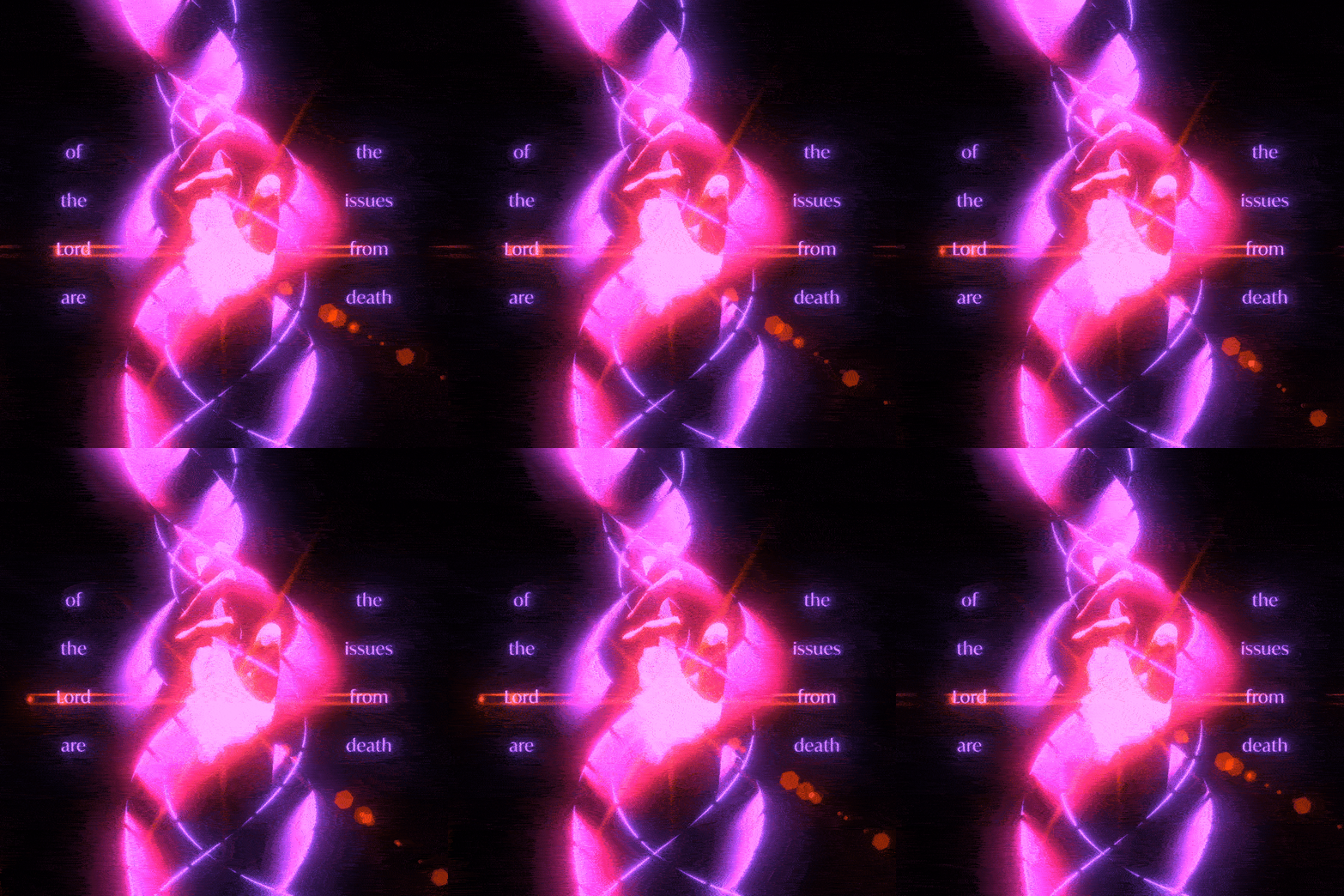
View a higher quality version of this gif here: