

Psalm 67:34
make it reign
Who mounteth above the heaven of heavens, to the east. Behold he will give to his voice the voice of power: (Psalm 67:34 DR)
In a previous passage the Psalmist spoke of Christ’s Resurrection in terms of ascending upon the west, wherein the west stood for the darkness of sin and death, following the image of the sun setting in the west. In His Resurrection He rides triumphant over the powers of sin and death and hell, and the Psalmist later describes His glorious Ascension.
The Resurrection and Ascension of our Lord are central to our belief in Him; St. Augustine comments on this passage noting that:
In these words he perceives not Christ, who believes not His Resurrection and Ascension. (St. Augustine, Exposition on the Psalms, 67, 38.)
In other words, if one does not accept our Lord’s Resurrection and Ascension, the Psalms’ description of these events will be occluded from the vision of the mind. One can see a parallel in Jesus’ appearance to the two disciples on the road to Emmaus following His Resurrection. Even though they had known Him they did not recognize Him, either in appearance or in words. However, as He expounded the Scriptures to them they began to sense a stirring of recognition in their hearts, and finally saw him. St. Luke provides the reason:
And it came to pass, whilst he was at table with them, he took bread, and blessed, and brake, and gave to them. And their eyes were opened, and they knew him: and he vanished out of their sight. And they said one to the other: Was not our heart burning within us, whilst he spoke in this way, and opened to us the scriptures? (Luke 24:30-32 DR)
Since they did not yet believe in the Resurrection, they could not perceive their Lord either in the Scriptures or in the flesh as Very Word of God. However, as His exposition of the Scriptures showed Himself, His Passion and Resurrection within them, they were finally able to perceive correctly.
The Psalmist’s words were no doubt some of those which our Lord expounded to His disciples, and the Psalmist continues to describe the reign of Christ over all things, as the figure of mounting above the heaven of heavens, to the east is one of rule and kingship:
The prophet then means to convey that Christ our Lord, after his ascension to heaven, of which he spoke when he said, “Thou hast ascended on high,” came to be higher and more elevated than heaven itself, sitting thereon as a man would on a horse or a chariot, or as a king upon his throne. The words, “to the east,” correspond exactly with what he said before, “who ascendeth upon the west;” that is, because he has all darkness beneath him, while he is himself in light, in light inaccessible, the source of all light that is communicated to Angels and to men. (St. Robert Bellarmine, A Commentary on the Book of the Psalms, 67, 33.)
This mounting above the heavens thus proclaims the triumph of Christ and His reign over all things. The Psalmist elsewhere conceptually sets the stage for this (cf. Psalm 109:1) which St. Paul explicitly attributes to our Lord:
But to which of the angels said he at any time: Sit on my right hand, until I make thy enemies thy footstool? (Hebrews 1:13 DR)
The New Testament is also replete with references to this reality:
And what is the exceeding greatness of his power towards us, who believe according to the operation of the might of his power, which he wrought in Christ, raising him up from the dead and setting him on his right hand in the heavenly places. Above all principality and power and virtue and dominion and every name that is named, not only in this world, but also in that which is to come. And he hath subjected all things under his feet and hath made him head over all the church, which is his body and the fulness of him who is filled all in all. (Ephesians 1:19-23 DR)
For which cause God also hath exalted him, and hath given him a name which is above all names: That in the name of Jesus every knee should bow, of those that are in heaven, on earth, and under the earth: And that every tongue should confess that the Lord Jesus Christ is in the glory of God the Father. (Philippians 2:9-11 DR)
[W]ho has gone into heaven and is at God’s right hand—with angels, authorities and powers in submission to him. (1 Peter 3:22 DR)
The Psalmist thus brings to culmination the prophetic vision on our Lord’s triumph over sin and death, in His Resurrection, His Ascension and His reign at the right hand of the Father. This rule and reign is expanded upon as the verse concludes, for the giving of the voice of power to His voice is a figure of this reign in action. He is not merely a figurehead or ruling in theory but in reality; to have the voice of power is to have authority and to carry it out.
There is a Trinitarian mystery embedded here as well, for our Lord receives authority from the Father, yet not as if He didn’t possess it by virtue of fully possessing the Godhead. The Son receives this authority and rule because he receives everything from the Father as proceeding from Him in eternity; there was never a time when the Son did not possess all that the Father has. And as the Word He is the voice, as it were, of the Father, the perfect expression of His being (cf. Hebrews 1:3). The Son as voice is thus given the voice of power in that as the Word He expresses all that the Father is, being fully one in being, will, etc. The culmination of this mystery is when the Son will judge all things, as St. Bellarmine explains:
“Behold he will give to his voice the voice of power.” He that appeared so humble and “was dumb as a lamb before his shearer,” now sits on the heaven of heavens, and will shortly “give to his voice the voice of power;” make it most powerful and effective, which shall come to pass, “when all that are in the graves shall hear the voice of the Son of God. And they that have done good shall come forth unto the resurrection of life; but they that have done evil, unto the resurrection of judgment.” No more powerful voice can be imagined… In truth, when compared to such a voice, all the laws, edicts, and commands of the rulers of this world sink into insignificance. (St. Robert Bellarmine, A Commentary on the Book of the Psalms, 67, 33.)
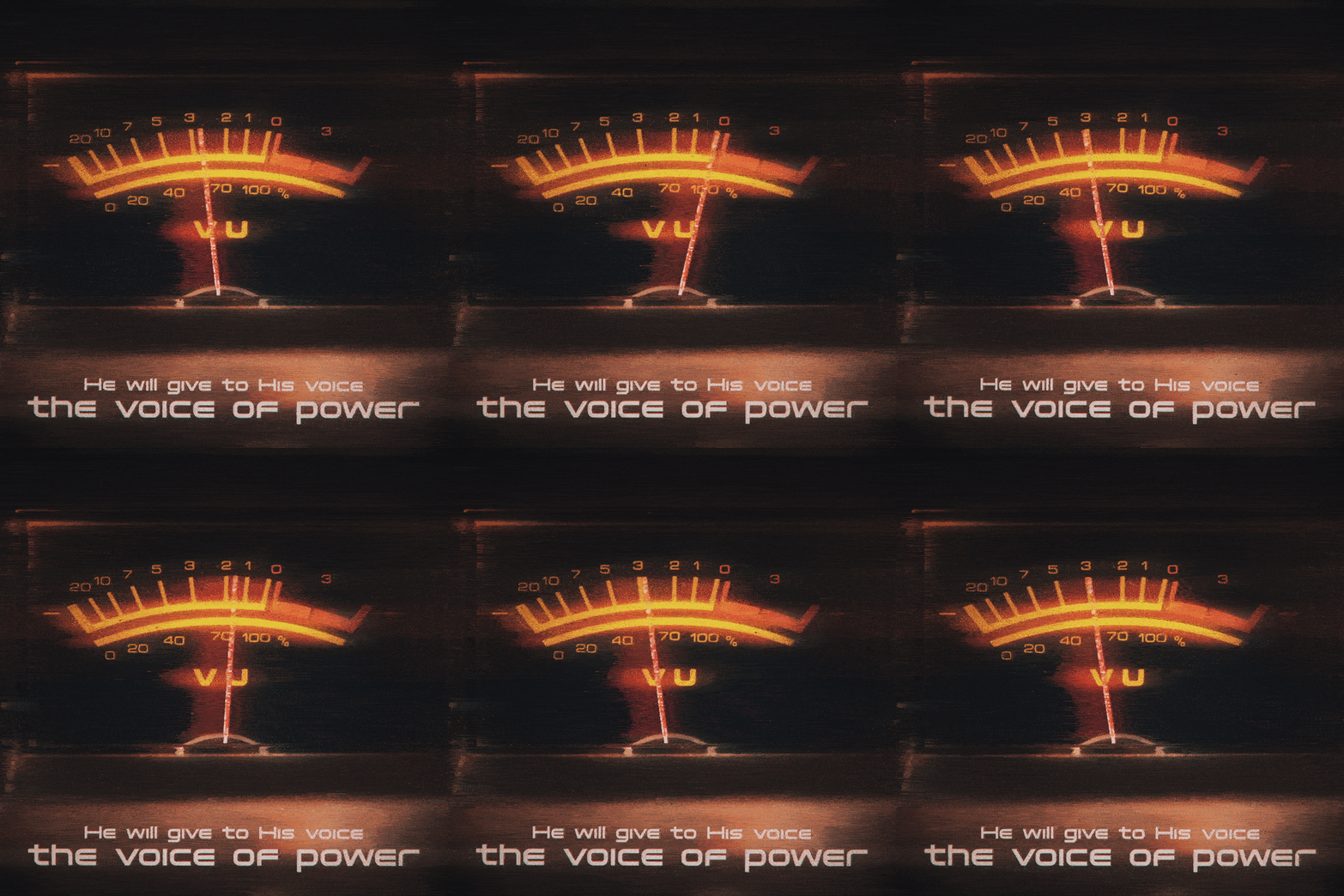
For this animation I wanted to focus on the voice of power aspect of this and thought immediately of a VU meter, which is used in audio contexts to display signal level and represents the perceived loudness of the signal. The mechanical nature of actual VU meters has enough lag in the response so that the needle doesn’t react to every change in power level but is more or less smoothed out over the duration of the signal to give a more accurate perception of the perceived loudness, rather than every single peak or valley which would have less utility.
At any rate, I thought it would make a nice animation, so I cut out the needle in Photoshop and brought the .psd into After Effects, setting the anchor point at the bottom of the needle and masking it on the bottom. I then applied a wiggle to the rotation so that it would jump around quite a bit. Probably not useful as an actual VU meter, but find for my purposes! I then added in some glows and color correction for effect.
Enjoy.
Who mounteth above the heaven of heavens, to the east. Behold he will give to his voice the voice of power:
(Psalm 67:34 DR)
View a higher quality version of this gif here: