

Psalm 67:8
letters in the desert
O God, when thou didst go forth in the sight of thy people, when thou didst pass through the desert: (Psalm 67:8 DR)
In the famous Poe short story The Purloined Letter, the detective Dupin finds a compromising letter that the police have been unable to locate, despite repeated and thorough searches of the thief’s apartment. Dupin is able to locate the letter rather easily as it has been—as it were—hidden in plain sight.
This is, of course, the somewhat reductionistic moral of the story, but Poe spends many words to describe what is far more interesting; that is, exactly why hiding it in plain sight was successful for so long. Dupin does not dispute that the police made an exceedingly thorough search, but the fault was not in the execution of their methods but in their principle:
They consider only their own ideas of ingenuity; and, in searching for anything hidden, advert only to the modes in which they would have hidden it. (Edgar Allen Poe, The Purloined Letter)
He goes on to note that in the case of most circumstances this works perfectly well, but when they are faced with something that steps outside of this paradigm, it then fails them:
They are right in this much --that their own ingenuity is a faithful representative of that of the mass; but when the cunning of the individual felon is diverse in character from their own, the felon foils them, of course. This always happens when it is above their own, and very usually when it is below. (ibid.)
This failure is finally consummated by the human tendency to double-down on a principle, thinking that additional effort will make up for a failed principle:
They have no variation of principle in their investigations; at best, when urged by some unusual emergency—by some extraordinary reward—they extend or exaggerate their old modes of practice, without touching their principles. (ibid.)
The Psalmist in this passage recalls God’s action in the history of His people, notably the event of their past that defined them as His people, their deliverance from slavery in Egypt. This is the time of the Psalmist’s people in the desert, which is marked by both its extraordinary character and its mundane application for most of them.
After all, the signs and wonders that God accomplished to free them from their bondage were prodigious, yet the same people almost immediately desired to return to Egypt. They were constantly led by signs form heaven—the pillar of cloud and of fire—and fed with the bread of angels (cf. Psalm 77:24-25) yet most still fell in the desert. The grace of God was literally in plain sight, but they did not have the eyes to see it; their paradigm was still captive in Egypt most could not see beyond. The Psalmist elsewhere recounts this hardness of heart:
And he had commanded the clouds from above, and had opened the doors of heaven. And had rained down manna upon them to eat, and had given them the bread of heaven. Man ate the bread of angels: he sent them provisions in abundance. He removed the south wind from heaven: and by his power brought in the southwest wind. And he rained upon them flesh as dust: and feathered fowls like as the sand of the sea. And they fell in the midst of their camp, round about their pavilions. So they did eat, and were filled exceedingly, and he gave them their desire: They were not defrauded of that which they craved. As yet their meat was in their mouth: And the wrath of God came upon them. And he slew the fat ones amongst them, and brought down the chosen men of Israel. In all these things they sinned still: and they believed not for his wondrous works. And their days were consumed in vanity, and their years in haste. (Psalm 77:23-33 DR)
St. Augustine remarks on this verse that God’s grace is something that is not seen with natural eyes, but only with the eyes of faith for those who are looking:
His going forth is perceived, when He appears in His works. But He appears not to all men, but to them that know how to spy out His works. For I do not now speak of those works which are conspicuous to all men, Heaven and earth and sea and all things that in them are; but the works whereby He leads forth men fettered in strength, likewise men provoking that dwell in the tombs, and makes them of one manner to dwell in a house. Thus He goes forth before His people, that is, before those that do perceive this His Grace. (St. Augustine, Expositions on the Psalms, 76, 8.)
In our natural selves we expect to find things in a natural way, and this paradigm will form the manner in which we seek after truth and perceive the “going forth” of God. In the desert of this vale of tears we will either leave our natural modes of thinking behind, enlivened by the gift of faith, or we will never search beyond our own ability, and thus miss seeing God and His grace, even though it is hidden in plain sight.
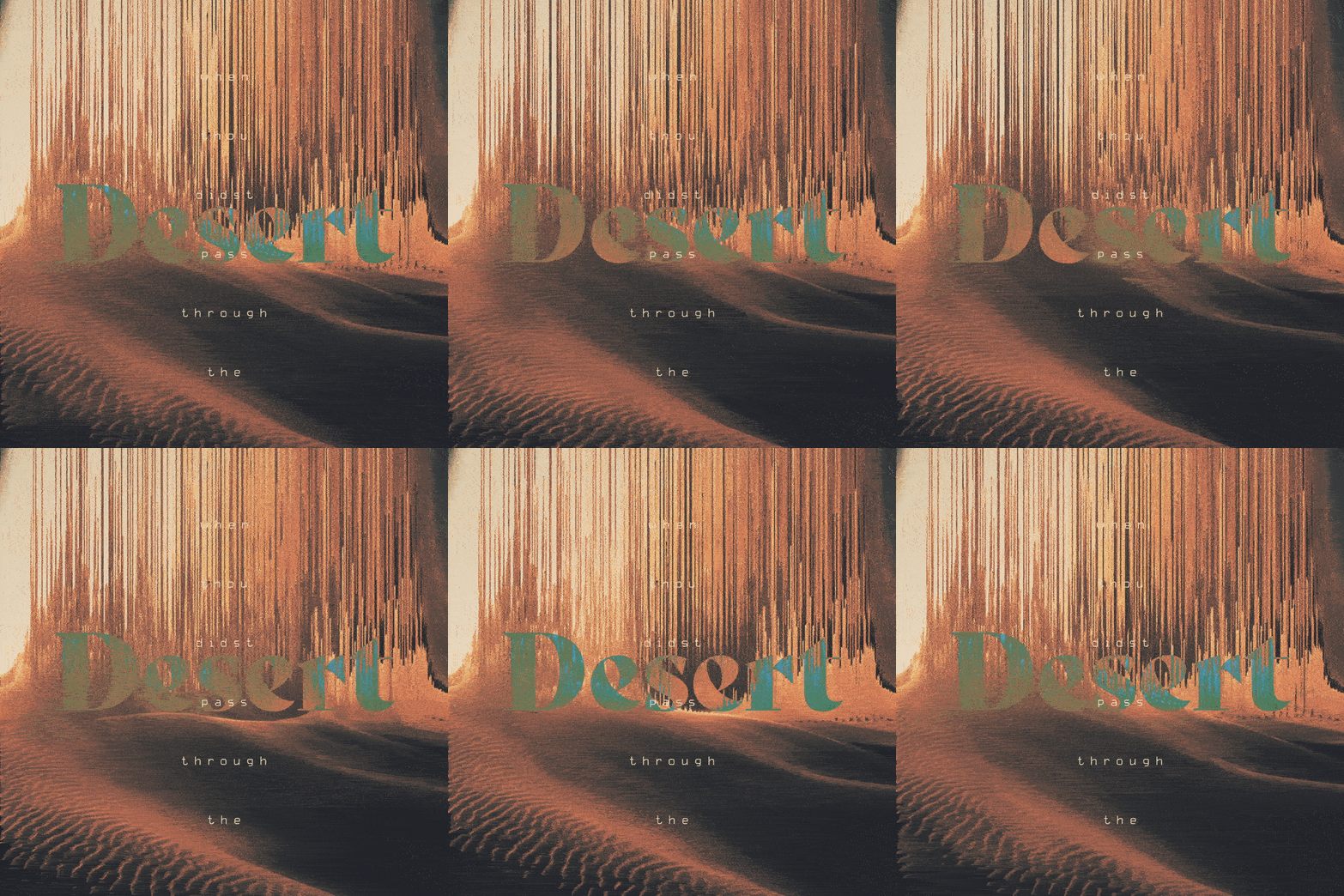
For this animation I found a great image of a desert and applied two different scripts to it. The first was LoopFlow, by which I created the flowing aspect of the desert towards the horizon, and then Stretch, which causes the pixels to stretch up into the sky. Fortunately for this the robots do all the work; I only needed to draw a few masks and then let the scripts do the rest. I adjusted a few parameters to tweak it for the image, but it was otherwise very straightforward.
Enjoy.
O God, when thou didst go forth in the sight of thy people, when thou didst pass through the desert:
(Psalm 67:8 DR)
View a higher quality version of this gif here: