

Psalm 69:6
a wizard is never late
But I am needy and poor; O God, help me. Thou art my helper and my deliverer: O Lord, make no delay. (Psalm 69:6 DR)
Probably one of the most inspiring scenes in the Lord of the Rings movie trilogy for me is near the end of the Two Towers at the siege of Helm’s Deep. The keep has been nearly overrun and the defenses are buckling, and the king of Rohan exclaims in despair “what can men do against such hate?” Aragorn replies with unwavering confidence: “ride out with me to meet them.” “For death and glory?” “For Rohan.”
This exchange rekindles the flames of courage in the king’s heart and he eagerly rides out to face a certain doom, but with head held high and face steeled towards the dawning sun. It is at this moment that the riders of Rohan ascend the summit overlooking Helm’s Deep with Gandalf and charge down into the fray. As the sun peers over the horizon they speed down into an overwhelming force mounted against them, yet the riders are undaunted, filled with courage and love for their country and countrymen. This resolve is so powerful that the charge breaks the lines of the enemy, turning the tide of the battle and saving the kingdom and people of Rohan.
Perhaps it’s the cynical side of me, but after the thrill of this scene my mind often wanders to think about those for whom the battle cost them their lives. Gandalf at some point in the trilogy quips that a wizard is never late; he arrives when he intends to. But what of all the bodies bereft of life for whom this seeming tardiness was too late?
In a similar vein it is often quipped that God is rarely early but never late. As cute as such a statement is, it can provide cold comfort when one is facing something truly devastating, at times when bumper sticker spirituality is simply not enough.
But this is really what it comes down to. In the modern world we have effectively sanitized the spiritual life into bumper stickers that are innocuous at worst when life seems fine, but seem outright cruel when the going gets tough. We have largely scrubbed suffering from the lexicon of the spiritual life, with the result that faith either seems a waste of time or something that will be abandoned when tested since it cannot handle the onslaughts of this fallen world.
The Psalmist in this final verse of Psalm 69 provides strong medicine to help combat such a spiritual malaise. He begins by reminding himself by means of his prayer that he is helpless in and of himself. The wretchedness of his condition is a reality, whether regrettable or not. There is no pretension that he enjoys it, but also no sense of entitlement; rather there is complete surrender to God’s mercy and grace and will. He recognizes that he can do nothing of himself; if any good is to come of this, it will be solely to God’s mercy and something to be thankful for, rather than something he is owed. The plea for help is not borne out of entitlement or thinking that God must act in a certain way; it the plea of a suppliant who looks to the hand of God for help if it is His will.
And as terrible as the afflictions of the body can be, God desires that our soul be healed and brought to uprightness. The Psalmist asks for help for the entirety of his person, desiring that his whole life be conformed to God’s image:
I am like an orphan, my soul is like a widow destitute and desolate: help I seek, always mine infirmity I confess. There have been forgiven me my sins, now I have begun to follow the commandments of God: still, however, I am needy and poor. Why still needy and poor? “Because I see another law in my members fighting against the law of my mind.” [Romans 7:23] Why needy and poor? Because, “blessed are they that hunger and thirst after righteousness.” [Matthew 5:6] Still I hunger, still I thirst: my fullness has been put off, not taken away. (St. Augustine, Expositions on the Psalms, 69, 7.)
There is thus a two-fold battle enfolding within the human soul. On the one hand we wage war against sin and against concupiscence which inclines us towards that. On the other hand those who desire God find that they can never get enough; they desire that union with their Lord that must await the eschaton, as St. Paul relates of himself:
For to me, to live is Christ; and to die is gain. And if to live in the flesh, this is to me the fruit of labour, and what I shall choose I know not. But I am straitened between two: having a desire to be dissolved and to be with Christ, a thing by far the better. But to abide still in the flesh, is needful for you. (Philippians 1:21-24 DR)
The more we purify our hearts and wills and conform them to God’s will, the more we discover a paradox: we desire to be done with this life so as to be with the Lord, but also are called to many things in this life and thus must experience this delay in attaining the beatific vision.
Both the Psalmist and St. Paul place themselves and their wills completely in the hands of God, desiring above all His will. From experience the Psalmist knows the goodness of the Lord and thus can with confidence call Him my helper and my deliverer.
In a similar vein St. Paul also knows the goodness of the Lord and voices the same sentiment in many of his writings. This is fascinating because St. Paul’s life is not simply filled with suffering but is characterized by it. Our Lord spoke to Ananias prior to St. Paul’s conversion and said that:
I will shew him how great things he must suffer for my name's sake. (Acts 9:16 DR)
This was not lost on St. Paul, for he counted it joy to suffer for his Savior:
[I] now rejoice in my sufferings for you, and fill up those things that are wanting of the sufferings of Christ, in my flesh, for his body, which is the church… (Colossians 1:24 DR)
This is naturally a foreign concept to most of us, especially in the modern world. But St. Paul saw this as the means by which he could more fully conform himself to the image of Christ, whom he desired more than anything.
The Psalmist concludes this Psalm by asking that God make no delay. There is a final paradox here, for it is in our suffering that we often tend to think the most that God is delaying in answering our prayers, in intervening, etc. However, the reverse is actually true and thus this paradox: suffering, as it conforms us to Christ by our willing acceptance of it, draws us closer to Him, the end to which we are aiming. This act of being conformed eliminates the delay as we are united with him in suffering, the most tangible way in this life that we can be.
In the ultimate irony we often want God to hold off or remove our suffering, and sometimes He grants this. However, we should not mistake this for favor or necessarily as a sign of God’s blessing, for we also are not afforded the opportunity to unite ourselves in suffering with our Lord, no matter how small that may be. God’s will may involve at times the alleviation of suffering, but if with the Psalmist we recognize ourselves as needy and poor, we should be open to His will which may in fact allow us the opportunity to suffer for him so as to die to sin and conform ourselves to the image of His Son.
This animation was paradoxically simple and tedious. The effect on the text was easy enough, it just took some time to get it to work.
I simply typed in the text and added a Chromatic Distortion to it and animated the distortion amount, the scale and the rotation. Nothing too crazy there. I had hoped that since I applied the effect to the text it wouldn’t affect anything else, but for some reasons (which I still haven’t figure out) that just didn’t happen. For some reason it treated the layer like an adjustment layer and distorted everything in the layers below it.
No problem, I thought, I’ll just precomp it and that should solve it. It did to some extent, but the result was kind of blocky when I wanted the glow around the word to be more sleek. I finally figure out that I needed to just place a black solid in the text precomp and then do some unmult in the main comp to fix everything. In retrospect it doesn’t seem that complicated, but it was kind of frustrating at the time. Oh well, everything turned out.
Enjoy.
But I am needy and poor; O God, help me.
Thou art my helper and my deliverer: O Lord, make no delay.
(Psalm 69:6 DR)
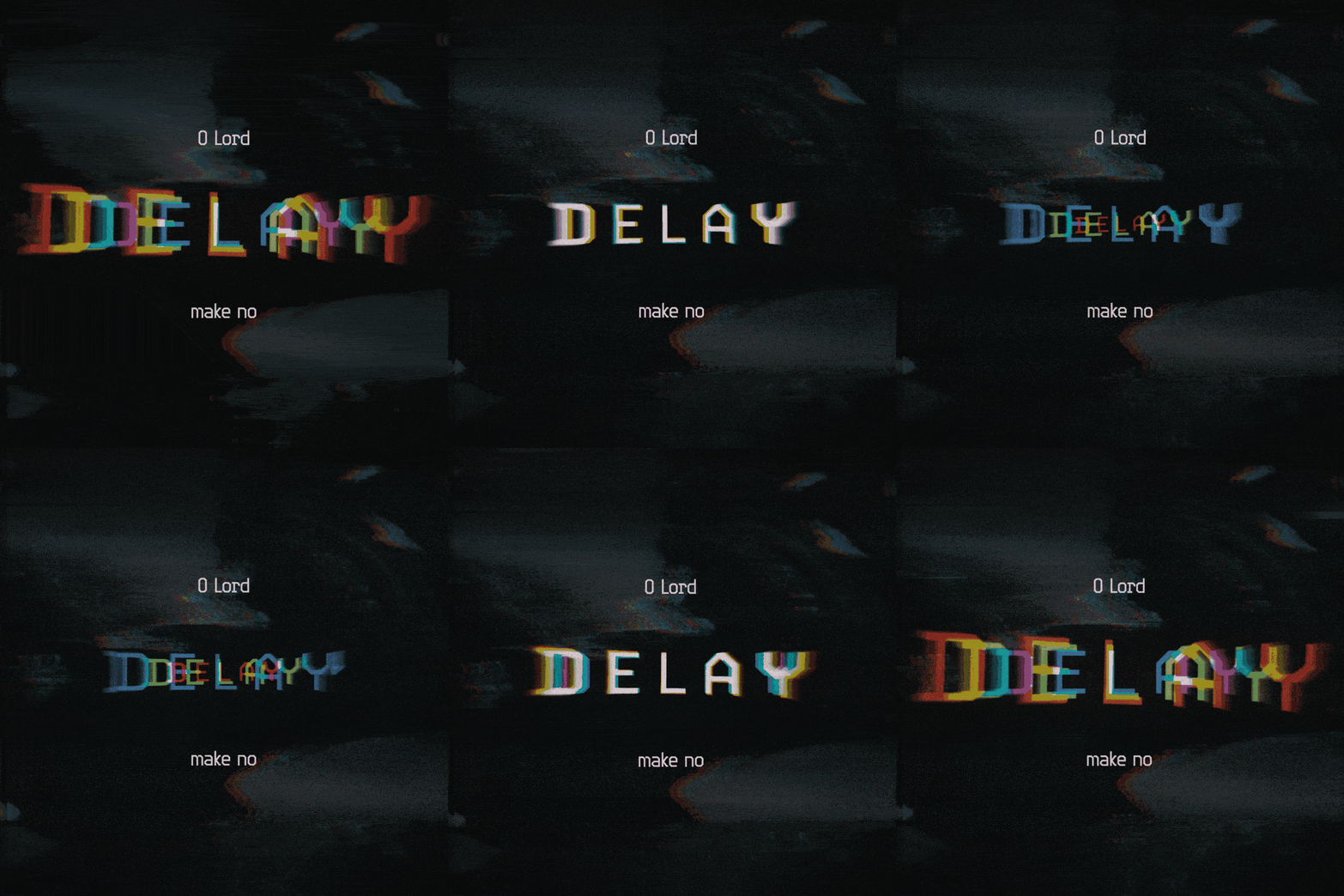
View a higher quality version of this gif here: