

Psalm 7:18
the double confession
I will give glory to the Lord according to his justice: and will sing to the name of the Lord the most high. (Psalm 7:18 DR)
As the Psalmist concludes this magnificent Psalm he seemingly ends on what to modern ears would seem a harsh note. For after just relating the three-fold manner in which the wicked are brought to ruin by their own sinfulness, he uses this as the reason for praising the Lord.
The Latin of this text is ambiguous in the word, for the root of confitebor is confiteor which can mean to confess (as in confess one’s sins) or to admit or to give praise or thanks. This latter meaning is far more common in later Ecclesiastical Latin, but in the Latin of St. Augustine and St. Jerome’s day it would have leaned much more towards the first two meanings. At root of confiteor is to acknowledge the reality of something, which seen from the side of confession would be the act of revealing that reality as a means of acknowledging it. There is thus not a hard a fast distinction here, for the acknowledgment of God’s justice against sin and wickedness (as the Psalmist does here) is mirrored by the confession of one’s own complicity in sin and iniquity.
Understood in this light, the Psalmist is right to praise or confess the justice of the Lord against the wicked:
This is not the sinner's confession: for he says this, who said above most truly, “If there be iniquity in my hands:” but it is a confession of God's justice, in which we speak thus, Verily, O Lord, You are just, in that You both so protect the just, that You enlighten them by Yourself; and so order sinners, that they be punished not by Your malice, but by their own. This confession so praises the Lord, that the blasphemies of the ungodly can avail nothing, who, willing to excuse their evil deeds, are unwilling to attribute to their own fault that they sin, that is, are unwilling to attribute their fault to their fault. (St. Augustine, Expositions on the Psalms, 7, 19.)
St. Augustine brings out an important point here, for even though the wicked often seem to prosper in this world and their iniquity is multiplied, yet the righteous can still confess to God His justice, for just as the sun is not diminished by the existence (so to speak) of darkness, neither is God’s justice undone by the existence (so to speak) of evil:
Likewise in Ecclesiasticus [39:20-21] it is said, “Confess to the Lord in all His works: and in confession you shall say this, All the works of the Lord are exceeding good.” Which can be seen in this Psalm, if any one with a pious mind, by the Lord's help, distinguish between the rewards of the righteous and the penalties of the sinners, how that in these two the whole creation, which God made and rules, is adorned with a beauty wondrous and known to few. Thus then he says, “I will confess to the Lord according to His justice,” as one who saw that darkness was not made by God, but ordered nevertheless. For God said, “Let light be made, and light was made.” [Genesis 1:3] He did not say, Let darkness be made, and darkness was made: and yet He ordered it. (ibid.)
His point is that God only created the light and thus—by extension—all that is good. The darkness—and thus evil—were not made by God and thus do not have an existence per se. When we sin we leave being, as it were, for we engage in the works of darkness which God permits but did not create nor will. His permission of evil is the ordering of the world in His wise providence, and thus the righteous can take heart and still confess to God His justice even in the face of evil, for it does not occur outside the ordering of that same providence. The mind of the righteous is enlightened by aligning itself with God, the source of light and life, and is able to perceive this ordering in faith. The mind of the sinner, however, turns towards non-being and is thus likewise darkened:
Not that there is any nature of darkness. For all nature, in so far as it is nature, is compelled to be. Now being belongs to light: not being to darkness. He then that leaves Him by whom he was made, and inclines to that whence he was made, that is, to nothing, is in this sin endarkened: and yet he does not utterly perish, but he is ordered among the lowest things. (ibid.)
Even the machinations of the wicked are unable to frustrate the will of God, for their machinations and such are merely diminishing efforts of diminished being to assert itself against the source of that being. Just as darkness flees at light and not the other way around, so non-being cannot overcome being but necessarily exists (as it were) within the created ordered which is directed by God’s will. It is because of this that the righteous can be confident in God’s wise rule and confess to Him His justice.
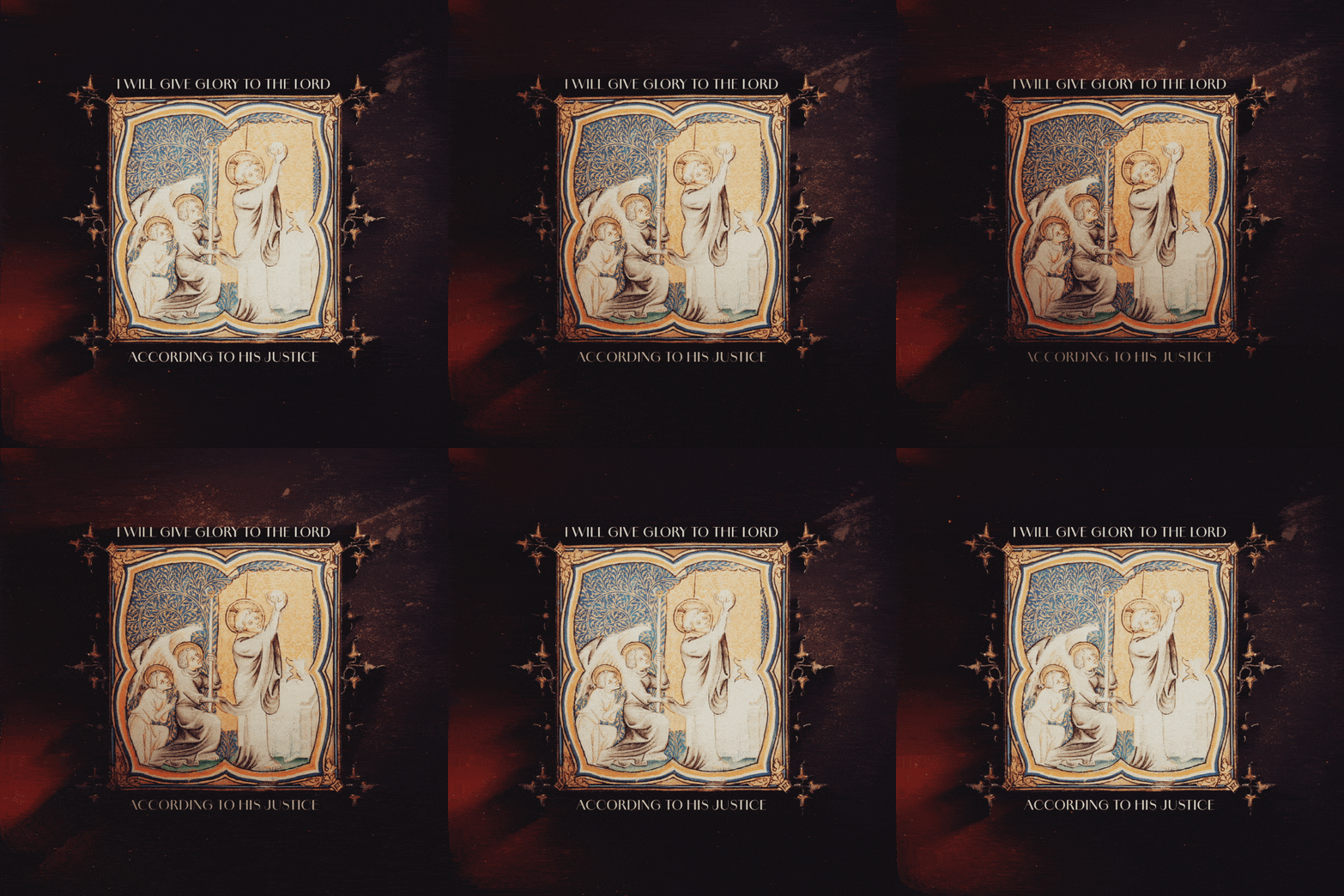
For this animation I found this wonderful miniature from the Gotha Missal immediately before the Introit for the Mass of Corpus Christi. I thought it would be appropriate as the Mass is the representation of Christ’s sacrifice on the cross, itself the triumph of light over darkness. I cut out the miniature in Photoshop and then applied Shadow Studio 3 to it in After Effects to get some nice shadowing on the background. I also made it into a 3D layer and added a light to give it some more shading. I attached the shadow source to the light so it would follow and sell the effect some more. I wanted to keep it nice and subtle, and I liked how it turned out.
Enjoy.
I will give glory to the Lord according to his justice: and will sing to the name of the Lord the most high.
(Psalm 7:18 DR)
View a higher quality version of this gif here: