

Psalm 72:10
the temptation to ridonkulousness.
Therefore will my people return here and full days shall be found in them. (Psalm 72:10 DR)
Though we are rational creatures, we are not only rational. Many times what presents itself to us as a reasonable appraisal of a situation can—in the moment—be colored by emotions or tinged by the passions. We can intellectually know something and perhaps even come to a satisfying conclusion in the mind, but there can still be a nagging doubt that arises from perhaps even deeper within that the reason cannot fully articulate or adjudicate.
The Psalmist has considered the prosperity of the wicked, moving from original vexation to more calmly contemplating the actual state of the situation; that is, how their prosperity and security leads to wickedness and further wretchedness. The temporal gain and success they experience becomes a chain around their neck and hands which ties them down to this world, preventing them from rising to higher things and ultimately cutting them off from God’s grace in the exercise of their pride. The more they prosper, the worse they become.
All these things are rationally explicable, and there is a certain intellectual satisfaction and resolution in their consideration. But there isa still that nagging doubt, for why exactly are the wicked allowed to prosper? Wouldn’t the world be better set up if wickedness led to ruin and righteousness to prosperity? What, after all, is the point of doing good if it doesn’t lead to prosperity, and what is the point of avoiding evil if it often does?
These thoughts come flooding back, and the rational case which has been made seems incapable of withstanding it in the heat of the moment, when the injustice looms so large despite considerations to the contrary.
Thus the Psalmist admits this temptation, for “my people will return here;” that is, the original state of vexation comes full circle. The zeal he experienced on seeing the prosperity of the wicked has not been relieved by a purely rational analysis. For as he returns to the beginning of the matter, he finds that full days shall be found in them. While this specifically refers to length of life, it is a proxy for all their prosperity, and how they are not cut off in this world nor meet any recompense for their evil deeds.
We see here the limit of a purely temporal view of righteousness and wickedness and of desiring to equate righteousness with prosperity and wickedness with material ruin. As St. Paul says:
If in this life only we have hope in Christ, we are of all men most miserable. (1 Corinthians 15:19 DR)
St. Augustine sees a mystical meaning in the term full days, for while the Psalmist applies it to the prosperity found in the wicked, he notes a significance that points beyond itself:
What is “full days?” “But when there came the fullness of time, God sent His Son.” [Galatians 4:4] This is the very fullness of time, when He came to teach men that things temporal should be despised, that they should not esteem as a great matter whatever object evil men covet, that they should suffer whatever evil men fear. He became the way, He recalled us to inward thought, admonished us of what should be sought of God. And see from what thought reacting upon itself, and in a manner recalling the waves of its impulse, he does pass over unto choosing true things. (St. Augustine, Expositions on the Psalms, 72, 13.)
The fullness of time he notes here is a reversal of the Psalmist’s vexation. The temptation in the face of the prosperity of the wicked is to view the goods of this world in precisely the same way they do, as an end to which must attain. If this is the case, then choosing righteousness is actually irrational, for it will make it more difficult to attain worldly and temporal goods. This is why the passions and emotions—that wave of impulse that St. Augustine brilliantly describes—lead the Psalmist back to his original complaint, for all the rational evaluation falls to the wayside if this vision of temporal things is not corrected and transcended.
St. Augustine’s point here is that our Lord came to save us from this limited vision, to set our eyes upon heavenly things which last rather than the temporal goods which are transitory and pass away. Hence our Lord says:
Lay not up to yourselves treasures on earth: where the rust, and moth consume, and where thieves break through and steal. But lay up to yourselves treasures in heaven: where neither the rust nor moth doth consume, and where thieves do not break through, nor steal. For where thy treasure is, there is thy heart also. (Matthew 6:19-21 DR)
The vexation of the righteous at the prosperity of the wicked thus becomes a point of decision. For by returning here in his mind he is faced with the choice of keeping his eyes fixed on the things of this world or lifting them to heavenly things. The intellectual exercise in noting the ways in which the wicked are spurred on by prosperity towards greater moral wretchedness is not in vain, but neither is it enough. Rather, as the will follows the intellect in any human act, so it must be here. We must choose to lay up treasures in heaven.
In this purifying act the vision can be clarified, but temptation also lurks to keep the vision rooted on earth. Our eyes must become accustomed to the brightness of heaven, rather than to the dimness of this world, as our Lord says:
The light of thy body is thy eye. If thy eye be single, thy whole body shall be lightsome. But if thy eye be evil thy whole body shall be darksome. If then the light that is in thee, be darkness: the darkness itself how great shall it be! (Matthew 6:22-23 DR)
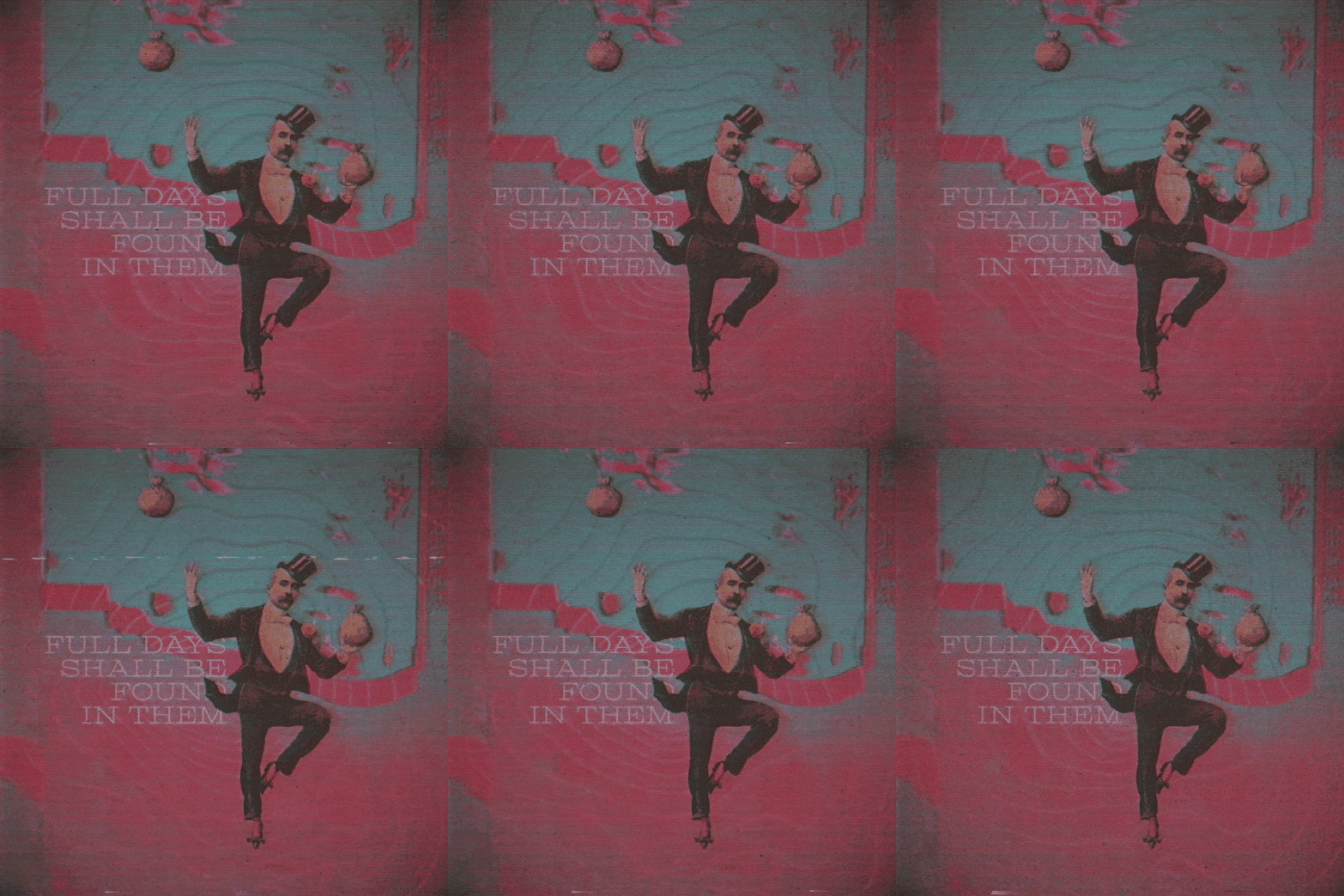
This animation arose—as they often do—from a rather random search for public domain imagery. I happened across this image from an old magazine and thought it would be perfect for the illustration of this verse, in the sense that the chasing after material things is a ridiculous enterprise and reduces those who do so to absurdity.
I cut out the figure in Photoshop and separated the money bags from the hands. In After Effects I rigged up the figure and animated him tossing the money bags up and down. I had considered going for a full juggling motion, but decided against it at the last minute.
I then added some hip movements in their to make it feel a bit more ridiculous and finally added some VHS effects to give it a vintage vibe. It’s silly certainly, but it was fun to create.
Enjoy.
Therefore will my people return here and full days shall be found in them.
(Psalm 72:10 DR)
View a higher quality version of this gif here: