

Psalm 72:17
like getting a dog to brush his teeth
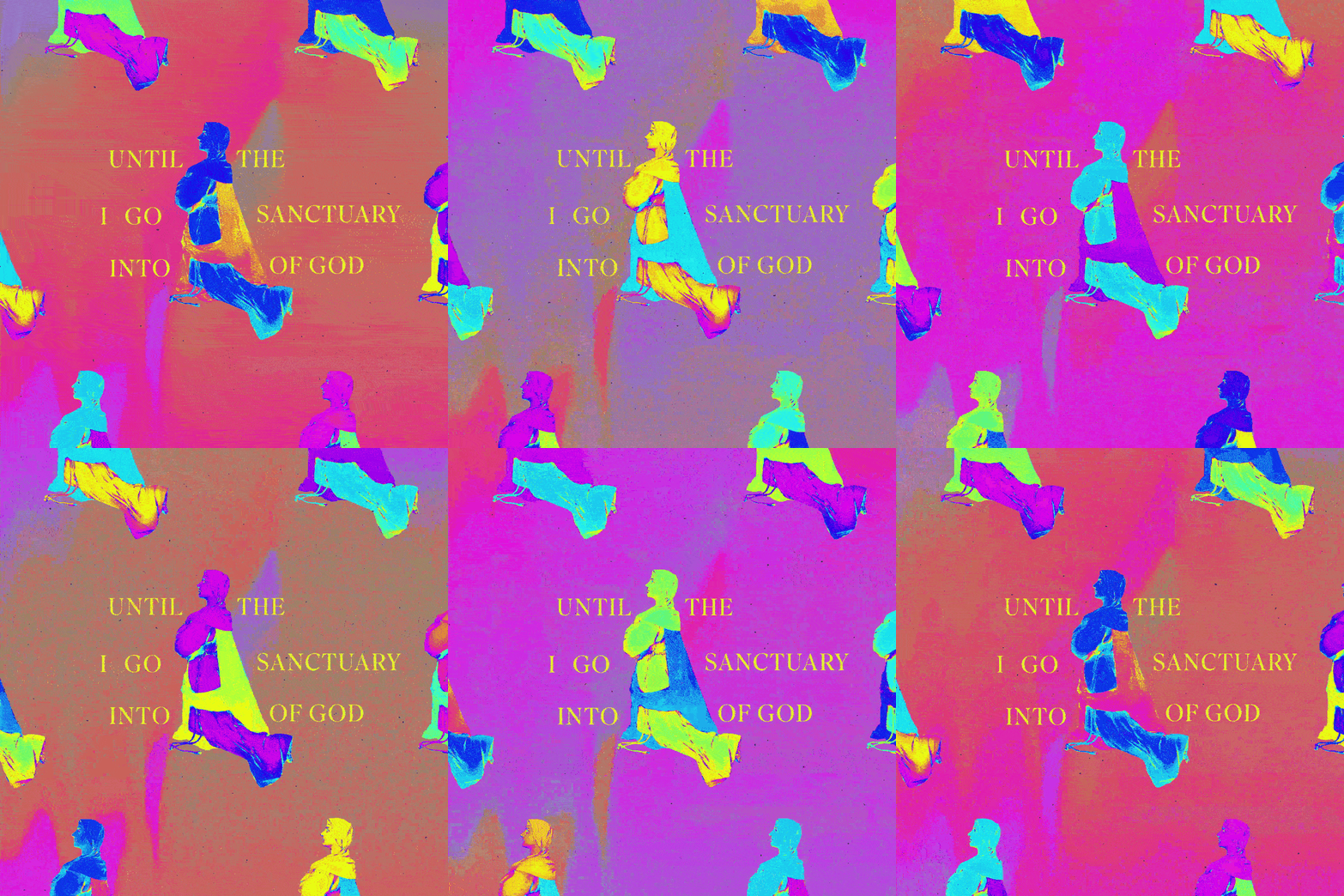
Until I go into the sanctuary of God, and understand concerning their last ends. (Psalm 72:17 DR)
It can be very challenging to brush a dog’s teeth. Perhaps you’ve been blessed with a compliant canine, but I am always met with wiggling and biting and general non-acceptance of the whole procedure.
And from the dog’s point of view, I suppose it makes sense. They generally don’t like anyone messing with their mouths, as it is one of the most sensitive parts of the their bodies. It’s a conduit of information for them, and they guard it jealously, or at least want to use it on their terms. Brushing teeth—in my experience—doesn’t fall into those terms.
And no doubt this comes down to my fault as an owner, but I’ve had to take my dogs in for dental procedures which I think is more expensive than for we humans. And while the brushing of teeth isn’t pleasant for them, even less so is tooth extraction. It would, of course, be nice if I could impress upon them that a little discomfort now would save them from discomfort in the future.
As I think this, I realize how lacking in efficacy that would be, for even with us humans with our reason we are often unwilling to suffer a little bit now to forego more suffering later. The fact that we all know how to care for our teeth yet still end up having to go to the dentist for preventable treatment proves this.
Yet in moments of lucidity we are sometimes able and willing to undergo suffering for the sake of a greater good. It usually takes dire situations to bring us there, but we can do it. While reason can balloon suffering into larger than life, it can also give us the ability to see beyond it, to suffer for something beyond the suffering itself.
In fact, sometimes knowing that there’s a point is half the battle. Suffering for its own sake is meaningless and thus difficult to bear, but if there is a reason or purpose behind it we can struggle through it. On the personal level we might suffer on account of someone else, thinking they wish us ill, but if we find out something to the contrary and see that there was a good reason that we didn’t know before, all can be forgiven and suddenly everything might make more sense.
There is a of course a vast ocean of in between here, and things are rarely so cut and dried. But is in struggling to understand that we can come to resolution even in the midst of great adversity.
For the Psalmist, he finds the prosperity of the wicked to be vexing, as has been noted. But he comes to understand that such thoughts would logically entail he condemns the justice of God and is still left with no resolution. He has made a turn in his mind, and begins the hard work to piece everything together. To be sure, this is not easy. it’s not as if he suddenly woke up and everything fit into place. But his difficult labor finally has its reward; he returns to himself and goes into the sanctuary of God, where he finds the necessary resolution.
This sanctuary is of course literally the temple of his time, but also stands in for prayer, that place of silence and meditation in which he seeks God and his will. It is in prayer that he remembers the end of the wicked, how the prosperity they seem to enjoy now is but a mist, here today and gone tomorrow. As he comes into God’s presence he discovers again that in this moment is the supreme good of life. In his prayer he is able to reframe all of existence and this world, to see it in the correct perspective. There is, after all, no higher good than God, and to obtain communion with God is to possess all, for God is the source of all that is good, begin Goodness itself. The things that the wicked chase after is as chaff in the wind:
[A] great difficulty presented itself, “until I go into the sanctuary of God;” and through prayer obtain light from him, and by that light “understand concerning their last ends;” get a view of the last end of those wicked people; for then, only, will it clearly appear that they had by no means all the happiness they appeared to have. (St. Robert Bellarmine, A Commentary on the Psalms, 72, 16-17.)
Prayer lifts us beyond the confines of this world, as it were, allowing us to see the end for which we are made—actually, to have a foretaste of it. Prayer is not something we are in our fallen nature naturally inclined to; as for the Psalmist, it is a labour in my sight. But analogous to brushing one’s teeth, it is necessary to maintain one’s spiritual health. But leaving that analogy behind, even more so it is a means of growing in grace and virtue, to understand the end more fully. Prayer attunes our hearts and minds for heaven and things that are eternal, causing the things of this world to become more like background noise. What seemed so crucial previously diminishes importance the more we grow in union with God through prayer.
Of course, there is a also a sacramental dimension, for prayer and the sacraments are like the lungs of the body. The Eucharist is especially a foretaste of our true end in that we have literal communion with our Lord, Himself present fully in the Blessed Sacrament. We enter into the sanctuary to receive our Lord, and leave becoming ourselves a sanctuary for Him. In that moment we have attained the end for which we were created, a reality which should spur us to shun the goodies of this world for the greatest Good which we are graced to possess.
When placed in its proper perspective, the prosperity of the wicked is nothingness, and thus no cause for vexation. The Psalmist comes to prayer and remembers the goodness of God and the emptiness of this world. Nothing in his circumstances has changed; the wicked still prosper and the righteous seem to have nothing but suffering. But while those are still the facts on the ground, when he fixes his eyes on his Lord he comes to understand reality as it truly is, beyond the passing mists of this life. This allows him to now face the world and all its suffering with confidence, knowing the greatest Good face to face.
This was a pretty simple animation. I wanted to capture attitude of prayer conveyed in this verse, and so I found this great drawing of a woman religious kneeling in prayer. I cut the figure out in Photoshop and cleaned it up a bit and then brought it into After Effects.
I precomped the figure so I could reuse it multiple times, knowing that I wanted to create a grid of sorts. In that precomp I added the little used and somewhat unruly Colorama effect and cycled the input to create the color shirt. I then applied a wiggle Hold expression to the Position of the figure.
In the main composition I added a Time Remap to the precomp and set up a loop. I then duplicated it several times and arranged them in the composition and finally offset them in time so that the color cycle and wiggle were offset.
Enjoy.
Until I go into the sanctuary of God, and understand concerning their last ends.
(Psalm 72:17 DR)
View a higher quality version of this gif here: