

Psalm 72:25
the wasting craving of the heart
For what have I in heaven? and besides thee what do I desire upon earth? (Psalm 72:25 DR)
The sad paradox of our existence is that we have desires for the things of this world, but the things of this world are not up to the task of fulfilling those desires. We can get temporary highs or momentary delights, but eventually it fades and all the effort we expended is left unrewarded.
Even worse, the very things that we think we want so badly often leave us worse off than not having them. The food that seems so sumptuous leaves us feeling sick. The stuff that we buy breaks or make us paranoid that we will lose it. Great wealth brings about a concomitant need to be constantly vigilant lest it is taken. It is not without reason that the Scriptures say:
Sleep is sweet to a labouring man, whether he eat little or much: but the fulness of the rich will not suffer him to sleep. (Ecclesiastes 5:12 DR)
The reality, of course, is that the desires we have for the goodies of this world are not actually for the things of this world, for even in our fallen intellects we can understand that they are not the sine qua non of our existence since they are transitory and will inevitably be lost upon our deaths. The dilemma we face is that the darkening of our intellects by means of Original Sin inverts the hierarchy of our nature, so that reason all too often becomes a slave to our appetites, and we thus imbue the cravings of our flesh as the summum bonum for which we are made. The saddest thing is that even though we can rationally know this to be a lie, we are generally all too ready to believe it nevertheless.
Our unfulfilled desires are not because the things of this world are evil, but rather that they are insufficient. They are goods, to be sure, but only as a means to an end, an end which does not exist in this material world but is found in God alone. All things that exist receive their goodness from Him as the source of all good. They are only good to the extent that they participate in His goodness. The upshot of this is that all good things by their very nature thus are directed towards God; to whatever extent we attempt to bifurcate their goodness from His goodness is the extent to which we begin to participate in idolatry.
These desires are thus unfulfilled because they can only be fulfilled in the Beatific Vision, the end for which we were created.
The Psalmist has now completely reframed his perspective, for having spent most of the Psalm lamenting the prosperity of the wicked, he now understands the truth that his desires are only satisfied with God alone and nothing less. The things o this world may be distracting and may seem to medicate those desires, but they leave a hollowness. As he contemplates his Lord in the sanctuary he understands how chasing after the desires of this world is settling for less, settling for nothing. Much like tasting a fine food or drink will ruin all lesser versions forever, so tasting and seeing “that the Lord is sweet” (Psalm 33:8 DR) now makes the prosperity that the wicked enjoy to seem as nothing.
As the spiritual journey of the Psalmist through this Psalm demonstrates, an increase in spiritual progress will inevitably bring about a decrease in a desire for the things of this world. The difference, in fact, becomes so great as to relatively take on the term “despise,” not that we see the goods of this world as evil but rather that our desire for heavenly things is so great that our love for things of this world seems like hatred in comparison. Thus we find the meaning behind our Lord’s words:
If any man come to me, and hate not his father, and mother, and wife, and children, and brethren, and sisters, yea and his own life also, he cannot be my disciple. (Luke 14:26 DR)
The Psalmist can begin to despise the goods and goodies of this world because he has found something much better:
Having said, “With glory thou hast received me,” he now, with his mind’s eye fixed on that glory, is so wrapt in spirit as to despise all created things. “For what have I in heaven?” what is there beautiful? what is there precious? that I could desire in heaven; “and besides thee what do I desire on earth?” what is there beautiful or precious that I could ask or desire upon earth? Nothing, positively nothing, I find nothing created to satisfy me, nothing with which my heart can rest perfectly content, either in heaven or on earth. (St. Robert Bellarmine, A Commentary on the Psalms, 72, 25.)
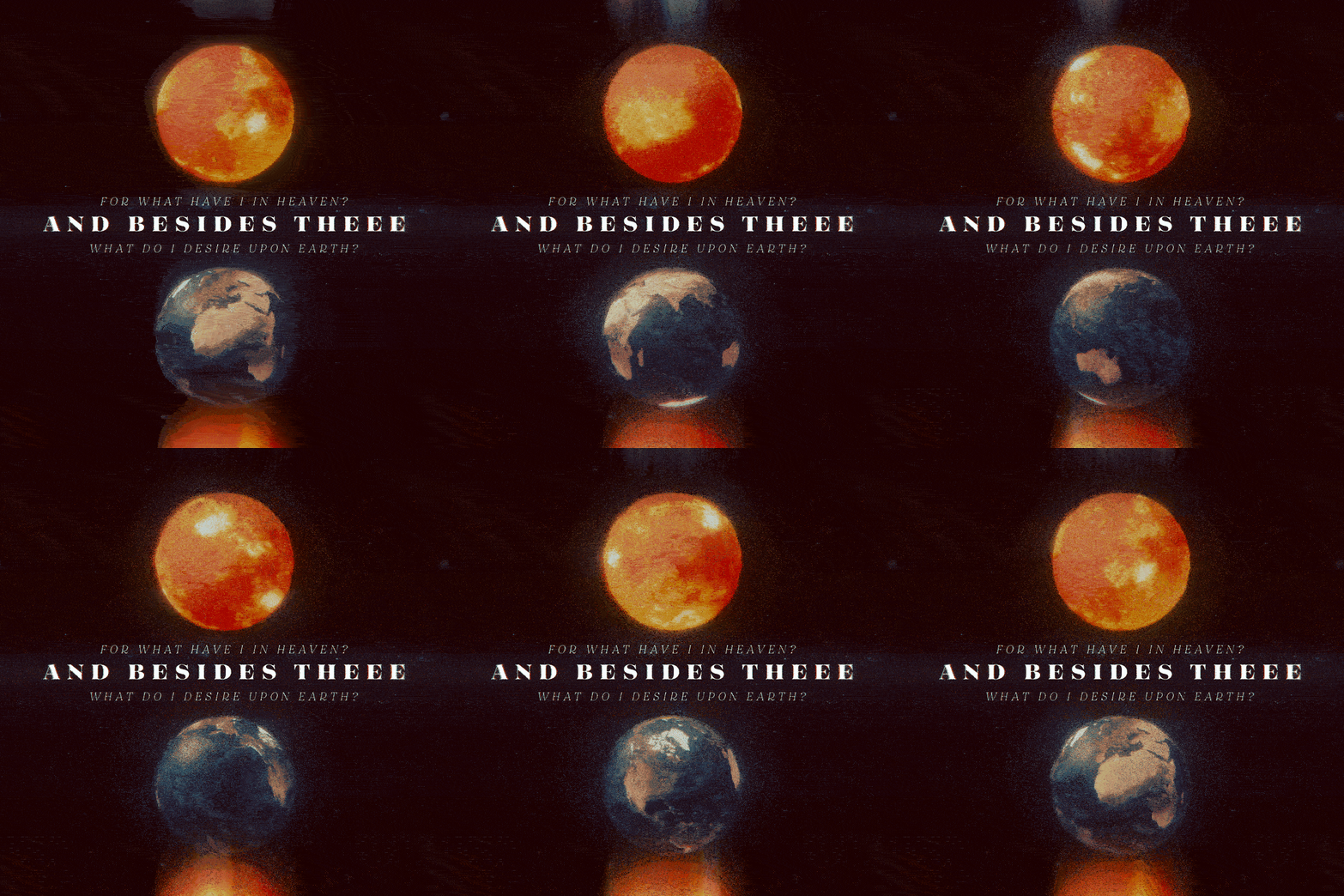
I know that the use of “heaven” here isn’t strictly speaking about the celestial bodies, but I thought it might make a nice visual juxtaposition nevertheless. I found some nice bump maps of the sun and earth and created some orbs using Video Co-Pilot’s Orb plugin, which basically increases the usefulness of the built-in CC Sphere. It does this by allowing you to assign different maps for the Bump (.e., elevation), Illumination, Reflections, etc., which helps you create semi-realistic spheres.
I basically just created a couple Solids and applied VC Orb to each and then placed all my maps in the timeline and assigned them as needed to each Solid. I then animated the Y Rotation within the effect for a full revolution to get the loop (which is why they are spinning so fast!).
The remainder was adding in the text and applying some color correction.
Enjoy.
For what have I in heaven? and besides thee what do I desire upon earth?
(Psalm 72:25 DR)
View a higher quality version of this gif here: