

Psalm 72:26
targeted ads for eternity
For thee my flesh and my heart hath fainted away: thou art the God of my heart, and the God that is my portion for ever. (Psalm 72:26 DR)
Perhaps one of the most annoying/terrifying aspects of the internet is just how much information our activity thereon provides about us. We’ve all experience targeted ads that place items in front of us that are perhaps obscure for a more general audience but for ourselves are disturbingly specific.
Whenever I’m on YouTube—no matter what the content is, whether watching videos of Gregorian chant or homilies or how to do a particular technique in After Effects—I am always bombarded with ads for design-related things. Amusingly enough, it’s often for Adobe’s Creative Cloud products, which I already use, so maybe the robots need a bit of refinement.
What’s even creepier—and I’m sure we’ve all experienced this—is when you’re talking to someone about something, and when you next pull up a browser on your phone you get ads for that thing you were just talking about.
In this world we all have different things that we desire, and what for one person is extremely important is shoulder-shrugging for the next. These desires are thus multi-faceted and—by dint of this very diversity—demonstrably not things which can satisfy the human heart. This is where envy rears its ugly head, for we mistake the things of this world for true wealth, and since they are both finite and transitory, we see anyone else possessing them as a threat to our fulfillment and thus transpose eternal value onto something that is here today and gone tomorrow:
What is it, brethren? Let us find out our riches, let mankind choose their parts. Let us see men torn with diversity of desires: let some choose war-service, some advocacy, some various and sundry offices of teaching, some merchandise, some farming, let them take their portions in human affairs: let the people of God cry, “my portion is my God.” Not for a time “my portion;” but “my portion is my God for everlasting.” Even if I always have gold, what have I? (St. Augustine, Expositions on the Psalms, 72, 24.)
The Psalmist has begun to have his mind purified as he lets go of attachment to worldly things as he turns his eyes to heaven. On a natural level we can rationally understand that the things of this world will pass away, and we with them. Philosophies like Stoicism and their self-discipline can thus take some of the edge off the attractions this world has for us.
But it takes a supernatural work for us to be able to turn our gaze towards heavenly things, for only by means of faith can we not only contemplate the difference between the temporal and the eternal, but also lay hold of that which is everlasting. It is the charity of God poured forth in our hearts (cf. Romans 5:5) which brings us into this union with the eternal, with the very Source and Summit of all, Who is God Himself:
To this is added, that He promises Himself to me, and He promises that I shall have this for everlasting. So great a thing I have, and never have it not. Great felicity: “my portion is God!” How long? “For everlasting.” For behold and see after what sort He has loved him; He has made his heart chaste: “God of my heart, and my portion is God for everlasting.” His heart has become chaste, for nought now God is loved, from Him is not sought any other reward. He that does seek any other reward from God, and therefore is willing to serve God, more precious does make that which he wills to receive, than Him from whom he wills to receive. What then, is there no reward belonging to God? None except Himself. The reward belonging to God, is God Himself. (ibid.)
The summit of the spiritual life is to love God for His own sake, to desire Him for Himself alone. As we progress in the spiritual life we move from loving God because of His acts in creation and redemption to loving Him purely because of who He is. In loving Him for His acts of creation, redemption, etc., which are of course noble motives and good in and of themselves, there is still a self-referential framing in which we set the goodness of God alongside the good things of this world and all its creatures. That is, in our spiritual infancy we see His goodness as a better form of goodness than what we can find in this world, which is of course true.
But as our union with God increases, our love deepens and is purified from the reference to all creatures until we love God for His own sake. This does not make the former things somehow unworthy of contemplation; rather, they are a means to an end. The Incarnation of our Lord to redeem us is not the end for which we were created; it is the means by which God rescued us from our sins so that we could attain unto union with Him, which is the end for which we were created. The Incarnation (and other such things) do not therefore drop away or become unimportant; rather, they forge the path towards the Beatific Vision, wherein we finally see that God is all in all.
The Psalmist speaks of his heart and flesh fainting away for the living God because he finally understands that his happiness can only be found in this union with God, only by receiving the reward of God Himself that St. Augustine speaks of. The things of this world fade and dissolve, just as his flesh and heart without attaining his one desire. We notice that his vexation at the prosperity of the wicked is completely absent, for they have chosen dust when he is seeking the one pearl of great price (cf. Matthew 13:45-46). Rather than suffering envy or consternation, he now senses within himself a longing for higher things, a realization that he simply cannot settle for anything less than God Himself:
[He] is the center of all my desires, he is my portion, my lot, my inheritance, the only thing I can hold for all eternity; let others have other portions, be they gold or silver, be they carnal desires or stately palaces, be they empires or kingdoms; God will suffice for me both for this world and for the next. (St. Robert Bellarmine, A Commentary on the Psalms, 72, 26.)
In our natural lives we understand how when we consistently choose something that we desire we find that other things which once held importance fade in that hold they had on our minds and affections. This can happen through time itself or a deliberate act of the will. This purification of desire is how we come to love something more fully, and as it works on the natural level so on the spiritual level. As we allow God’s grace to enter into our souls and transform our affections we find that the attractions and attachments of this world start to lose their grip on us, and as we pursue virtue more fully and prayer more robustly we can begin to even dis-attach from ourselves so that our love for God becomes about Him alone, until we—by His grace—are brought into that union with Him for which we were made:
My God, I love Thee, not because
I hope for heav'n thereby,
nor yet for fear that, loving not,
I might forever die.
But for that Thou didst all mankind
upon the cross embrace;
for us didst bear the nails and spear,
and manifold disgrace;And griefs and torments numberless,
and sweat of agony,
e'en death itself, and all for man,
who was Thine enemy.
Then why, most loving Jesus Christ,
should I not love Thee well?
Not for the sake of winning heav'n,
nor any fear of hell;Not with the hope of gaining aught,
nor seeking a reward,
but as Thyself hast loved me,
O ever-loving Lord!
E'en so I love Thee, and will love,
and in Thy praise will sing,
solely because Thou art my God,
and my eternal King!(St. Francis Xavier, Translation by Fr. Caswall.)
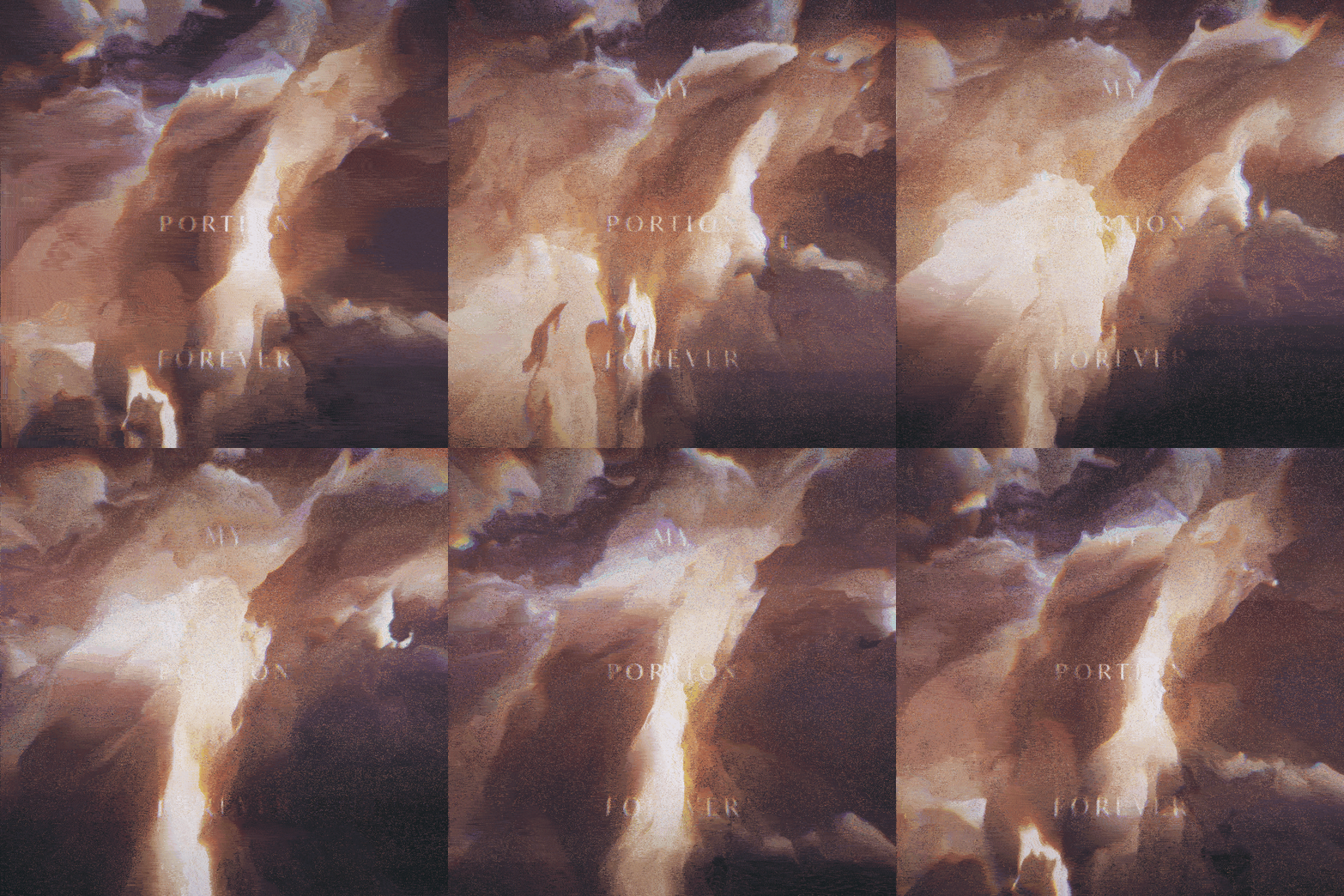
I wanted to play around with Trapcode Mir for this animation, so I modified the parameters until I came up with something that looked to me like a nice rolling cloudscape, which I felt was apropos for the subject matter. The bulk of the effort was just getting the look right; the rest was letting the robots do all the work.
Don’t feel bad for the robots—they had it coming. Just like we will when they one day enslave us.
Enjoy.
For thee my flesh and my heart hath fainted away: thou art the God of my heart, and the God that is my portion for ever.
(Psalm 72:26 DR)
View a higher quality version of this gif here: