

Psalm 7:4
the shadow in the conscience
O Lord my God, if I have done this thing, if there be iniquity in my hands: (Psalm 7:4 DR)
When the future King David was being persecuted by King Saul, it was for reasons of jealousy. David had been immensely successful in his military campaigns, such that it became a refrain among the soldiers and even the commoners that:
Saul slew his thousands, and David his ten thousands. (1 Samuel 18:7 DR)
Instead of being grateful to the Lord for a wise commander who brought victory to his people and renown to himself by extension, King Saul interpreted this in the worst possible light, projecting onto David his own insecurities, imagining that David couldn’t help but to be plotting a coup:
They have given David ten thousands, and to me they have given but a thousand; what can he have more but the kingdom? (1 Samuel 18:8 DR)
It must be remembered that King Saul specifically chose to have David serve him; it is said that he would not let David return to his father’s house (cf. 1 Samuel 7:2), which is a means of saying that he pressed him into his service and gave him sufficient favors and authority to remain. King Saul’s son Jonathan and David were also close friends, and King Saul had intentionally set David as commander over his soldiers because of his prudence and success. David had also been the only one who could relieve the torment he received from the evil spirit.
However, jealously is a raging fire, and it utterly consumed King Saul so that instead of returning gratitude unto God for providing him with a competent commander who selflessly gave of himself and brought glory and renown to Israel, he could only think of how it might redound poorly upon his own perception of himself. He imagines that the cravenness of his own heart must likewise exist in David, and thus David must be plotting against him because that is precisely what he would do if he were in David’s position.
As David now as the exiled king looks back upon the past, he laments to the Lord that he has been rendered evil for good. As he flees Jerusalem there is a fascinating scene in which a man starts hurling rocks and curses at him for what he perceives as David’s usurpation of Saul’s kingdom:
And king David came as far as Bahurim: and behold there came out from thence a man of the kindred of the house of Saul named Semei, the son of Gera, and coming out he cursed as he went on, and he threw stones at David, and at all the servants of king David: and all the people, and all the warriors walked on the right, and on the left side of the king. And thus said Semei when he cursed the king: “Come out, come out, thou man of blood, and thou man of Belial. The Lord hath repaid thee for all the blood of the house of Saul: because thou hast usurped the kingdom in his stead, and the Lord hath given the kingdom into the hand of Absalom thy son: and behold thy evils press upon thee, because thou art a man of blood.” (2 Samuel 16:5-8 DR)
As we know from the accounts, David did not usurp Saul’s kingdom, and even acted with kindness towards his progeny, rather than slaying them as would have been customary. In fact, one of Saul’s descendants at the same moment is plotting to retake the kingdom as David flees (cf. 2 Samuel 16:1-4). But even in this moment as he is being cursed he refuses to retaliate, musing that perhaps God told Semei to do so, and if he accepts it from the hand of the Lord it will go well for him.
It is in this context that David as the Psalmist raises these words, protesting his innocence and his refusal to sin against the Lord’s anointed. He is even willing to accept an unjust curse from Semei because he thinks there may be a possibility it is from the Lord.
David, after all, knew how to consider himself in humility and knew the very depths of his own sin (cf. Psalm 50). For even though he was innocent of usurpation, there were many other wicked things he had done as king, and he does not discount them nor imagine that he must necessarily be unpunished for them. We see here also an examination of conscience, for even though he believes himself to be innocent, he also is willing to consider that perhaps Saul’s paranoia about him was true. Maybe in the recesses of his heart he did desire Saul’s kingdom, something that only God would know.
He doesn’t pretend to know himself fully, but entrusts himself completely to the Lord. It is by accepting the curse of Semei that he believes to be unjust that he allows his heart to be fully weighed and measured. He will allow the Lord to be the judge of his motives and his actions, with the proof of the thing being in its resolution. He is certain of his innocence, but allows it to be fully judged and proved, forming the beginning of an imprecation upon himself if he has deceived himself as to his innocence. Here he follows the instruction of St. Paul:
But to me it is a very small thing to be judged by you, or by man's day; but neither do I judge my own self. For I am not conscious to myself of any thing, yet am I not hereby justified; but he that judgeth me, is the Lord. Therefore judge not before the time; until the Lord come, who both will bring to light the hidden things of darkness, and will make manifest the counsels of the hearts; and then shall every man have praise from God. (1 Corinthians 4:3-5 DR)
As thoroughly as we can examine ourselves, we must always come in humility before the Lord, sorrowful for our sins and imploring his mercy for those things we do that are hidden even to ourselves. But there is confidence in leaving the judging to the Lord, for He knows all and there is nothing hidden from Him. Thus, when He judges we can be absolutely sure of that judgment. In the sacrament of Penance the priest in the person of Christ pronounces that judgment in respect to the forgiveness of sins. Our consciences need no longer be troubled, for the verdict is certain and absolute. In this we can be fully confident without any shadow of doubt, even if our hearts are troubled:
In this we know that we are of the truth: and in his sight shall persuade our hearts. For if our heart reprehend us, God is greater than our heart, and knoweth all things. (1 John 3:19-20 DR)
In this is the charity of God perfected with us, that we may have confidence in the day of judgment: because as he is, we also are in this world. Fear is not in charity: but perfect charity casteth out fear, because fear hath pain. And he that feareth, is not perfected in charity. (1 John 4:17-18 DR)
For this animation I wanted to do something with shadows, given that sometimes our consciences can cast shadows, as it were, even for things of which we have been forgiven.
I drew an ellipse in After Effects and applied some looping wiggle to the position of the shape itself to have it move around. The nice thing about this is that when you then duplicate the layer it treats that new layer as a random seed for the wiggle and gives you some nice randomness without having to try and fake it yourself.
I then added in the text and preocmped the text and ellipses. Next I added Shadow Studio 3 to the precomp to get the nice ray-traced shadow effect and then linked the origin of the light to a Null and applied some looping wiggle to that to get the “light” moving so as to affect the shadows.
Enjoy.
O Lord my God, if I have done this thing, if there be iniquity in my hands:
(Psalm 7:4 DR)
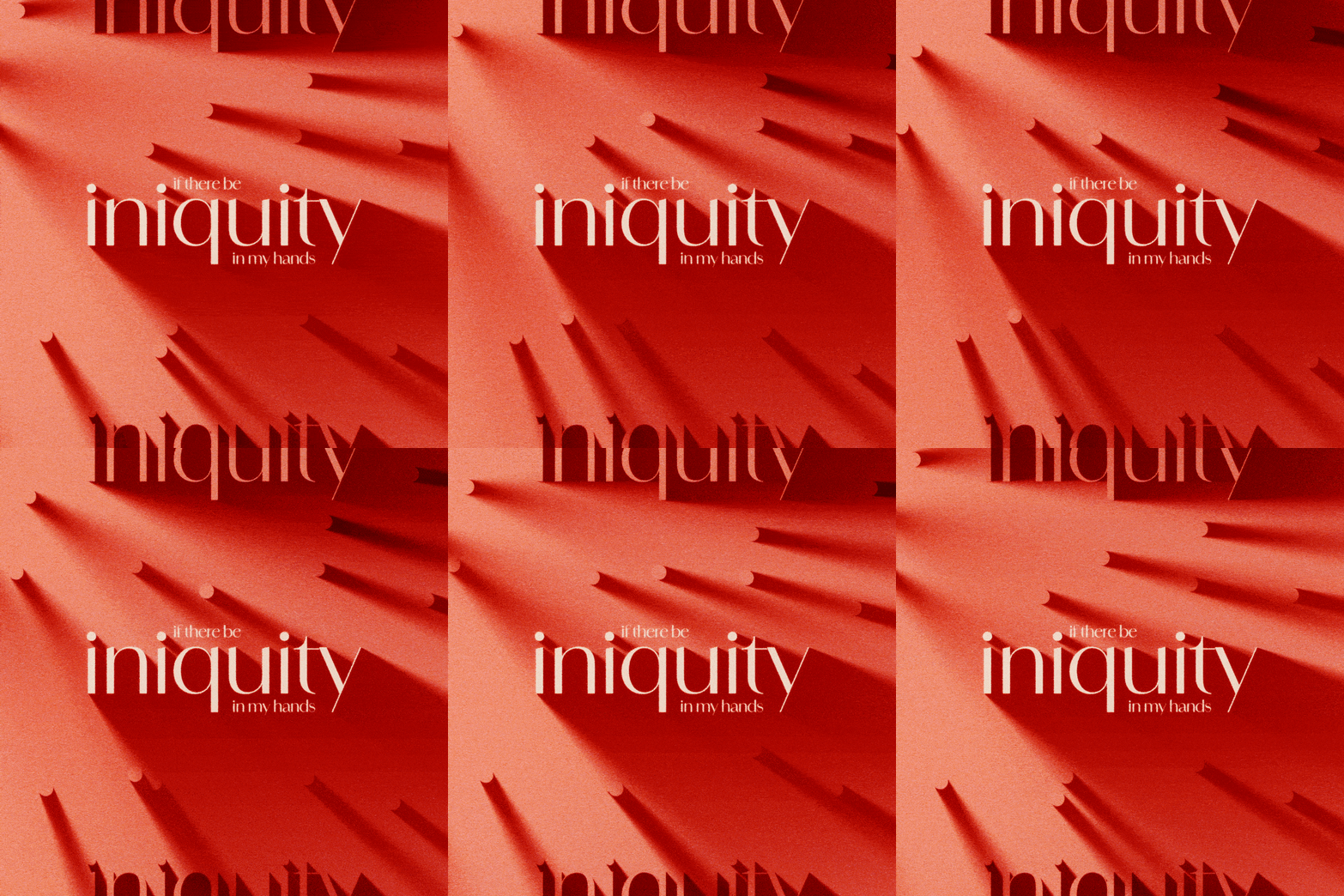
View a higher quality version of this gif here: