

Psalm 76:21
time to come home
Thou hast conducted thy people like sheep, by the hand of Moses and Aaron. (Psalm 76:21 DR)
As the Psalmist concludes this Psalm, he makes reference to two of the most pivotal figures of his people’s history: Moses and Aaron. These two brothers had been chosen by God to fulfill different roles in the economy of God’s liberation of his people and the establishment of the covenant: Moses was the lawgiver and prophet, whereas Aaron was the progenitor of the priestly line. These men loomed large in the consciousness of God’s people, for they represented those aforementioned aspects of the covenant.
What is fascinating is that there was a built-in expiration date, so to speak, on these roles. Moses himself prophesied that another prophet greater than him would one day arise:
The Lord thy God will raise up to thee a PROPHET of thy nation and of thy brethren like unto me: him thou shalt hear: …I will raise them up a prophet out of the midst of their brethren like to thee: and I will put my words in his mouth, and he shall speak to them all that I shall command him. (Deuteronomy 18:15-19 DR)
And the Psalmist elsewhere describes the coming Messiah as of a priestly line which supersedes that of Aaron because it is from eternity:
The Lord said to my Lord: Sit thou at my right hand: Until I make thy enemies thy footstool. The Lord will send forth the sceptre of thy power out of Sion: rule thou in the midst of thy enemies. With thee is the principality in the day of thy strength: in the brightness of the saints: from the womb before the day star I begot thee. The Lord hath sworn, and he will not repent: Thou art a priest for ever according to the order of Melchisedech. (Psalm 109:1-4 DR)
Thus there is baked into the covenant the promise of and the looking-forward-ness to a new one, which many of the later prophets will prophesy. The Psalmist here by invoking Moses and Aaron thus is not only recounting a historical fact or remembering how God delivered his people, but by the very act of doing so speaks n prophetic utterance of the fulfillment of that which these things foreshadow.
Jesus as the fulfillment and institutor of the new covenant is that prophet that Moses spoke of who speaks what God commands, as he very often says of himself, and is also the high priest of the order of Melchisedech who initiates and mediates the new covenant in his blood. And just as the people of God were saved from their bondage to Egypt by their passage through the waters of the Red Sea, so in the new covenant God’s people are saved from their sins through their passage through the waters of baptism.
This baptism of regeneration is what the Psalmist prophetically alluded to in the previous verse, wherein he spoke of how God’s way is in the sea and His paths in the many waters where his footsteps shall not be known. Our Lord takes up this sort of language when describing the new birth:
Jesus answered: Amen, amen I say to thee, unless a man be born again of water and the Holy Ghost, he cannot enter into the kingdom of God. That which is born of the flesh, is flesh; and that which is born of the Spirit, is spirit. Wonder not, that I said to thee, you must be born again. The Spirit breatheth where he will; and thou hearest his voice, but thou knowest not whence he cometh, and whither he goeth: so is every one that is born of the Spirit. (John 3:5-8 DR)
Just as the footsteps of God shall not be known in the paths of the many waters, so the Spirit who regenerates in baptism breatheth where he will. This is utterly cryptic unless our Lord is understood as the fulfillment of the Law and the Prophets, for he brings to fruition all the promises that God made to his people in the new covenant as foretold by the prophets:
Behold the days shall come, saith the Lord, and I will make a new covenant with the house of Israel, and with the house of Juda: Not according to the covenant which I made with their fathers, in the day that I took them by the hand to bring them out of the land of Egypt: the covenant which they made void, and I had dominion over them, saith the Lord. But this shall be the covenant that I will make with the house of Israel, after those days, saith the Lord: I will give my law in their bowels, and I will write it in their heart: and I will be their God, and they shall be my people. And they shall teach no more every man his neighbour, and every man his brother, saying: Know the Lord: for all shall know me from the least of them even to the greatest, saith the Lord: for I will forgive their iniquity, and I will remember their sin no more. (Jeremiah 31:31-34 DR)
In our Lord Jesus Christ God fulfills his promises that the Psalmist speaks of, for as Moses and Aaron conducted the people like sheep, so our Lord as the Good Shepherd brings into the sheepfold those who hear his voice. As the promised prophet he brings God’s word to his people in his blessed Incarnation and as eternal high priest is the mediator of the new and eternal covenant in his own blood, bringing those who pass through the waters into his ternal kingdom.
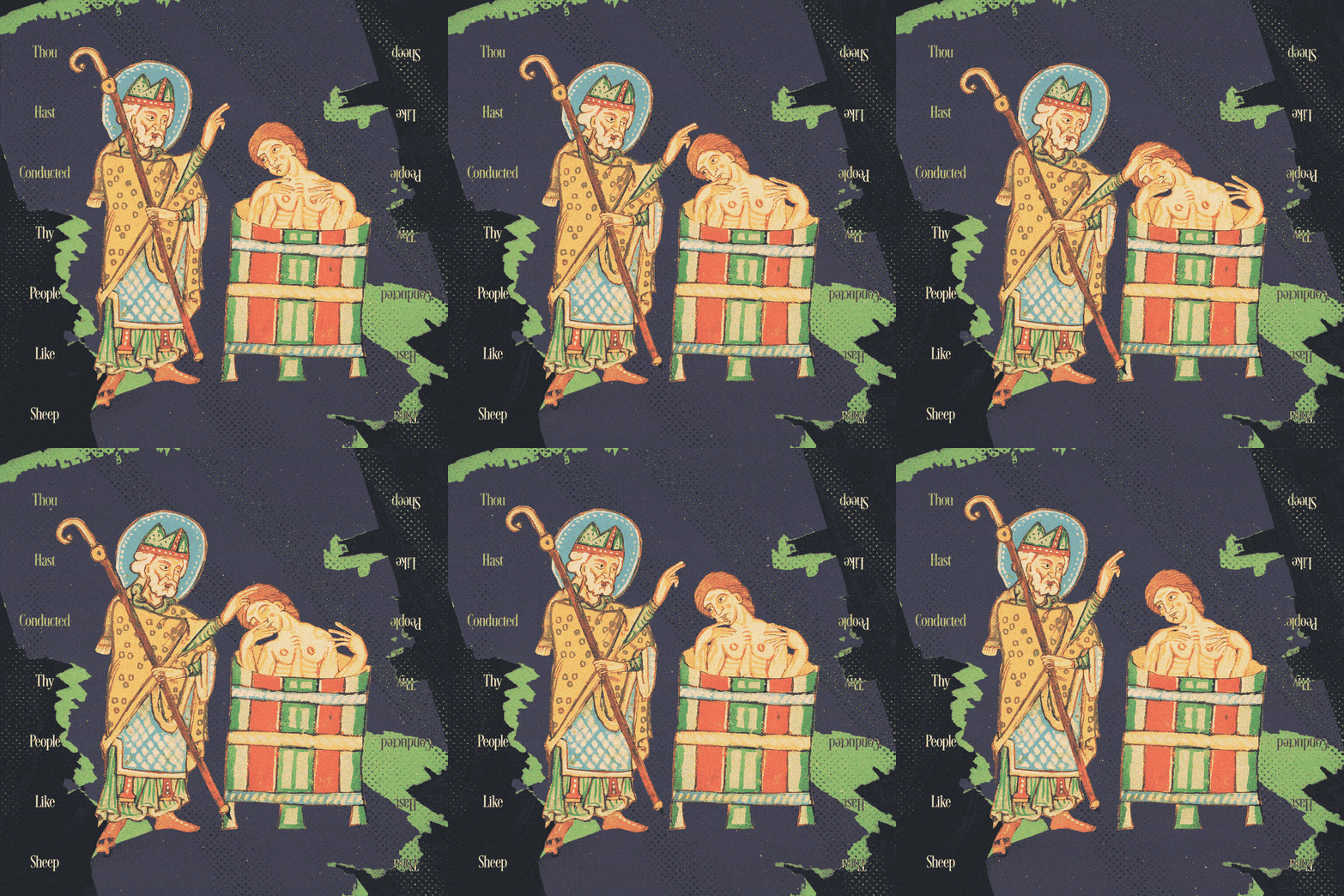
For this animation I wanted to focus on the baptismal undertones that I think can be gleaned form this verse, and so as I was searching around I found this great medieval miniature of the baptism of St. Augustine. In this image bishop St. Ambrose is preparing to baptize the future St. Augustine, and has his hand in the posture of a blessing, whereas St. Augustine’s hands are folded in humility.
I cut out both figures in Photoshop and used some of the Generative Fill tools to help fill in some missing pixels after separating some of the limbs into separate layers. It’s not a perfect tool, but when it works it’s frighteningly good.
In After Effects I recomposited the figures and their various layers and used a combination of the Puppet Tool and some simple parenting to animate the movements. Nothing to out of the ordinary, but I liked how it turned out.
Enjoy.
Thou hast conducted thy people like sheep, by the hand of Moses and Aaron.
(Psalm 76:21 DR)
View a higher quality version of this gif here: