

Psalm 76:8
when the other shoe drops
Will God then cast off for ever? or will he never be more favourable again? (Psalm 76:8 DR)
One inevitability of searching our hearts in the silence of solitude and prayer is that we become painfully aware of our own limitations, our weaknesses, our vices and our sins. Faults that we barely gave mind to can bring themselves to the fore, uncovered in this sweeping of the spirit.
One senses this dynamic in another psalm wherein David calls to mind his sinfulness after his sin with Bathsheba:
For I know my iniquity, and my sin is always before me. To thee only have I sinned, and have done evil before thee: that thou mayst be justified in thy words and mayst overcome when thou art judged. For behold I was conceived in iniquities; and in sins did my mother conceive me. For behold thou hast loved truth: the uncertain and hidden things of thy wisdom thou hast made manifest to me. (Psalm 50:5-8 DR)
He is so convicted of his sin and has searched deep within him that not only does he acknowledge the sin that he has just committed but also goes back in his mind to the beginning, recognizing that such has been his state from the moment of his conception. Original sin is at play here, certainly, but he also is mindful that his sinfulness has been a woeful companion throughout his life, and that God is just to bring whatever judgment upon him that he sees fit.
Here in this verse of Psalm 76 the Psalmist likewise recognizes the just judgment of God, and wonders aloud if there is any hope. The things of this life have led him into sin and offer no reprieve; in what then shall he hope?
Weariness he had found in this life; in no place a trustworthy, in no place a fearless comfort. Unto whatsoever men he betook himself, in them he found scandal, or feared it. In no place therefore was he free from care. An evil thing it was for him to hold his peace, lest perchance he should keep silence from good words; to speak and babble without was painful to him, lest all his enemies, anticipating watches, should seek slanders in his words. Being exceedingly straitened in this life, he thought much of another life, where there is not this trial. And when is he to arrive there? For it cannot but be evident that our suffering here is the anger of God. (St. Augustine, Expositions on the Psalms, 76, 9.)
It is here in this moment where the human spirit becomes acutely aware of its own wretchedness and helplessness that God’s grace can begin the process of transformation. When we are laid bare in the silence and solitude of prayer of all our pretensions and excuses, of all our self-sufficiency and pride—that is when spiritual growth can take place and virtue can begin to sprout and bloom in the human heart. In our weakness Christ’s strength is made manifest, and the seed which is scattered by his word can take root and bring forth fruit. This posture—both physical and spiritual—of humility is a necessary condition for the grace of God to flow into our souls, for:
But he giveth greater grace. Wherefore he saith: God resisteth the proud, and giveth grace to the humble. Be subject therefore to God, but resist the devil, and he will fly from you. Draw nigh to God, and he will draw nigh to you. Cleanse your hands, ye sinners: and purify your hearts, ye double minded. Be afflicted, and mourn, and weep: let your laughter be turned into mourning, and your joy into sorrow. Be humbled in the sight of the Lord, and he will exalt you. (James 4:6-10 DR)
The wrath of God against sin is just and good, and we as sinners justly fall under its condemnation in our natural selves. But God’s mercy and grace provides the remedy for the malady of sin through the transformation wrought by his grace infused into our souls by which we are justified and sanctified and made into his adopted sons. These moments of sweeping the spirit continually bring us face to face with our sinfulness and God’s righteousness, but also provide the opportunity to turn to God in humility and be set free and renewed in heart and mind, which is why St. Paul can say:
There is now therefore no condemnation to them that are in Christ Jesus, who walk not according to the flesh. For the law of the spirit of life, in Christ Jesus, hath delivered me from the law of sin and of death. For what the law could not do, in that it was weak through the flesh; God sending his own Son, in the likeness of sinful flesh and of sin, hath condemned sin in the flesh; That the justification of the law might be fulfilled in us, who walk not according to the flesh, but according to the spirit. (Romans 8:1-4 DR)
The Psalmist brings this cry of humility into his prayer in the earliest watches of the night, searching out his soul for impurity and sinfulness that he might be cleansed from all sin and hidden faults. Elsewhere the Psalmist cries:
Prove me, O God, and know my heart: examine me, and know my paths. And see if there be in me the way of iniquity: and lead me in the eternal way. (Psalm 138:23-24 DR)
As we grow in communion with God we desire that he know us inside and out, which—since he already does—is an inverted longing to belong totally to him, that we would know him as he knows us, that all that is within us would be conformed unto his image and likeness. This desire is the solution to the Psalmist’s question, for while God might seem far off and to have cast off his servant, as we cling to him and abide in his love his love is shed abroad in our hearts so that we no longer fear:
In this is the charity of God perfected with us, that we may have confidence in the day of judgment: because as he is, we also are in this world. Fear is not in charity: but perfect charity casteth out fear, because fear hath pain. And he that feareth, is not perfected in charity. (1 John 4:17-18 DR)
In this animation I wanted to try and capture the sense of being cast off and abandoned, so I searched for images of people floating or falling and didn’t have a whole lot of luck, but finally came across this one and went with it.
I cut out the figure in Photoshop and pieced it into two layers, one with the background leg as an individual layer. Next I rigged up the character in After Effects with the Puppet Tool and did some slight motions on the various limbs to give the sense of falling or flailing, or—better yet—being caught in some sort of suspended limbo.
For the background I found an abstract image and applied some pixel sorting to it to give a sense of movement to the background, and animated the sorted pixels flowing up, which I thought was a nice touch.
In the end it didn’t turn out exactly as I envisioned, but I still liked it and had some fun creating it.
Enjoy.
Will God then cast off for ever? or will he never be more favourable again?
(Psalm 76:8 DR)
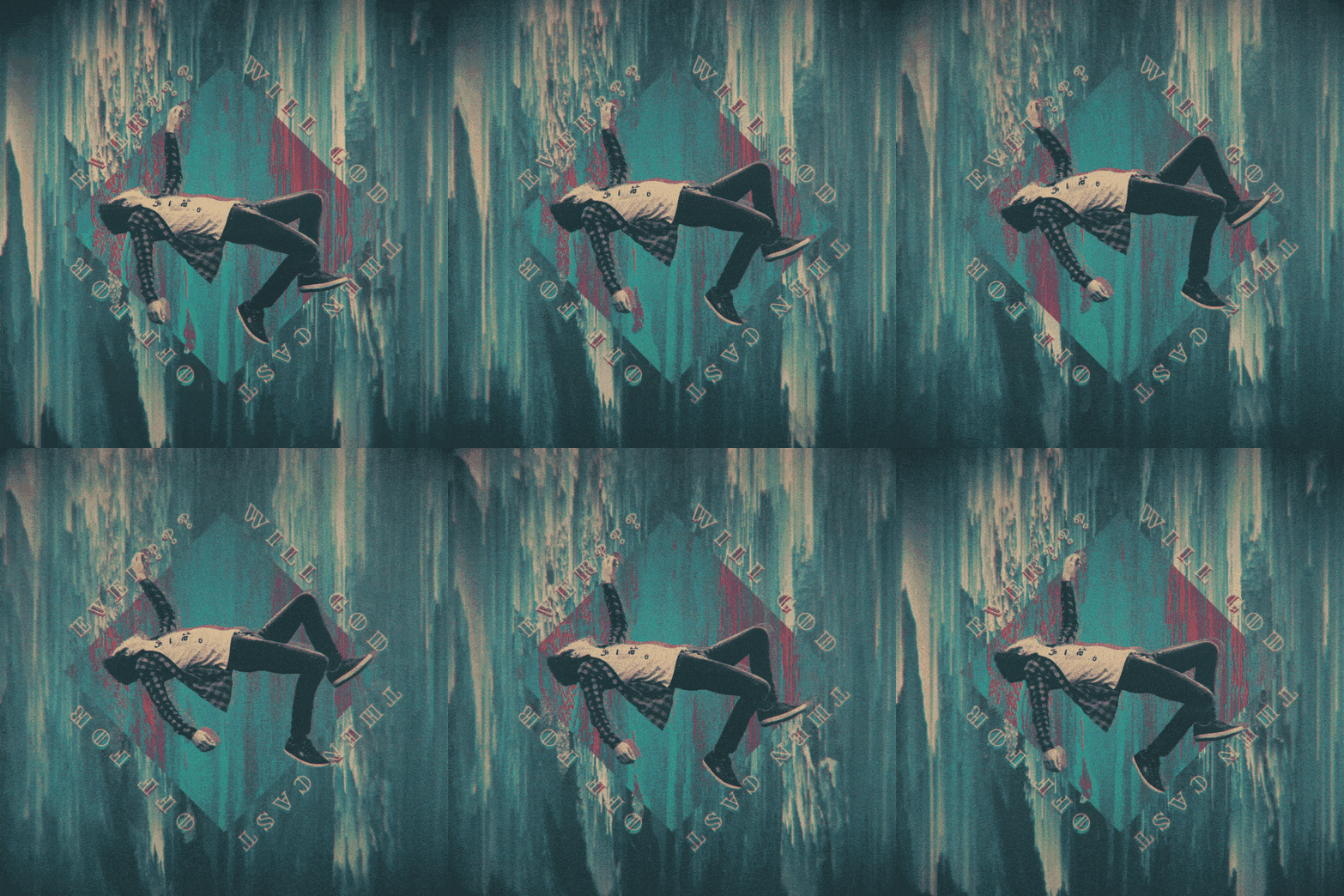
View a higher quality version of this gif here: