

Psalm 7:9
becoming a better candle
The Lord judgeth the people. Judge me, O Lord, according to my justice, and according to my innocence in me. (Psalm 7:9 DR)
The Psalmist has such confidence in the justice of the Lord and in the vindication of the righteous that he now calls upon God to prove this righteousness within him—to judge him according to his justice and innocence. He echoes a similar request elsewhere in the Psalms:
Judge me, O Lord, for I have walked in my innocence: and I have put my trust in the Lord, and shall not be weakened. (Psalm 25:1 DR)
Such a request is a bold one, to be sure, but is borne out of his trust in God’s righteousness as well as a remembrance of how he refused to do evil in the past because of his desire to follow God’s law. Thus, when given the opportunities to take revenge on King Saul—which on a natural level might have seemed just—he refused, knowing that he could not blamelessly raise his hand against the Lord’s anointed, even if King Saul was unjustly persecuting him. This didn’t cause David to justify King Saul’s actions or overlook them, but it rather caused him to place his hope and trust in the Lord and His ultimate vindication of him.
It is this which is the cause of the innocence within him, a righteousness which does not arise from his own effort (since it was against all natural instincts) but was granted and bestowed upon him by God because he constantly sought the law of God. This infused righteousness of which the Psalmist speaks is the righteousness of Christ which is paradoxically both not of himself yet also the ground and cause of his actual righteousness before God. At the Lavabo the priest in persona Christi prays some of the remaining verses of Psalm 25 which echo the Psalmist’s request here:
I will wash my hands among the innocent: and I will compass Thine altar, O Lord That I may hear the voice of praise: and tell of all Thy wonderous works. I have loved, O Lord, the beauty of Thy house and the place where Thy glory dwelleth. Take not away my soul, O God, with the wicked: nor my life with blood-thirsty men. In whose hands are iniquities, their right hand is filled with gifts. But I have walked in my innocence: redeem me, and have mercy on me. My foot hath stood in the direct way, in the churches I will bless Thee, O Lord. (Lavabo, Psalm 25:6-12 DR)
St. Augustine sees in the expansion of thought in the poetic parallelism a proof that we are speaking of the righteousness of Christ, for while justice can be predicated of man to some extent, innocence (harmlessness in his rendering) towards an enemy is of divine grace by means of it being in or upon him:
“Judge me, O Lord, according to my righteousness, and according to my harmlessness, that is upon me.” This is true harmlessness, which harms not even an enemy. Accordingly, well does he require to be judged according to his harmlessness, who could say with truth, “If I have repaid them that recompense me evil.” As for what he added, “that is upon me,” it can refer not only to harmlessness, but can be understood also with reference to righteousness; that the sense should be this, Judge me, O Lord, according to my righteousness, and according to my harmlessness, which righteousness and harmlessness is upon me. By which addition he shows that this very thing, that the soul is righteous and harmless, she has not by herself, but by God who gives brightness and light. (St. Augustine, Expositions on the Psalms, 7, 8.)
This is the reason the Psalmist can ask God to judge him according to his justice, because he has been graced to walk in that justice and innocence. He is not boasting of some righteousness that arises from within him or is generated out of his own effort, but rather that which is divinely bestowed on him because he is cooperating with God’s grace. The entirety of Psalm 118 goes to great lengths to describe his love for the law of the Lord, which is a description of his desire to walk in righteousness as assisted by grace. To look into the law of the Lord is to attune one’s heart and mind to it and to brings one’s will into conformity to it. The soul becomes, as it were, a reflection of the divine law and the divine will. St. Augustine describes it as a candle which burns with a light it did not kindle itself:
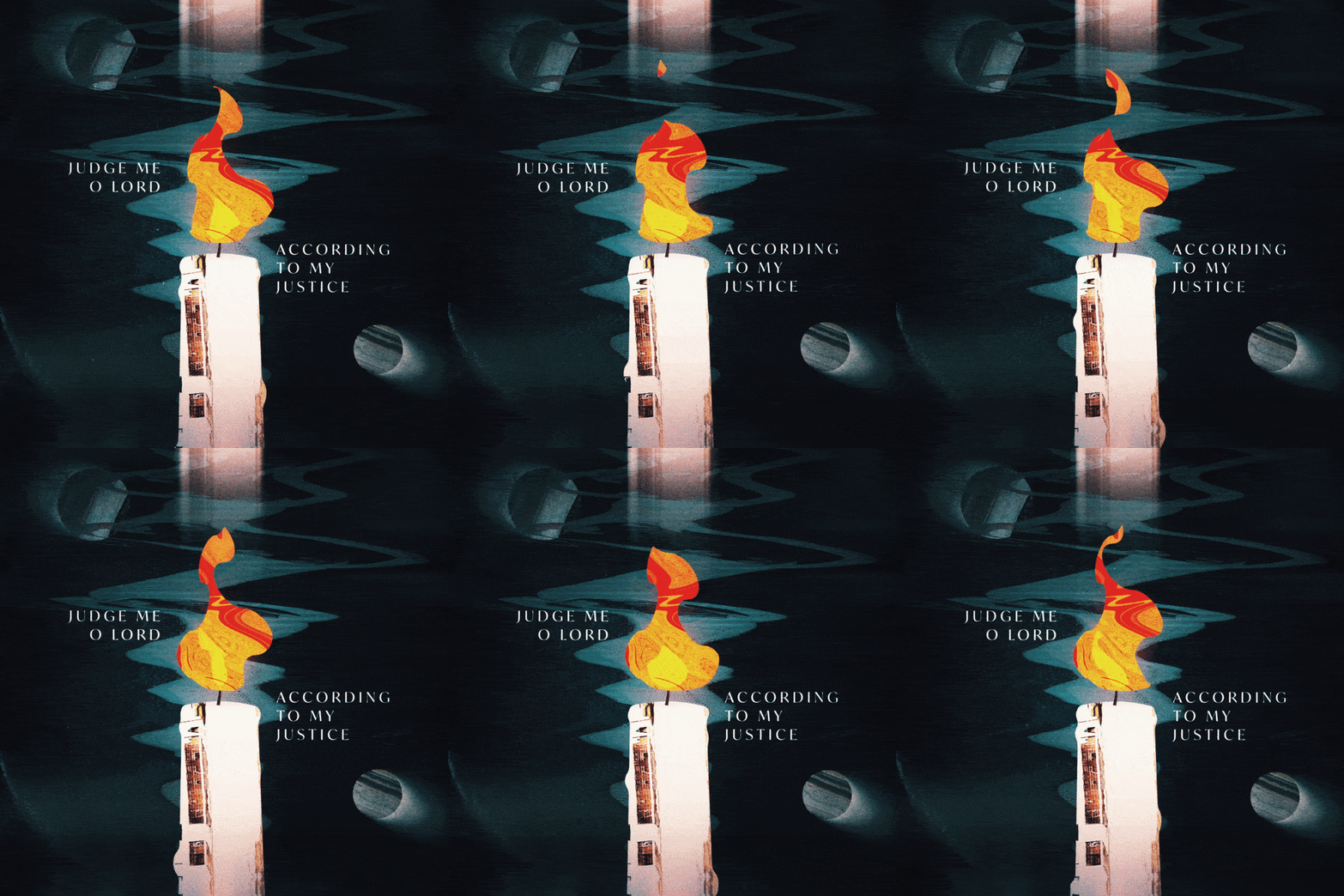
For of this he says in another Psalm, “You, O Lord, will light my candle.” And of John it is said, that “he was not the light, but bore witness of the light.” [John 1:8] “He was a burning and shining candle.” [John 5:35] That light then, whence souls, as candles, are kindled, shines forth not with borrowed, but with original, brightness, which light is truth itself. It is then so said, “According to my righteousness, and according to my harmlessness, that is upon me,” as if a burning and shining candle should say, Judge me according to the flame which is upon me, that is, not that wherewith I am myself, but that whereby I shine enkindled of you. (ibid.)
This is simply another way of describing how we love God with the charity that he pours into our hearts by the Holy Ghost (cf. Romans 5:5). The righteousness by which we are justified is not our own but infused into our souls by the Holy Ghost so that we are really made righteous because God makes us so. This is the defeat of sin, the entire purpose for which our Lord became incarnate (cf. 1 John 3:8) and the confidence by which we hope in the Lord and in his vindication of the righteous.
I enjoyed St. Augustine’s metaphor of the candle for this passage, and so I thought it’d make a nice illustration. I illustrated a candle shape and precomped it. In that precomp I animated some circles flowing down and then applied some gaussian blur and then a matte choker to create the dripping wax effect. In the main comp I applied a texture to that precomp for visual interest and then created the flames using some shapes and other shapes as mattes, applying Wave Warp to them to create as much procedural randomness as possible.
Enjoy.
The Lord judgeth the people. Judge me, O Lord, according to my justice, and according to my innocence in me.
(Psalm 7:9 DR)
View a higher quality version of this gif here: