

Psalm 8:3
wisdom in unexpected places
Out of the mouth of infants and of sucklings thou hast perfected praise, because of thy enemies, that thou mayst destroy the enemy and the avenger. (Psalm 8:3 DR)
The paradox of the Incarnation is such that it becomes a scandal and a stumbling block to the wisdom of the world (cf. 1 Corinthians 1:23; Romans 9:32-33) which cannot accept God’s Wisdom on His own terms (cf. John 1:10-11). It becomes such that the magnificence of God that the Psalmist previously proclaimed is now hidden in the open, as it were, being manifest only to those who are willing to perceive and receive it.
That the praise of the Lord is set forth here from the mouths of infants is of course itself a paradox of sorts, for infants and sucklings cannot properly give voice to this praise in the normal mode of speaking or of hearing. The Psalmist thus is not intending a literal meaning but rather a mystical or moral one in which the infants and sucklings pertain to the lowly and humble of heart. In fact, the Psalmist elsewhere connects these two ideas explicitly:
Lord, my heart is not exalted: nor are my eyes lofty. Neither have I walked in great matters, nor in wonderful things above me. If I was not humbly minded, but exalted my soul: As a child that is weaned is towards his mother, so reward in my soul. (Psalm 130:1-2 DR)
It is the humility of heart that provides the soil—as it were—for the Word of the Lord to be received which brings forth a harvest of righteousness (cf. Matthew 13:9). Pride and self-righteousness place barriers to this reception and can blind the heart and mind to the truth, whereas humility opens the heart to hear what God would speak, as our Lord says:
I confess to thee, O Father, Lord of heaven and earth, because thou hast hid these things from the wise and prudent, and hast revealed them to the little ones. (Matthew 11:25 DR)
This flows from the paradox of the Incarnation, for in our Lord Jesus Christ the fullness of divinity dwelt in human form (cf. Philippians 2:6-7), the surpassing greatness of the Godhead hidden under the veil of human flesh, as it were. In a similar manner the wisdom of God that leads to salvation does not map onto the wisdom or pretended sophistication of the world but is revealed to those who imitate our Lord in His humility. St. Paul elaborates:
For the word of the cross, to them indeed that perish, is foolishness; but to them that are saved, that is, to us, it is the power of God. For it is written: “I will destroy the wisdom of the wise, and the prudence of the prudent I will reject.” [Isaiah 29:14]
For the foolishness of God is wiser than men; and the weakness of God is stronger than men. (1 Corinthians 1:18-19; 25 DR)
St. Augustine draws a direct parallel to St. Paul’s admonitions to Corinthians in that St. Paul uses the same image of infants:
I cannot take babes and sucklings to be any other than those to whom the Apostle says, “As unto babes in Christ I have given you milk to drink, not meat.” [1 Corinthians 3:1-2] Who were meant by those who went before the Lord praising Him, of whom the Lord Himself used this testimony, when He answered the Jews who bade Him rebuke them, “Have ye not read, out of the mouth of babes and sucklings You have made perfect praise?” [Matthew 21:16] (St. Augustine, Expositions on the Psalms, 8, 5.)
This reading is further strengthened for him in that the Psalmist speaks of the infants and sucklings not only speaking forth praise but “perfecting” it, which in his reading stands in for the growth in holiness and sanctification that St. Paul goes on to urge of his hearers:
Now with good reason He says not, You have made, but, “You have made perfect praise.” For there are in the Churches also those who now no more drink milk, but eat meat: whom the same Apostle points out, saying, “We speak wisdom among them that are perfect;” [1 Corinthians 2:6] but not by those only are the Churches perfected; for if there were only these, little consideration would be had of the human race. But consideration is had, when they too, who are not as yet capable of the knowledge of things spiritual and eternal, are nourished by the faith of the temporal history, which for our salvation after the Patriarchs and Prophets was administered by the most excellent Power and Wisdom of God, even in the Sacrament of the assumed Manhood, in which there is salvation for every one that believes; to the end that moved by Its authority each one may obey Its precepts, whereby being purified and “rooted and grounded in love,” he may be able to run with Saints, no more now a child in milk, but a young man in meat, “to comprehend the breadth, the length, the height, and depth, to know also the surpassing knowledge of the love of Christ.” [Ephesians 3:17-19] (ibid.)
His point here is that not everyone is where they need to be spiritually so as to be able to comprehend the wisdom of God that St. Paul speaks about, and so God in His mercy reveals this wisdom in ways that the world might deem unfitting; that is, through humility of heart and the scandal of the Incarnation and the cross, as well as the example of saints (part of the “temporal history”) who—though simple by the world’s standards—gave their lives for their Lord:
Secondly, by “infants and sucklings,” may be understood humble people, little ones in their own eyes, and not versed in the science of the world; like many of the prophets and apostles, and a great number of monks and holy virgins, and mere children too, who, in early years, have so perfectly understood the glory of God, that they had no hesitation in spilling their blood for it. In such sense did our Savior quote this very Psalm, Mt. 21, “Have you never read that from the mouth of infants and sucklings he hath perfected praise?” (St. Robert Bellarmine, A Commentary on the Book of the Psalms, 8, 2.)
This stands in marked contrast to the “enemies” of which the Psalmist speaks, and in fact the dispensation of God’s wisdom to the infants and sucklings is specifically to confound the wisdom of this world. Knowledge and wisdom per se is not at issue, but rather that the fallen human tendency is to bypass humility and faith, as St. Augustine explains:
By enemies to this dispensation, which has been wrought through Jesus Christ and Him crucified, we ought generally to understand all who forbid belief in things unknown, [1 Corinthians 2:6-10] and promise certain knowledge: as all heretics do, and they who in the superstition of the Gentiles are called philosophers. Not that the promise of knowledge is to be blamed; but because they deem the most healthful and necessary step of faith is to be neglected, by which we must needs ascend to something certain, which nothing but that which is eternal can be. Hence it appears that they do not possess even this knowledge, which in contempt of faith they promise; seeing that they know not so useful and necessary a step thereof. (St. Augustine, Expositions on the Psalms, 8, 6.)
“But without faith it is impossible to please God,” St. Paul says (Hebrews 11:6), and thus the enemies that the infant and sucklings confound are those who attempt to attain to the knowledge of eternal things without it. Their promise of wisdom is vain, however, and they ultimately fail in their search for they do not come to the One Who is Wisdom itself.
In the spiritual life humility is the gateway to the all the virtues, as it allows the grace of God to be poured into our hearts (cf. Romans 5:5) so that our minds may be enlightened and come to knowledge of truth and salvation, which is God’s will for us (cf. 1 Timothy 2:4). In humility we align our will with God’s will, becoming like little children (cf. Matthew 18:3) in whom His praise can be perfected.
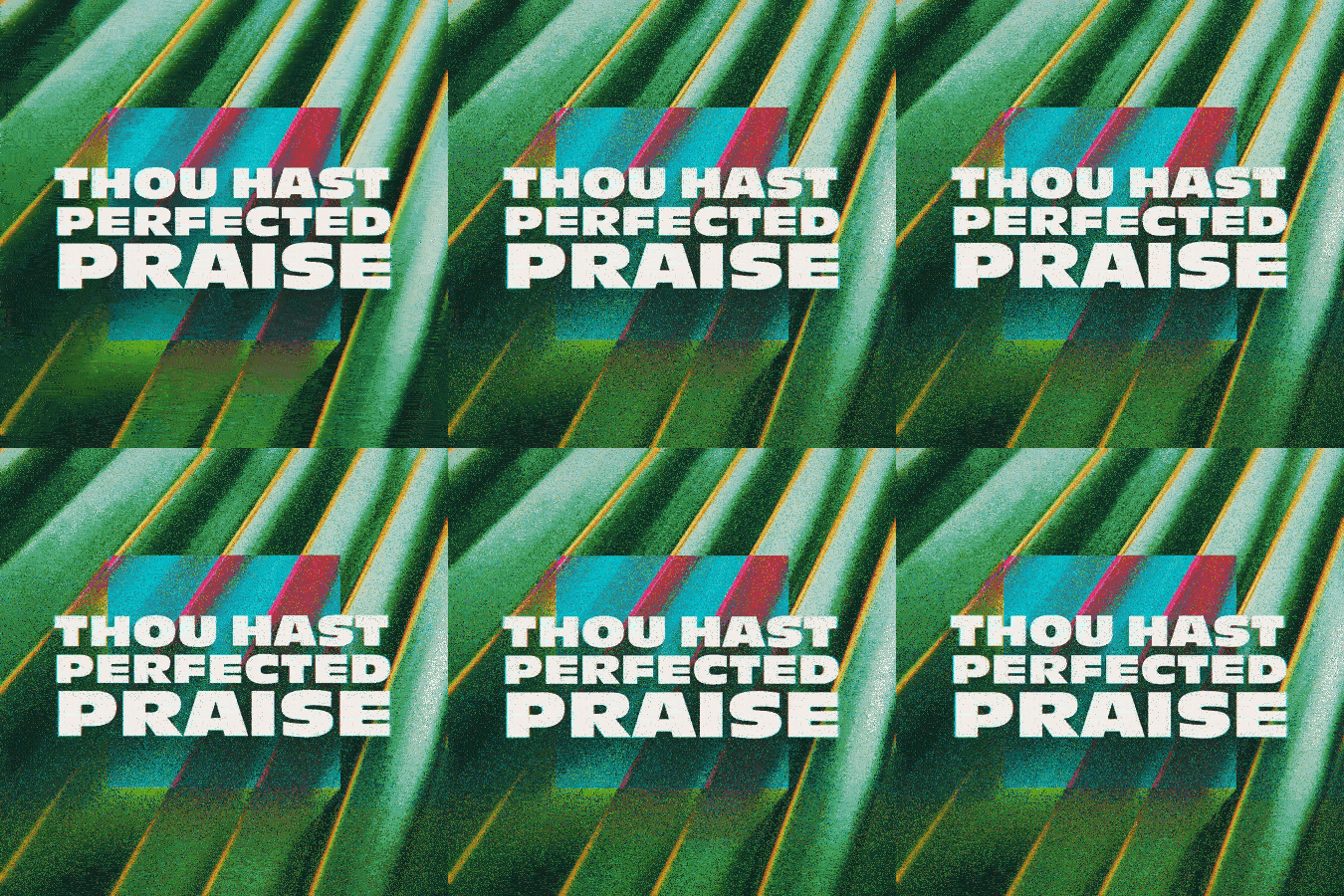
I wanted something simple for this animation given that I didn’t have a solid concept in mind. I found this interesting image of a palm branch (I think) and brought it into After Effects. I drew some masks following the veins of the branch and applied several instances of loopFlow to it to create some movement there, which I thought would be an interesting look. It’s fairly subtle but that’s ok.
I added a colored box on top and set it to exclusion to get some interesting coloring for contrast and then placed the text on top of that box. I added some wiggle hold to the box and the text to provide some subtle movement and finally added in some color correction.
Enjoy.
Out of the mouth of infants and of sucklings thou hast perfected praise, because of thy enemies, that thou mayst destroy the enemy and the avenger.
(Psalm 8:3 DR)
View a higher quality version of this gif here: