

Psalm 83:1
under pressure
Unto the end, for the winepresses, a psalm for the sons of Core. (Psalm 83:1 DR)
The Psalmist begins this Psalm—as many other Psalms—with an inscription, but this time with a seemingly odd dedication to winepresses. It could be easy to pass by this dedication to get to the heart of the Psalm, but the previous designation as unto the end signals that there is a prophetic import, for this end is invariably our Lord Jesus Christ.
But what has that to do with winepresses? St. Augustine takes up this theme and considers that the winepresses in question can certainly not be referring ultimately to physical winepresses, but have a spiritual significance:
For certainly, if after the title it mentioned anything about such things as I enumerated, carnal persons might have believed that it was a song concerning those visible wine-presses; but as it has this title, yet says nothing afterwards of those winepresses which we know so well, I cannot doubt that there are other wine-presses, which the Spirit of God intended us to look for and to understand here. Therefore, let us recall to mind what takes place in these visible winepresses, and see how this takes place spiritually in the Church. (St. Augustine, Expositions on the Psalms, 83, 1.)
Wine is made from grapes, but grapes do not naturally bring forth wine. If they are left to hang on the vine they will behave like other fruits, and can certainly be eaten and enjoyed as other fruits. Instead, the juice from the grapes has to be extracted be means of pressing them. But there is a two-fold aspect to this.
The first is that by pressing the grapes one must forego eating and enjoying them as grapes. Grapes are a delightful fruit in and of themselves, and so there is a deliberate denial of that enjoyment for the sake of something greater—the wine, which can arguably be even more enjoyable than grapes in and of themselves. Thus, by an act of self-denial the grapes are made into something greater and better than they are on the vine, the spiritual implications of which are probably obvious: we must deny ourselves and our desires to make spiritual progress and to become more than just natural and carnal men:
The grape hangs on the vines, and the olive on its trees. For it is for these two fruits that presses are usually made ready; and as long as they hang on their boughs, they seem to enjoy free air; and neither is the grape wine, nor the olive oil, before they are pressed. Thus it is with men whom God predestined before the world to be conformed to the image of His only-begotten Son, [Romans 8:29] who has been first and especially pressed in His Passion, as the great Cluster. (ibid.)
The second is that pressure has to be applied to the grapes to release the juice so that wine can eventually be made. In the ancient world this was sometimes accomplished by stomping on large quantities of grapes with one’s bare feet, although there were other methods as well. But regardless of method, the grapes had to be crushed, which would separate the skin or flesh of the grape from the juice. The spiritual import of this is that spiritual progress and sanctification cannot occur unless there is pressure and crushing in the form of tribulation:
Men of this kind, therefore, before they draw near to the service of God, enjoy in the world a kind of delicious liberty, like hanging grapes or olives: but as it is said, “My son, when you draw near to the service of God, stand in judgment and fear, and make your soul ready for temptation:” [Sirach 2:1] so each, as he draws near to the service of God, finds that he has come to the winepress; he shall undergo tribulation, shall be crushed, shall be pressed, not that he may perish in this world, but that he may flow down into the storehouses of God. He has the coverings of carnal desires stripped off from him, like grape-skins: for this has taken place in him in carnal desires, of which the Apostle speaks, “Put ye off the old man, and put on the new man.” All this is not done but by pressure: therefore the Churches of God of this time are called winepresses. (ibid.)
In the modern world we do not often conceive of our Churches as winepresses, but St. Augustine indicates that if one is truly seeking to follow after Christ, one will conform oneself to His image, who was Himself bruised for our sins (cf. Isaiah 53:5) as the grape is bruised so as to made into wine. He is, as St. Augustine mentioned above, the Great Cluster who was pressed in His Passion.
The one who is progressing in sanctification should thus expect great pressure and tribulation rather than less, as this crushing of our evil desires is necessary to root them out so that the purity of charity can flow forth like juice from the grapes in the winepress:
But being placed under pressure, we are crushed for this purpose, that for our love by which we were borne towards those worldly, secular, temporal, unstable, and perishable things, having suffered in them, in this life, torments, and tribulations of pressures, and abundance of temptations, we may begin to seek that rest which is not of this life, nor of this earth; and the Lord becomes, as is written, “a refuge for the poor man…” (St. Augustine, Expositions on the Psalms, 83, 3.)
The more our charity towards God increases, the greater our longing for Him increases, and the more the things of this world become unattractive. Our longing then takes on the character of a delayed desire, like waiting for a fine wine to age, which increases in quality and delight the longer its consumption is deferred:
The poor then are destitute of all this world's substance, for even though it abounds around them, they know how fleeting it is; and crying unto God, having nothing in this world with which they may delight themselves, and be held down, placed in abundant pressures and temptations, as if in winepresses, they flow down, having become oil or wine. What are these latter but good desires? For God remains their only object of desire; now they love not earth. For they love Him who made heaven and earth; they love Him, and are not yet with Him. Their desire is delayed, in order that it may increase; it increases, in order that it may receive. (ibid.)
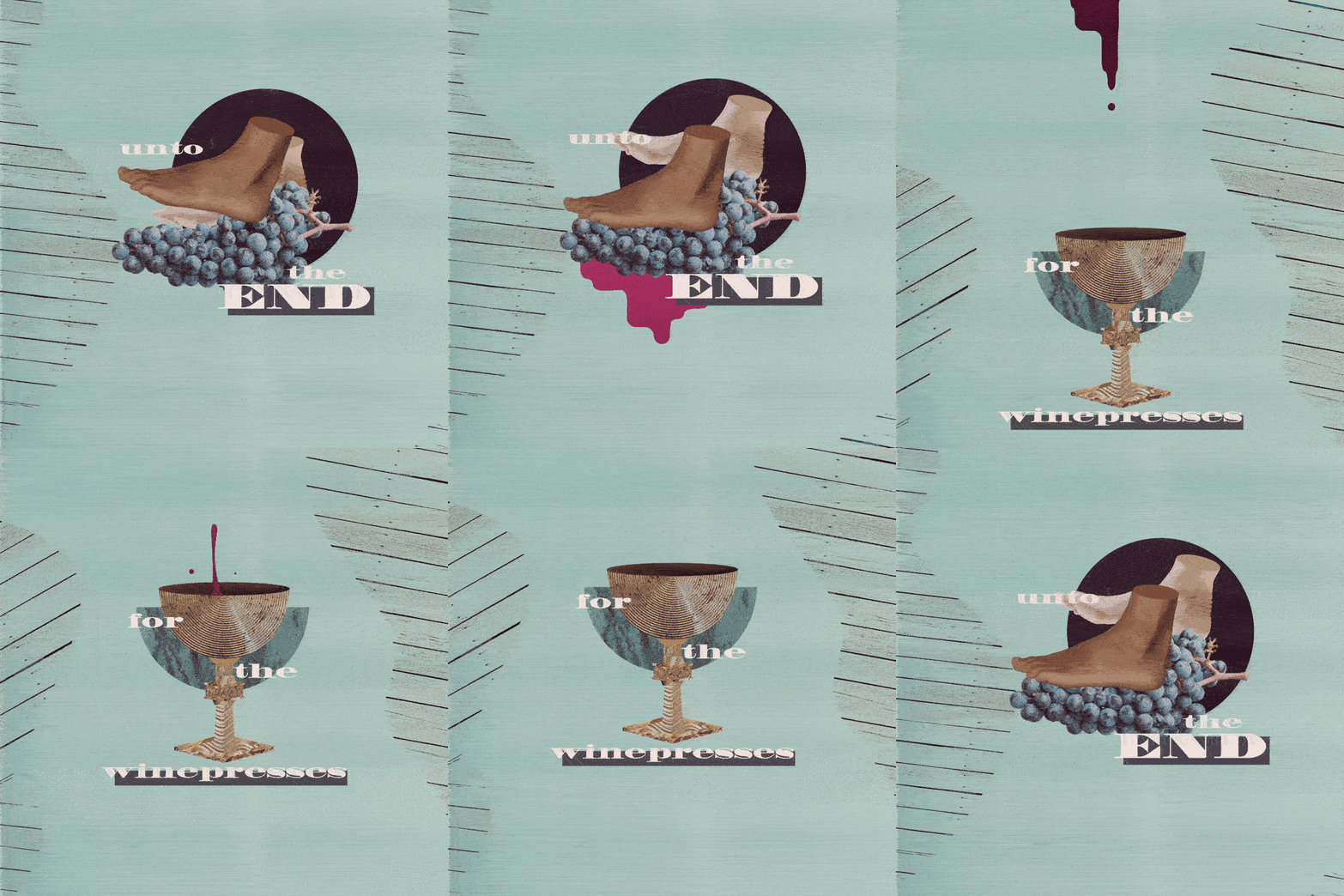
This animation was pretty fun to put together, and I was thinking about our Lord as the great Cluster, as St. Augustine terms Him, although not explicitly in those terms. But I had this notion in my head along similar lines that His being pressed down for our sins is the source of our salvation, and thus the great mystery of the sacrament of the Eucharist is perhaps alluded to in this verse.
I found some feet and grapes images and cut them out in Photoshop. I also drew the chalice shapes and used some textures matted to those shapes to create an interesting looking chalice.
In After Effects I animated the feet stomping the grapes, using the Puppet Tool on the grapes to give them a little bounce and appear as if they were interacting with the feet stomping. I then drew some rectangle shapes and animated them for the wine flow, applying some Rounded Corners on the shape layer to round off the edges and join them together more convincingly in a stylized manner.
I finally animated the drop dropping into the chalice and some splashes. Pretty simple stuff, but I think it worked nicely. The last bit was to add in the camera moves and textures and finally to repeat the animation so it would loop.
Enjoy.
Unto the end, for the winepresses, a psalm for the sons of Core.
(Psalm 83:1 DR)
View a higher quality version of this gif here: