

Psalm 83:2
when heaven comes to earth
How lovely are thy tabernacles, O Lord of hosts! (Psalm 83:2 DR)
There is a certain paradox to this life, for though we should in justice give thanks for all the good things we receive from the hand of God, at the same time there is a realization that the things of this world are simply not enough, no matter how good they are. They are in some manner a foretaste of our true home, and the mistakes we make are usually in forgetting the impermanence of the things of this world, imagining that our happiness lies herein.
St. Augustine famously recalled how the delight of created things had a hold on him:
Too late did I love You, O Fairness, so ancient, and yet so new! Too late did I love You! For behold, You were within, and I without, and there did I seek You; I, unlovely, rushed heedlessly among the things of beauty You made. You were with me, but I was not with You. Those things kept me far from You, which, unless they were in You, were not. (St. Augustine, Confessions, Book X, 27.)
This the poetic aspect of this section of the Confessions, but he will go on to get down to the nitty-gritty of various temptations of the flesh and the world and how their allurements still press upon him even after his conversion and years of priesthood.
Even things that are per se good like the chanting of the Psalms was—for him—a potential stumbling-block, for he recognized in himself the ability and tendency to love the beauty of the created thing rather than the Creator about which that created thing was intended:
Sometimes I appear to myself to give them more respect than, is fitting, as I perceive that our minds are more devoutly and earnestly elevated into a flame of piety by the holy words themselves when they are thus sung, than when they are not; and that all affections of our spirit, by their own diversity, have their appropriate measures in the voice and singing, wherewith by I know not what secret relationship they are stimulated. But the gratification of my flesh, to which the mind ought never to be given over to be enervated, often beguiles me, while the sense does not so attend on reason as to follow her patiently; but having gained admission merely for her sake, it strives even to run on before her, and be her leader. (St. Augustine, Confessions, Book X, 33.)
And while he eventually concedes that it is probably better not to banish music altogether precisely because of its ability to stimulate devotion, he nevertheless still feels the pull of these temptations to elevate created things above their proper place, a temptation to which we are all prone.
The Psalmist feels this same pull, this pressure, as it were, as was seen in the previous passage. The growth in the spiritual life is like being squeezed in the winepress, and part of that pressure is this state of living in a world that is not one’s home, yet finding it all too easy to take up permanent residence in the soul:
Such are the effusions of a pious soul making for its country, and expressing its desire of coming to its journey’s end; such desires proceeding from the happiness to be found in its home, as well as from the troubles to be encountered in its pilgrimage. For the pious soul, whatever may be the amount of its happiness here below, always looks upon itself as miserable and “suffering persecution.” For the prosperity of this world is a great temptation, and a persecution. (St. Robert Bellarmine, A Commentary on the Book of the Psalms, 83, 1-2.)
The pious soul thus cannot find its contentment in this world and must—like the Psalmist—long for the tabernacles of the Lord. That he describes them as lovely dovetails nicely with St. Augustine’s Confessions, for it was the lovely things of this world which kept him for so long from the truly lovely things of heaven. Like St. Augustine the Psalmist understands himself as existing in a pilgrim state, never finding a true home in this world but continually journeying towards his home country:
“Lord of Hosts,” what can make your tabernacles more beautiful, or more delightful than the innumerable hosts of Angels, endowed with all wisdom, perfection, power, and beauty, the least glimpse of one of whom would suffice to gladden one’s whole pilgrimage here below; while the combined brightness and splendor of the entire is but as darkness when compared to the brightness of Him whom we hope there to behold face to face. (ibid.)
While the Psalmist looked forward dimly to the coming of the Anointed One who would fulfill all of God’s promises to dwell with His people, we now have the privilege of partaking of that promise. The tabernacle of the Lord is, after all, the very Incarnation of our Lord who literally tabernacled among us (cf. John 1:14). And through the mystery of the Blessed Sacrament of the Altar that tabernacling occurs at every Mass, wherein our Lord is truly present not simply in a spiritual manner but in the full reality of His Incarnation.
The deferred longing of the Psalmist is thus brought to fulfillment in the Mass, a forestate of heaven for it is the meeting of heaven and earth.
This animation was pretty straightforward.
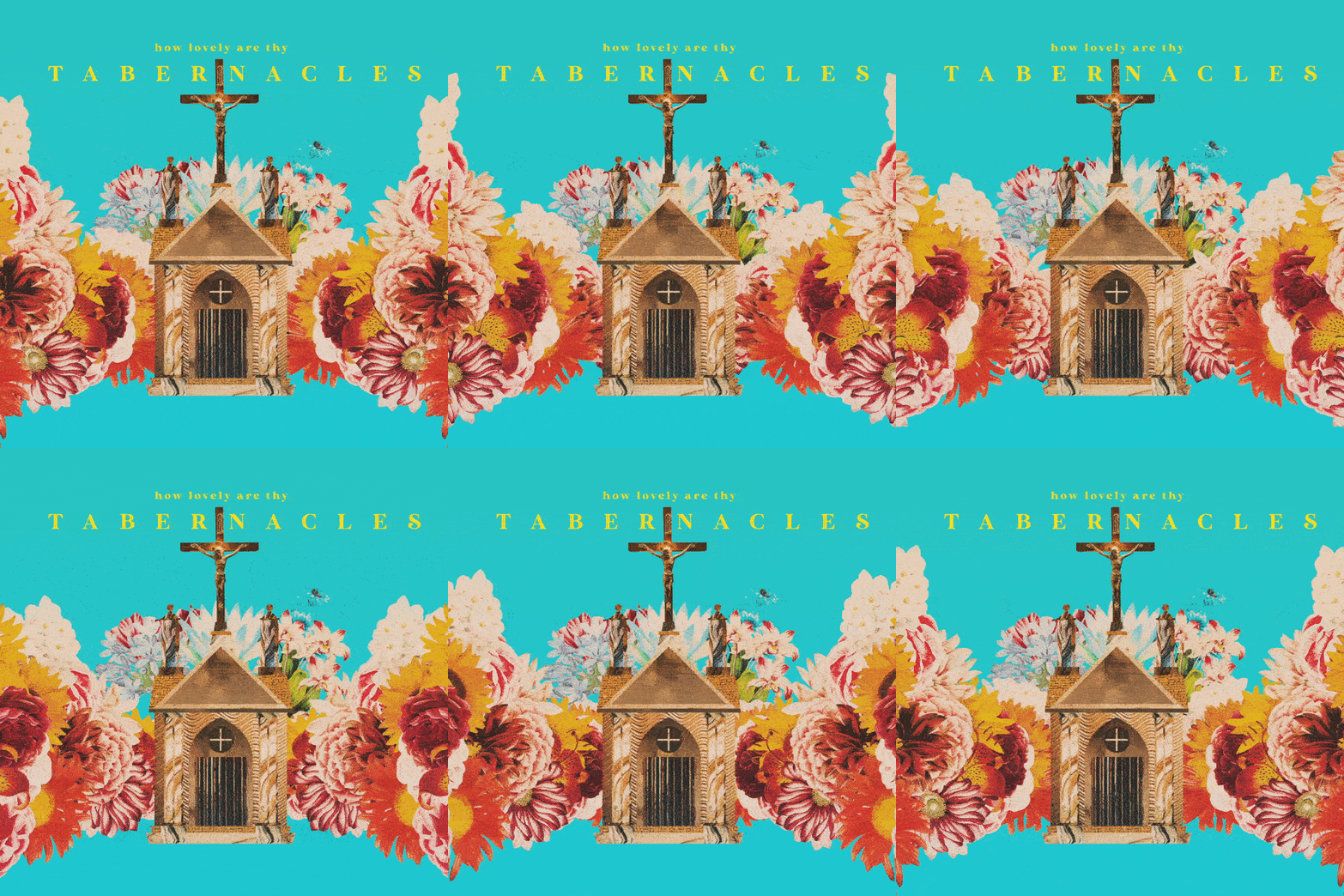
I started off by creating the shapes for the tabernacle and used various realistic textures (like marble, metal, gold, etc.) matted to those shapes to created the look of it. I added in a photo of a crucifix at the top to finish off that part of it.
I also found a bunch of vintage illustrations of flowers and cut them out in Photoshop and brought them into After Effects. I then simply animated the scale and position and rotation and offset them in time and overlapped them to make it look like they were issuing forth from the tabernacle.
Enjoy.
How lovely are thy tabernacles, O Lord of hosts!
(Psalm 83:2 DR)
View a higher quality version of this gif here: