

Glorious things are said of thee, O city of God. (Psalm 86:3 DR)
The inspiration of Scripture is such that the types found within the Old Testament are fulfilled in the New, and this creates (from our perspective) interlocking patterns that weave in and out of sacred Scripture to create a seamless and glorious tapestry from beginning to end.
One might perhaps detect something like this occurring in this Psalm, for the Psalmist began in verse 1 describing the foundations of Sion, then moved to the gates, and now in this passage speaks of the city as a whole, which seems an inversion of how one would normally speak; that is, going from the general (the city) to the specific (gates and foundations). St. Bellarmine and and St. Augustine both comment on this in various ways.
However, perhaps the reason for this inversion is that it is not an inversion at all, but rather a typologically mirrored image of the New Jerusalem as St. John describes in Apocalypse 21. For as he tells of that holy city descending from heaven, he inverts the order that the Psalmist uses:
And he took me up in spirit to a great and high mountain: and he shewed me the holy city Jerusalem coming down out of heaven from God, and it had a wall great and high, having twelve gates… And the wall of the city had twelve foundations, and in them, the twelve names of the twelve apostles of the Lamb. And he that spoke with me, had a measure of a reed of gold, to measure the city and the gates thereof, and the wall. (Apocalypse 21:10, 12, 14-15 DR).
Thus we can see a chiastic structure created here between this Psalm’s description of the holy city and St. John’s in the Apocalypse:
A. foundations (Psalm 86:1)
       B. gates (Psalm 86:2)
              C. city (Psalm 86:3)
              C.* city (Apocalypse 21:10)
       B.* gates (Apocalypse 21:12)
A.* foundations (Apocalypse 21:15)
As with all typologies, the type is surpassed, fulfilled and perfected in the reality that the type foreshadows, and—importantly—the reality is always greater than its type. This is why, for example, the Blessed Virgin Mary as the New Eve—which is a parallel to Christ as the New Adam—typologically sets forth the conditions for her Immaculate Conception. For if Eve was created without sin but then fell into sin, for the type to be fulfilled in Mary as the New Eve would necessitate (at a minimum) that she was also without sin, and instead of submitting to temptation as Eve did, instead submitted to God, undoing the damage that Eve had wrought.
In a similar manner the Church as the fulfilment of the type of the city of Jerusalem is itself a greater reality, which is why the Psalmist now proclaims that “glorious things are said of thee.” In speaking of the holy city of Jerusalem as a type, the Psalmist speaks of a temporal city which will one day give way to a greater reality, one that will not have its foundations made of stone or gates of metal, but rather will fill the whole earth. He also shows forth this he is speaking prophetically, for the glorious things “are” said of this city, implying that such will be a perpetual and permanent state. The physical city of Jerusalem, however, itself cannot be the ultimate object of the Psalmist’s vision, for it will eventually be destroyed:
“Very excellent things are said of you, thou city of God.” He was, as it were, contemplating that city of Jerusalem on earth: for consider what city he alludes to, of which certain very excellent things are spoken. Now the earthly city has been destroyed: after suffering the enemy’s rage, it fell to the earth; it is no longer what it was: it exhibited the emblem, and the shadow has passed away. (St. Augustine, Expositions on the Psalms, 86, 5.)
St. Paul succinctly applies this typological framework to the sacrifices of the Old Covenant compared to that of Christ, showing forth that the former were a presaging or shadow of the reality:
It is necessary therefore that the patterns of heavenly things should be cleansed with these: but the heavenly things themselves with better sacrifices than these. For Jesus is not entered into the holies made with hands, the patterns of the true: but into heaven itself, that he may appear now in the presence of God for us. Nor yet that he should offer himself often, as the high priest entereth into the holies, every year with the blood of others: For then he ought to have suffered often from the beginning of the world: but now once at the end of ages, he hath appeared for the destruction of sin, by the sacrifice of himself. And as it is appointed unto men once to die, and after this the judgment: So also Christ was offered once to exhaust the sins of many; the second time he shall appear without sin to them that expect him unto salvation. (Hebrews 10:23-28 DR)
In a similar manner St. John in the Apocalypse fills out the reality of the type found in this Psalm, for the earthly city of God gives way to and is perfected in the heavenly Jerusalem; the walls of the earthly city stretch up to heaven, the heavenly city comes down to earth. The “glorious things” that the Psalmist speaks of are found within the Church, the New Jerusalem, for it is the Body of Christ and God Himself dwells therein:
And I saw no temple therein. For the Lord God Almighty is the temple thereof, and the Lamb. And the city hath no need of the sun, nor of the moon, to shine in it. For the glory of God hath enlightened it, and the Lamb is the lamp thereof. (Apocalypse 21:22-23 DR)
The Church as a visible and sacramental reality is thus essential to the Christian faith, for not only did our Lord explicitly found her in her foundations and gates—the Apostles and their successors—but also dwells within her, for she is the Mystical Body of our Lord, and His glory is diffused throughout and she thus radiates with an effulgence of grace which she dispenses throughout the world.
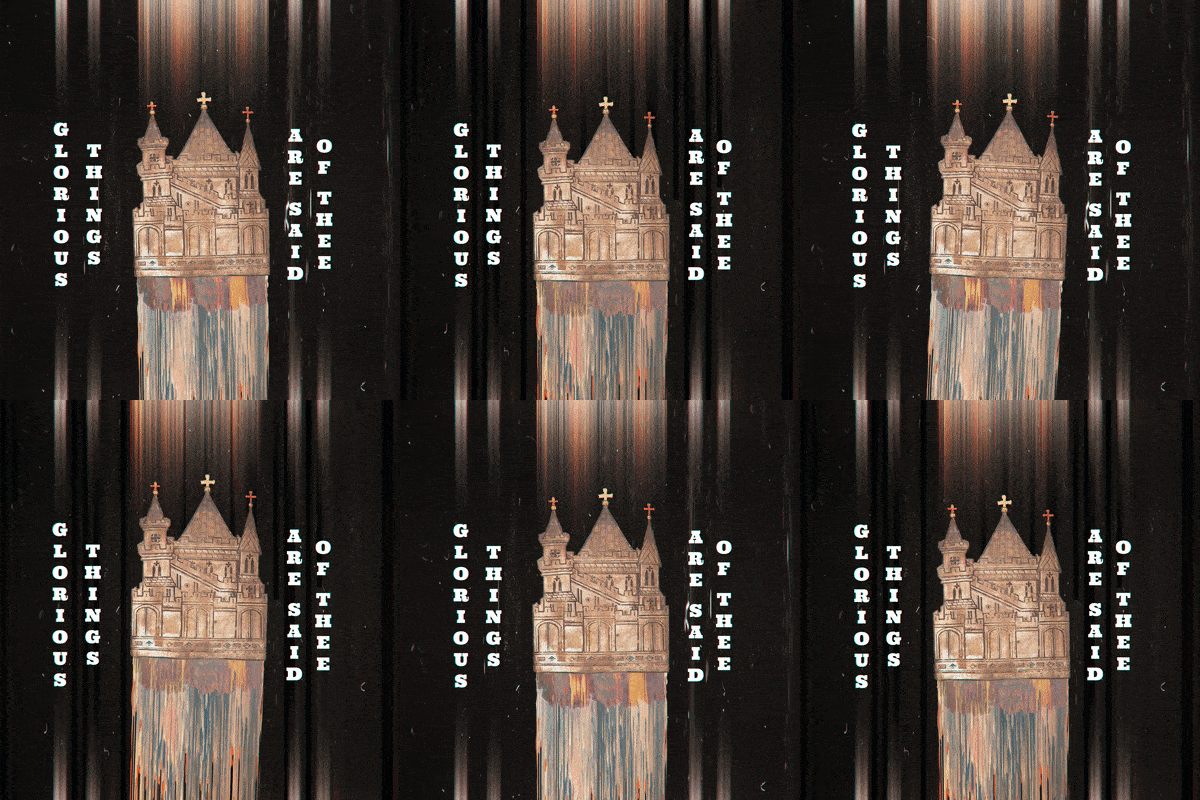
In this animation I found an excellent medieval miniature of the New Jerusalem from the Cloisters Apocalypse, which has some striking imagery. I wanted to have this city ascending, which I know is different from the vision of the Apocalypse, but I also wanted to capture somewhat of the typological movement between the type and its fulfillment.
I isolated it in Photoshop and precomped it in After Effects. I had also isolated the cloud it sits on an precomped that and then applied Stretch to it so that I could have the movement streaks coming from the cloud as if the city were rapidly ascending.
I found a good abstract background image and also applied Stretch to that to give it some parallax, although it’s pretty subtle, but hopefully enough to give the overall impression of quick movement.
I then parented the cloud to the city and animated the position and rotation of the city slightly and looped them and then offset them to give it a bit of movement wiggle from (I guess) wind resistance.
I then added in some noise and color correction and placed the text with a bit of wiggle hold on the position and rotation.
Enjoy.
Glorious things are said of thee, O city of God.
(Psalm 86:3 DR)
View a higher quality version of this gif here:


