

Shall not Sion say: This man and that man is born in her? and the Highest himself hath founded her. (Psalm 86:5 DR)
This rather enigmatic passage of Psalm 86 has admitted of various interpretations throughout the centuries, with some of the greatest luminaries coming to divergent albeit not contradictory readings.
After describing the glories of the city of God in that the nations are brought into her, the Psalmist now shifts to consider the founding of the holy city, which he ascribes to God Himself when he says “and the Highest Himself hath founded her.” This portion of the passage is the clearest, but the opening half contains some measure of obscurity, for in the various translations “Sion” is either the subject or the object.
The Vulgate has “nunquid Sion dicet,” which places Sion as the subject and thus the subject asking the question. The Douay-Rheims—following the Vulgate—therefore makes this an introductory phrase to the following question, rendering it as “Shall not Sion say:” In this respect the question is rhetorical, and the Douay-Rheims adds in the word “not” to make this clear in English.
The Old Latin has “Mater Sion dicit:” meaning “The Mother of Sion says:” The Septuagint diverges from this slightly with Μήτηρ Σιων, ἐρεῖ ἄνθρωπος, which other Old Latin variants render as “Mater (a) Sion, dicet homo,” which is read in English as “The mother of Sion will say, “a man,” or, “Sion, (my) mother, a man will say.” St. Augustine follows this latter reading.
Finally, St. Jerome’s Hebrew translation has “Ad Sion autem dicetur” which has Sion as the one to whom these things are said.
St. Augustine follows off of the previous passage by asking how Rahab and Babylon can come to find their dwelling in the holy city. They do so because they cease to be what they were and are conformed to her holiness and sanctification; they become like unto Jerusalem:
Listen now to a deep mystery. Rahab is there through Him, through whom also is Babylon, now no longer Babylon, but beginning to be Jerusalem. The daughter is divided against her mother, and will be among the members of that queen to whom is said, “Forget your own people, and your father's house, so shall the king have pleasure in your beauty.” For how could Babylon aspire to Jerusalem? How could Rahab reach those foundations? How could the Philistines, or Tyre, or the people of the Ethiopians? (St. Augustine, Expositions on the Psalms, 86, 6.)
This question is answered by the mystery of Christ and His mystical Body the Church:
Listen to this verse, “Sion, my mother, a man shall say.” There is then a man who says this: through whom all those I have mentioned make their approach. Who is this man? It tells if we hear, if we understand. It follows, as if a question had been raised, through whose aid Rahab, Babylon, the Philistines, Tyre, and the Morians, gained an entrance. Behold, through whom they come; “Sion, my mother, a man shall say; and a man was born in her, and Himself the Most High has founded her.” What, my brethren, can be clearer? Truly, because “very excellent things are spoken of you, thou city of God.” Lo, “Sion, O mother, a man shall say.” What man? “He who was born in her.” (St. Augustine, Expositions on the Psalms, 86, 6.)
This “man” who was born in her and the man who calls Sion his mother is thus the same “man,” which is then further expanded and expounded in the second half of the passage. The man who is born in her is then said to be the “Highest” Who has founded her, which St. Augustine sees as an unmistakable prophecy of the Incarnation of our Lord:
It is then the man who was born in her, and He Himself has founded her. Yet how can He be born in the city which He Himself founded? It had already been founded, that therein He might be born. Understand it thus, if you can. “Mother Sion, he shall say;” but it is “a man” that “shall say, Mother Sion; yea, a man was born in her:” and yet “he has founded her” (not a man, but), “the Most High.” As He created a mother of whom He would be born, so He founded a city in which He would be born. What hope is ours, brethren! On our behalf the Most High, who founded the city, addresses that city as a mother: and “He was born in her, and the Most High has founded her.” (St. Augustine, Expositions on the Psalms, 86, 6.)
In the Old Covenant Sion was city of David and the location of the temple of the Lord, and the Psalmist foresees that the One for Whom the temple was built is the founder of the city in which it resides. The kingly line of David was to be that from which the Messiah would come, and in the Incarnation our Lord takes flesh from that very royal line, creating the fulfillment of this prophecy. He was, after all, not born in the city of Sion but in Bethlehem. However, it is because the Church is the fulfillment of Sion that He is born in Sion, for all those types of the Old Covenant are accomplished in Him. He thus transfers and completes the type of the city of Sion to the Church through His Incarnation in His own Person, and the Church as His mystical Body and the true Sion is thus founded as He is “born in her.” Our Lord received His human substance from the Blessed Virgin, and the Church—of whom our Lady can be truly called Mother—receives its substance from our Lord through her union with Him, as branches to the vines (cf. John 15:5-8).
St. Jerome takes a slightly different approach to this passage, and spends some time—in his characteristically blunt manner—of critiquing the Septuagint’s rendering of this passage, in that he supposes it to have added a rho so as to make the reading of “Μήτηρ.” He supposes that the implication of a birth later in the passage led to such a rendering, and then proceeds to provide an interpretation based on this:
These are they who are born in the Church. They believe in the Church and begin life in the Church, for unless they have been baptized, they are not sons of the Church. They, indeed, who have been baptized in the Church call the Church “Mother.” (St. Jerome, Homily 18.)
The fascinating aspect of this interpretation is that it is probably the most straightforward reading of the Vulgate, and especially of how the Douay-Rheims renders it in English. Nor is it in any way contradictory to St. Augustine’s commentary, for those who come into the Church and are reborn in the waters of Baptism become sons of God, as St. John notes:
But as many as received him, he gave them power to be made the sons of God, to them that believe in his name. Who are born, not of blood, nor of the will of the flesh, nor of the will of man, but of God. (John 1:12-13 DR)
St. Jerome then moves on to what he considers the correct reading of the Hebrew:
Now let us turn to the Hebrew truth. “Shall not Sion say a man, and a man is born in her?” The true sense of the Hebrew is this: Who will be able to announce to Sion, who of men will be able to announce to her, that a man shall be born in her and shall be her Savior? In other words, no mere man has the power to announce to Sion that she will be saved in the man who will be born in her. “And a man is born in her.” Who is this man? “And he who has established her is the Most High Lord.” Let the Arians answer, for they say that the Father alone is the Highest. Behold, here it speaks of the Son and says: “And he who has established her is the Most High Lord.” The psalmist did not say, the Son of God who was in the beginning with the Father, but what did he say? “A man is born in her, and he who has established her is the Most High Lord.” If, moreover, He is said to be the Most High Lord, how much the more is He the Word of God? (St. Jerome, Homily 18.)
What is fascinating here is that St. Augustine and St. Jerome have slightly different readings of the text, yet come to essentially the same conclusion, albeit with mirrored perspectives. In St. Augustine’s reading, the Church is the one who proclaims the Incarnation of our Lord, whereas for St. Jerome our Lord proclaims this to the Church. And the truth is that they are both correct, for our Lord proclaimed Himself as the Truth to His apostles, and in turn gave them the authority and commission to proclaim that very same Truth to the nations.
Even the minority report reading that this pertains to the nations born in the Church falls within these interpretations, for their conversion is the end result of both the Incarnation and the proclamation of the Gospel by the Church. In this manner the tapestry of Scripture is intricately and beautifully woven in both clarity and obscurity, fulfilled in our Lord in Whom it all unites.
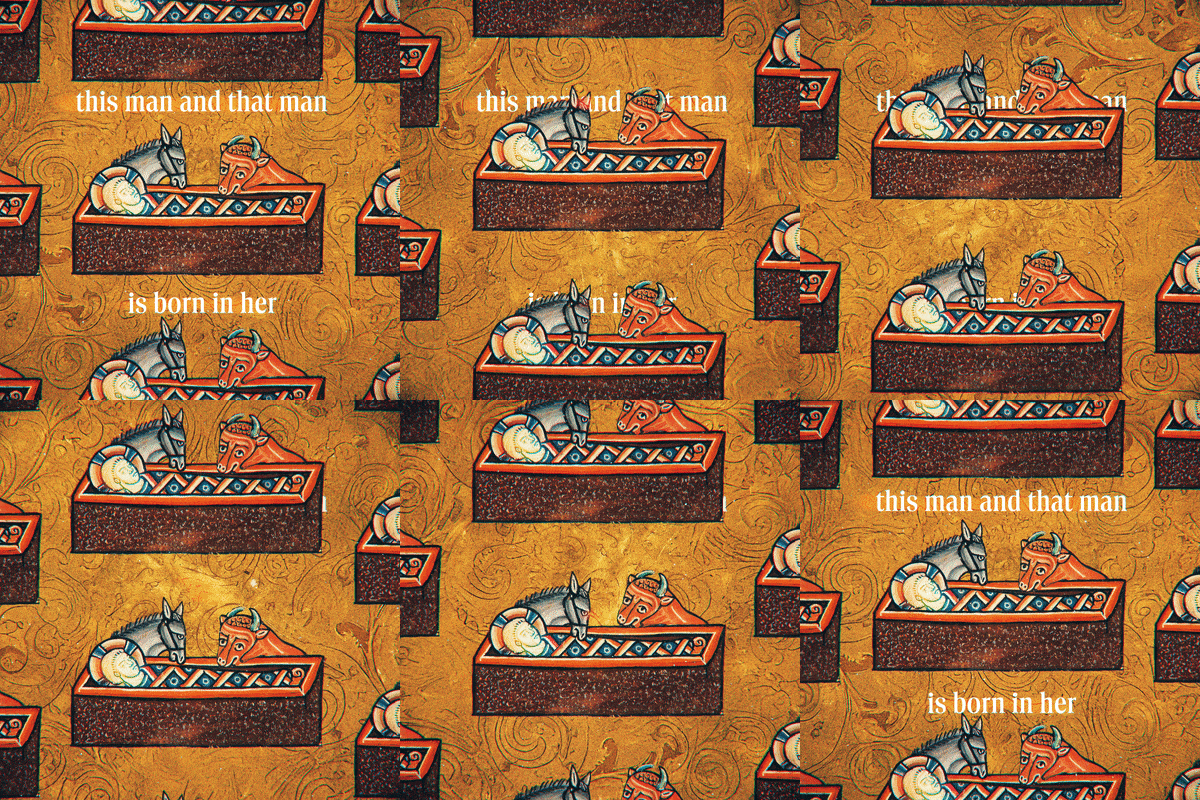
As I began this animation I didn’t yet have these various interpretations in mind, although I had read through St. Augustine’s. I found this medieval miniature of the nativity and thought that would fit well with his reading of this, but I also wanted to capture the intensification of the repetition of “this man” and “that man” as appears in the Douay-Rheims.
I isolated the image and brought it into After Effects and precomped it. I slightly animated the animals, although it’s probably hard to tell. I then used Motion Tile on that precomp to duplicate and animated the source point to loop. I then duplicated that and reversed the animation have them going in opposite directions.
I went back to the orginal image and grabbed some of the background and used Generative Fill to fill in some missing pixels and used it as a background for this, adding a simple rotation to it.
Enjoy.
Shall not Sion say: This man and that man is born in her? and the Highest himself hath founded her.
(Psalm 86:5 DR)
View a higher quality version of this gif here:


