

Psalm 90:1
turtles all the way down
The praise of a canticle for David. He that dwelleth in the aid of the most High, shall abide under the protection of the God of Jacob. (Psalm 90:1 DR)
In older forms of the Divine Office Psalm 90 was always the second Psalm of Compline, recited or sung every night. Following the revisions of Divino Afflatu it was reordered for Sundays and feasts of certain classes. And while there may have been good reasons for such revisions, one cannot help but note with regret that such a powerful Psalm was removed from such a regular encounter.
St. Augustine notes well the importance of this Psalm, and indirectly provides the logic for why it was fitting that it was recited every night in the Office:
This Psalm is that from which the Devil dared to tempt our Lord Jesus Christ: let us therefore attend to it, that thus armed, we may be enabled to resist the tempter, not presuming in ourselves, but in Him who before us was tempted, that we might not be overcome when tempted. Temptation to Him was not necessary: the temptation of Christ is our learning, but if we listen to His answers to the devil, in order that, when ourselves are tempted, we may answer in like manner, we are then entering through the gate, as you have heard it read in the Gospel. (St. Augustine, Expositions on the Psalms, 90, 1.)
From St. Augustine’s view this Psalm is a crucial weapon in overcoming temptation since it was the Psalm of choice from which the devil tried to tempt our Lord. The rationale, then, is that by carefully considering this Psalm—by working it into one’s life—we can more readily detect temptation and overcome it:
Thus then do thou, when you suffer the troubles of this world, which the devil, openly by men, or secretly, as in Job's case, inflicts; be courageous, be of long suffering; “you shall dwell under the defense of the Most High,” as this Psalm expresses it: for if you depart from the help of the Most High, without strength to aid yourself, you will fall. (ibid.)
The consistent repetition of this Psalm was thus a fitting place for this Psalm in Compline, set as the day draws to a close and one prepares to retire. It follows an examination of conscience and the Confiteor, in which we can take stock of the day and all our temptations and failings, followed by stirring up a genuine repentance. The positioning of Psalm 90 following these is providential to remind ourselves that we must remain under the protection of God, to continually implore his aid in the face of temptation. In this way the promises and petitions of this Psalm can become like a continual shield from the storm, a shelter that we carry with us continually:
To explain the words. “He,” no matter who he may be, rich or poor, learned or unlearned, patrician or plebeian, young or old, for “God is no respecter of persons,” but he is “rich to all that call upon him”—“that dwelleth,” to give us to understand that this liberal promise does not apply to those who put only a certain amount of trust in God, but that this trust must be continuous, constant, and firm, so that man may be said to dwell in God, through faith and confidence, and to carry it about with him, like a house, like a turtle, “in the aid,” for God’s aid is not like one of the strongholds of this world, to which people fly for defense, but consists in an invisible and most secret tower that can be found, and entered by faith alone. (St. Robert Bellarmine, A Commentary on the Book of the Psalms, 90, 1.)
I find the image of the turtle striking, in that while its shell is not a house in the literal sense, it does nevertheless carry a shelter with it wherever it goes. Without that shell it is entirely vulnerable to the elements, predators, etc., but when faced with danger does not have to run but rather can retreat into its shell to find protection.
It in this sense that St. Augustine invokes Christ’s temptation, for he did not flee from the devil, but rather met him on the field of battle and overcome him. Being God he was of course incapable of sin, but on the human level he was frail from fasting like any of us would be. Yet the scriptures so permeated his mind and heart that they served as a defense against temptation, even when that temptation was to twist the scriptures against him.
In a similar way we come to dwell in the aid of the Most High when we place our entire confidence in him, hoping in his protection. This confidence is not some naive or pietistic movement in which we neglect the ordinary means God has given us through secondary causes to face adversity; when temptation arises we should flee it if we are able. It is God’s work to bring us to that which we cannot avoid, but our normal course lies in escape. We thus pray and study the scriptures and avail ourselves of the sacraments as far as we are able, and entrust ourselves into God’s hands:
However, the expression in the Greek as well as the Latin conveys, that we must place the most entire confidence in God, but still we are not to neglect the ordinary means that man can avail himself of. The husbandman puts his trust in him who gives the rain from heaven, and makes his sun to rise, but in the meantime he will be sure to plough, to sow, and to reap, knowing that God helps those who help themselves. (ibid.)
This expression that God helps those who helps themselves has often been banalized into some kind of paean to individualism, but in St. Bellarmine’s use it is the natural complement of dwelling in the aid of the Most High. It no use to say one has confidence in God if one does not actually do the things that demonstrate that confidence, any more than one can say that one loves one’s spouse and yet never shows any form of kindness.
By the use of means such as meditating on the Psalms we come to have more confidence in God’s protection because we come to know him and his will more fully, even as we empty out our own self-will. And like the turtle we do not trust in our own fragile frame but entrust ourselves to the protection that w carry with us at all times, if only we will.
Jesus himself modeled this in his life by continually going off at night to pray; is it too much to assume that some of the prayer included Psalm 90?
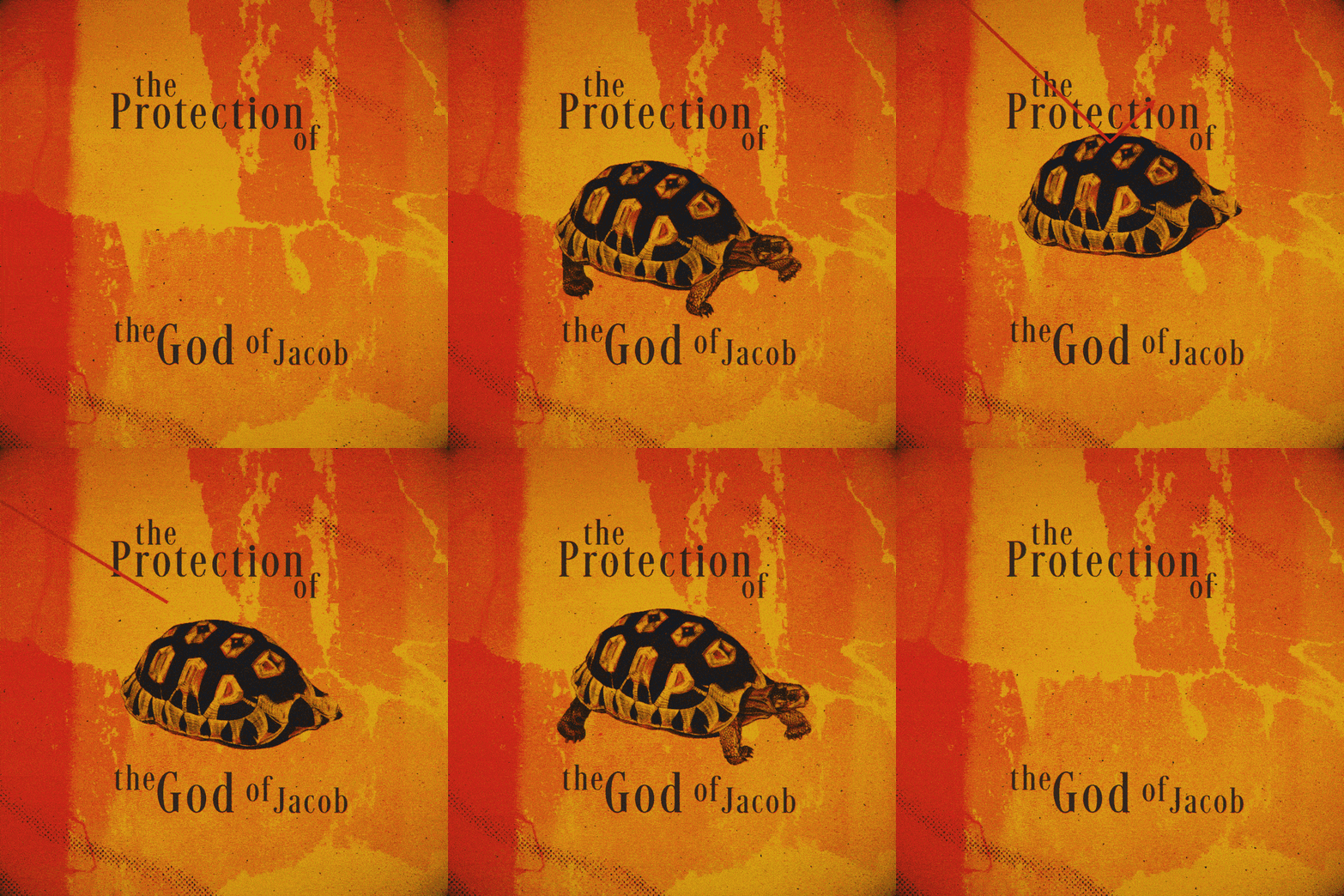
For this animation I was so struck by St. Bellarmine’s image of the turtle that I wanted to use that for the imagery.
There were many images of turtles to choose from, but this one from an 1872 zoological publication of the Testudo angulata was especially good and provided the angle and characteristics that I wanted for the animation. (As an aside, this turtle is classified as a land tortoise, now known as the Bowsprit Tortoise. Thus its shell tends to be thicker as it cannot as easily retreat into water. The males also have a protruding throat shield that they use when fighting other males.)
I cutout the tortoise in Photoshop and separated the legs and head into separate layers and then used the Content Aware Fill tool to replace some of the missing pixels.
In After Effects I composited all the pieces into a precomp and set anchor points at the joints so I could simulate leg movement. After the tortoise walks in I animated it to react to the incoming arrows, using a bit of anticipation with rh head and legs slightly extending and then pulling in. As they contract I then had the shell bounce to give the impression that the force of the contraction causes the upward movement. Finally I had the bounce effectively happen in reverse, but slightly adjusted the timing to make it appear that the extension of the limbs and heads causes this second bounce, and finished with a bit of overshoot to sell the inertia.
Enjoy.
The praise of a canticle for David. He that dwelleth in the aid of the most High, shall abide under the protection of the God of Jacob.
(Psalm 90:1 DR)
View a higher quality version of this gif here: