

Psalm 90:11
no good temptation
For he hath given his angels charge over thee; to keep thee in all thy ways. (Psalm 90:11 DR)
In keeping with the theme that St. Augustine noted at the beginning of this Psalm—namely, that it is the one with which the devil tempted our Lord—we finally come to the portion which found itself in the tempter’s mouth.
The context of this temptation is that Satan basically dares Jesus to prove himself by hurling himself off the top of the temple, the rationale being that if Jesus is truly the Son of God, then surely the angels will keep him from harm, either because of his inherent dignity or because he can command them to do so. The devil then quotes these words from Psalm 90:
[H]e hath given his angels charge over thee, and in their hands shall they bear thee up, lest perhaps thou dash thy foot against a stone. (Psalm 90:11 DR)
The diabolical aspect of this temptation is that the quotation from Scripture, for—after all—the words spoken are true. The Psalmist places his hope in the Lord, and this couplet is an explanation of that trust, that God’s providence even directs the angels to care for those who abide in him.
However, I’m not sure if there is any significance to this or if the writer of the Gospel is merely abbreviating the quotation, but the tempter’s words leave out a line: “to keep thee in all thy ways.” To be fair, within the parallelism of the poetics this is an amplification of the previous line. Nevertheless, I think there might be something to be drawn out of this.
The Psalmist has taken great care to describe the just and righteous man as abiding within the aid of the Most High. The theme that runs through this Psalm is that the righteous man who hopes and trusts in the Lord sticks close to God, he makes his habitation within the ways of God, so to speak, so that God’s ways become more and more identical with his own. In verse 9 he states that the Lord is his hope, with the reply being that such indicates that this man has made the Lord his refuge.
The implication here is that this state of trust and hope and refuge is to be within God’s will to walk in God’s ways. Thus, when the Psalmist states that the angels will keep thee in all thy ways, he is not referring to just anything the righteous man decides to do but rather those things which fall under the protection and refuge and aid of the Most High. In Proverbs this entire orientation of one’s life is described thusly:
Have confidence in the Lord with all thy heart, and lean not upon thy own prudence. In all thy ways think on him, and he will direct thy steps. (Proverbs 3:56 DR)
Thus, what the devil leaves out may actually be the proverbial devil in the details. Jesus as God could certainly have commanded the angels to catch him in a flying leap off the temple; even the devil knew this. In fact, his temptation seems to be predicated on it. Instead of Jesus’ identity being in who he is and his relation to the Father, the devil is trying to get him to prove it by means of parlor tricks, to step outside of the ways of God that the angels are promised to keep one in. Later on in the Gospel’s Jesus will rebuke the devil through Peter for a similar mindset in trying to misdirect him from God’s ways:
Go behind me, Satan, thou art a scandal unto me: because thou savourest not the things that are of God, but the things that are of men. (Matthew 16:23 DR)
The temptations we face are thus not only to do evil in diverse forms, but also sometimes to do what seems to be good but isn’t within God’s will. St. Augustine notes that the devil will often tempt Christians in this manner, for instead of living a holy sacramental life he might tempt them to extraordinary things, or to envy those who do such:
What if he tempt you in these words: If you were a Christian, you would do miracles, as many Christians have done? You, deceived by a wicked suggestion, would tempt the Lord your God, so as to say to Him, If I am a Christian, and am before Your eyes, and Thou dost account me at all in the number of Your own, let me also do something like the many works which Your Saints have done. You have tempted God, as if you were not a Christian, unless you did this. Many who desired such things have fallen. (St. Augustine, Expositions on the Psalms, 90, 15.)
He goes on to describe the fall of Simon Magus who desired what he perceived as the showy and flashy power of the laying on of hands so that people would receive the Holy Ghost. His crime wasn’t necessarily desiring to have others receive the Holy Ghost though him, but rather that he wanted that power for the sake of the power, and he wanted it on his terms, rather than God’s. To confer the Holy Ghost was a good thing, but he was tempted to it in an evil way and it led to his downfall.
In a similar way we can leave God’s ways and tempt God by envying the things he has chosen not to give us, by forming our identity not according to our adoption as sons of God but in terms of something else which may be good in and of itself but is not within the ways that God has chosen for us. God has many good works planned for us all, but he is the one to bring us to them, not ourselves.
There is a great scene in A Man for All Seasons where St. Thomas More has just learned from his daughter that they are going to administer the Oath of Supremacy regarding the King’s title vis-a-vis the Church. He queries her on the wording of the Oath, and she rebuffs him, stating that they both know what it’s going to say. But he replies that he needs to know the words to see if he can take it:
Listen, Meg, God made the angels to show Him splendor, as He made animals for innocence and plants for their simplicity. But Man He made to serve Him wittily, in the tangle of his mind. If He suffers us to come to such a case that there is no escaping, then we may stand to our tackle as best we can, and, yes, Meg, then we can clamor like champions, if we have the spittle for it. But it's God’s part, not our own, to bring ourselves to such a pass. Our natural business lies in escaping. If I can take the oath, I will. (A Man for All Seasons.)
He would eventually discover she was correct, but his point remains. He could look up to martyrs of old and desire to be in their company, but it was God’s part and not his own to bring about such a state. Similarly, there are many saints from the history of the Church who are worthy of emulation and have done great things and whom we should imitate, but we cannot allow spiritual pride to tempt us beyond where God desires to bring us.
The goal of the spiritual life lies in attaining to God himself, not in comparison with our fellow travelers. God pours out his gifts and blessings as he will, and it is our part to humbly receive them and work with all our hearts to make use of them, as Jesus commands in the parable of the talents. Our part is not to clamor over who is given more to work with, but to realize that all is a gift, and thus we must both freely receive and freely give. It is God’s work in us to perfect us as he will, and in our cooperation we stay within his ways, and thus continue to abide under the aid of the Most High and can rebuff the temptations of the devil, even when his forked tongue quotes from the Psalms.
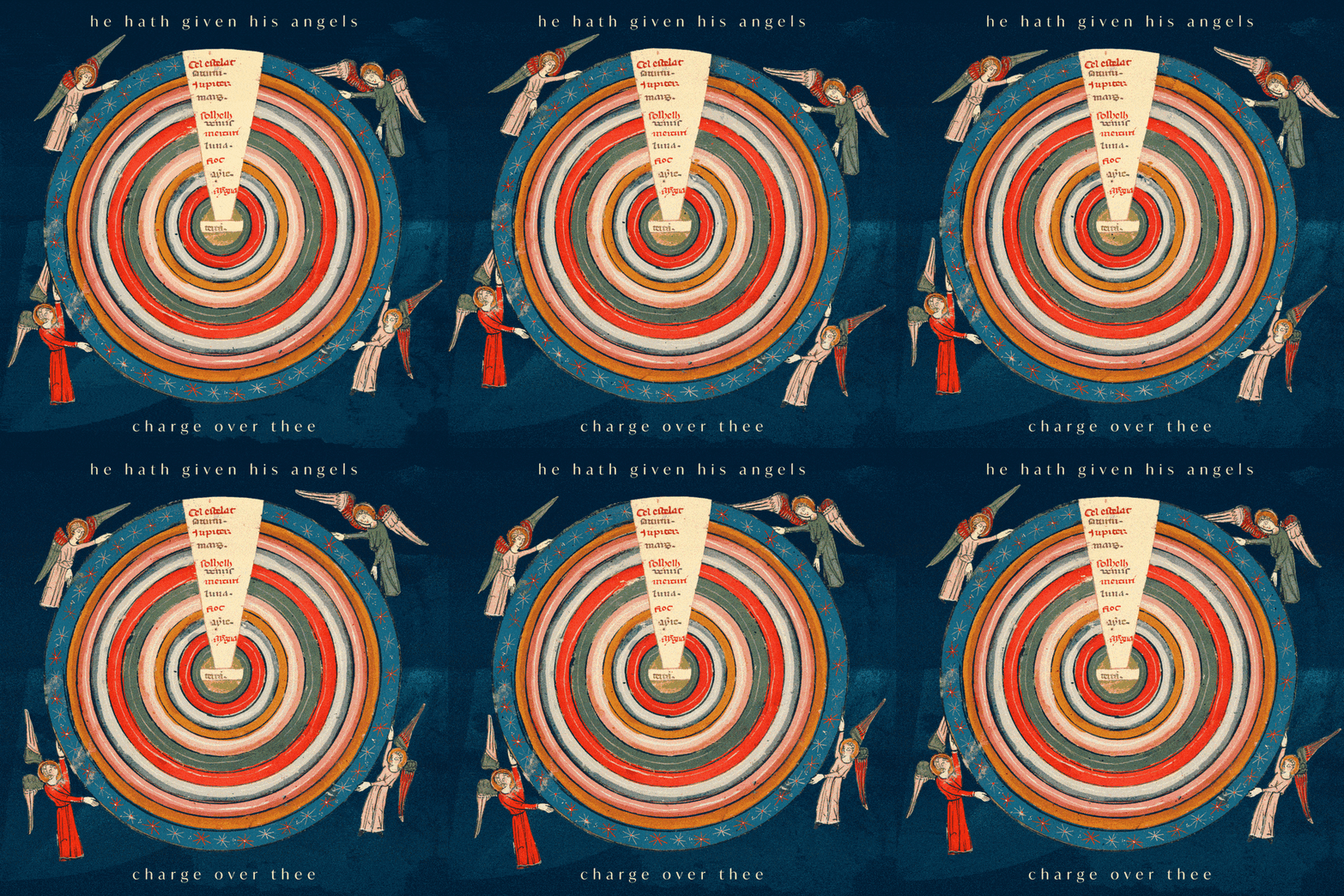
In this animation I wanted to focus on the angels and their administration over creation. I found this wonderful image from the Breviari d'Amor, a 14th century manuscript created by Matfre Ermengaud di Béziers.
I started by cutting out and isolating all the angels from the celestial discs, as well as isolating the wings so I could later animate them.
Next I isolated each disc of the disc wheel so that I could animate the rotation of each individually. This required a lot of back filling in pixels for which I used bot the Context Aware Fill and the new Generative Fill, depending on the section.
With that completed I brought all the pieces into After Effects and recomposited them together, animating the rotation of each disc at the same rate. I applied the loopOut() expression to each rotation and then offset the layers so that the rotations happen at different times, almost like the force of the outer circle rotating has a delay on the inner circles doing so.
I also animated the angels wings for a slight flapping and attached the angels and their wings to the outer disc so it would appear as if they were controlling it. A lot of work on the front end for this and then it came together pretty simply at the end, but I liked how it turned out.
Enjoy.
For he hath given his angels charge over thee; to keep thee in all thy ways.
(Psalm 90:11 DR)
View a higher quality version of this gif here: