

Psalm 90:6
the noonday devil
Of the arrow that flieth in the day, of the business that walketh about in the dark: of invasion, or of the noonday devil. (Psalm 90:6 DR)
For many of the early monastics, the retreat from the world was not a retreat at all but rather a mobilization into an ever more intense battle with the demonic. For while the normal assaults of the world were not as hard-pressing, this was compensated for, so to speak, by the interior war of perfecting oneself, which inevitably entailed engaging in combat with the demonic.
It was thus common for the monastic to experience a sort of spiritual sloth known as acedia or more colloquially as the noon-day devil. It received this vivid description because this sort of torpor was prone to overcome the monk around the middle of the day under the blazing height of the sun, between the rigors of the morning office and the future struggle of the nocturnal vigil. It was then that a sense of sluggishness and carelessness could often show its face. John Cassian describes the genesis of the noon-day devil as such:
And when this has taken possession of some unhappy soul, it produces dislike of the place, disgust with the cell, and disdain and contempt of the brethren who dwell with him or at a little distance, as if they were careless or unspiritual. It also makes the man lazy and sluggish about all manner of work which has to be done within the enclosure of his dormitory. (John Cassian, Institutes, Book X, 2.)
What acedia develops within the soul is a sort of spiritual malaise, in which those good fruits borne through prayer and penance are seen as hopelessly out of reach, and all the striving one has done is pointless. It causes one to despair of making any spiritual progress, and causes one to look at one’s vocation as a waste of time. There is discontent and a general lack of hope, for contentment and fulfillment seems to lie elsewhere.
The danger in acedia is that is can cause us to neglect perseverance in our duties, in our vocation, in prayer and in penance because it causes us to think that these bring no benefit, and often employs a deception that engaging in some other activity—even an ostensibly good one—would be more spiritually fruitful. This is not to say that everyone is called to the same sort of life or vocation, but rather that one should not abandon that to which God has called him. But the life of following after God and his will is fraught with struggle and suffering, and should not be abandoned so easily.
Worse still, the noonday devil will often tempt one with other good things so as to neglect progressing in the spiritual life, as Cassian notes:
Then the disease suggests that he ought to show courteous and friendly hospitalities to the brethren, and pay visits to the sick, whether near at hand or far off. He talks too about some dutiful and religious offices; that those kinsfolk ought to be inquired after, and that he ought to go and see them oftener; that it would be a real work of piety to go more frequently to visit that religious woman, devoted to the service of God, who is deprived of all support of kindred; and that it would be a most excellent thing to get what is needful for her who is neglected and despised by her own kinsfolk; and that he ought piously to devote his time to these things instead of staying uselessly and with no profit in his cell. (ibid.)
What is fascinating here is that everything Cassian describes here would be—in another circumstance—charitable things to do that might otherwise be profitable for one’s spiritual growth. And Cassian is not saying that these are wrong things, even for a monastic to do. Rather, the deception is that these pious works are being used as an excuse to avoid the struggle of prayer and penance, and thus are used by the devil as a temptation to spiritual sloth.
And thus the person in this situation is trying to attain the same virtue at bargain-price as it were through a sort of counterfeit charity. He is not doing good works for the sake of the works themselves or out of charity for his neighbor, but rather to attain a good for himself without the cost that it would require.
Seen in this manner, Cassian’s description is quite apropos to the world removed from the monastic life, as we are all tempted in one way or another to a sort of cheap virtue in which we attempt to score the proverbial brownie-points with God by doing good not because we desire good or desire the good of our neighbor but because we desire to avoid the suffering that true spiritual growth requires. This ersatz spiritual growth is the deception of acedia and why the noonday devil prowls not only the deserts of the monastic but also within the home and heart of every one.
For Cassian one of the main remedies for acedia is manual labor coupled with perseverance in prayer. Labor has a way of keeping one’s mind from fixating on thoughts of what could be or might have been and focuses the intellect on the task before it. The very basic need to provide for oneself also has a salutary benefit, which is why Cassian is wont to quote St. Paul’s admonition that “if any man will not work, neither let him eat.” (2 Thessalonians 3:10 DR) It is actually quite fascinating how often St. Paul talks about working, avoiding idleness, etc., all of which Cassian quotes. He also relates the story of a holy abbot who would burn his entire year’s worth of work so he would have work to do in the future:
And when [Abbot Paul’s] cave had been filled with a whole year's work, each year he would burn with fire that at which he had so diligently laboured: thus proving that without manual labour a monk cannot stop in a place nor rise to the heights of perfection: so that, though the need for food did not require this to be done, yet he performed it simply for the sake of purifying his heart, and strengthening his thoughts, and persisting in his cell, and gaining a victory over accidie and driving it away. (John Cassian, Institutes, Book X, 24.)
The Psalmist is the previous verse spoke of the trust the righteous man has in the Lord, how if he dwells in the aid of the Most High he will be delivered from the evil one and be compassed about by the shield of the Lord’s truth. The external enemies are put to flight, but even those internal assaults can be repelled, including the noon-day devil, and thus the man that trusts in the Lord needn’t fear.
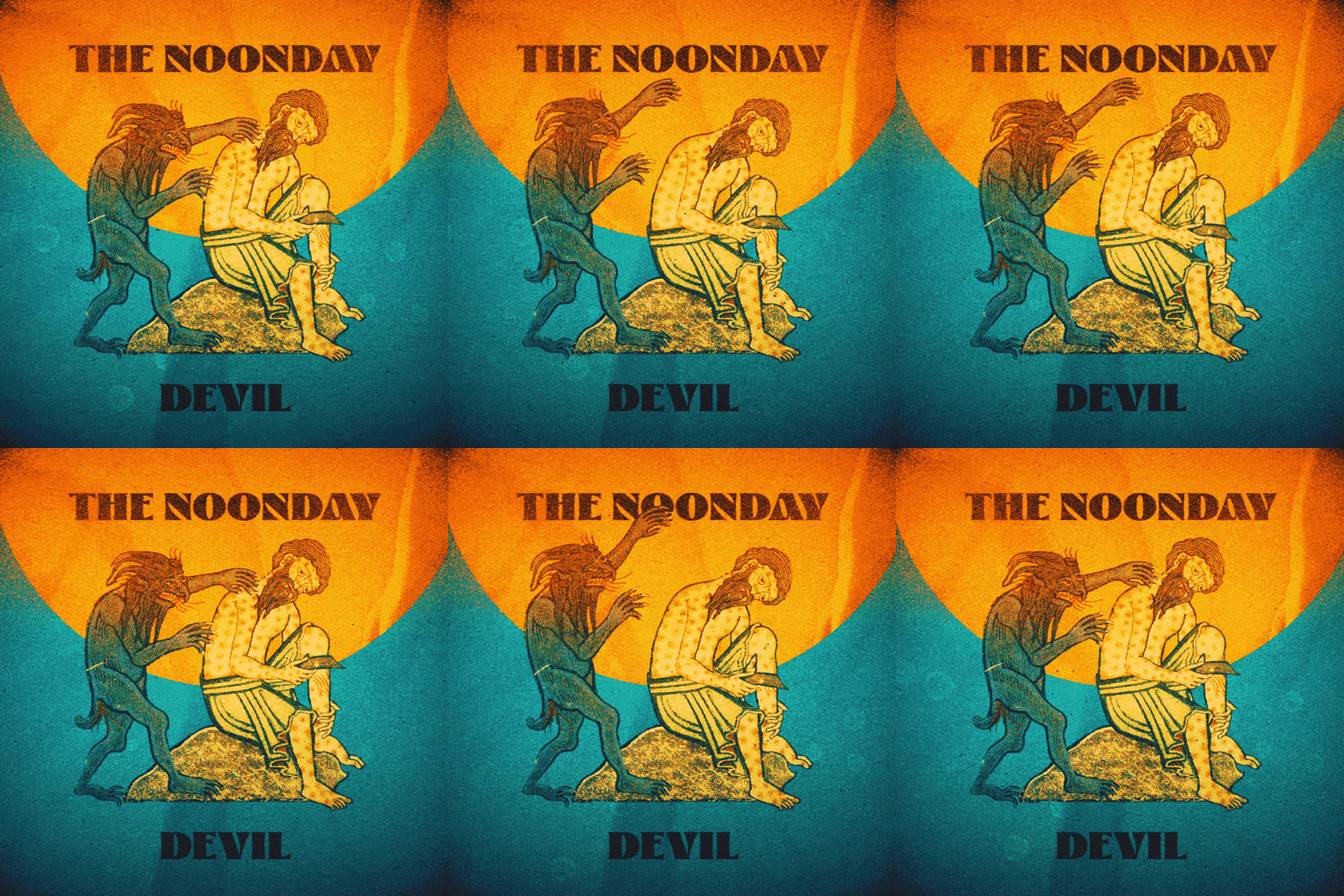
For this animation I found a great medieval miniature of the temptation of Job, in which Job is being literally afflicted by the devil. I thought it would serve as a nice illustration of the noon-day devil as I would imagine Job was beset by the temptation of acedia yet overcame it.
I cut out the figures in Photoshop and brought them into After Effects and pre-comped each one individually. In Photoshop I had also isolated Job’s foreground arm with the pottery shard so that I could animate apart from the rest of his body.
I rigged up each character using the Puppet Tool and used the handy PuppetTools 3 to link the pins to Nulls to make them easier to animate. I then did some simple position and rotation animations and offset them in time so that it feels a bit like Job’s scraping action follows the scraping motion of the devil on his back.
I added in the big sun in the background for the noonday aspect of it, which I guess is kind of on the nose, but sometimes that’s the best way to approach things.
Enjoy.
Of the arrow that flieth in the day, of the business that walketh about in the dark:
of invasion, or of the noonday devil.
(Psalm 90:6 DR)
View a higher quality version of this gif here: