

Psalm 90:8
stand fast a little
But thou shalt consider with thy eyes: and shalt see the reward of the wicked. (Psalm 90:8 DR)
A common theme in many Psalms is this seeming disjunction between wickedness of evil men and the lack of punishment they receive. This lament it taken up poignantly in Psalm 72, where the Psalmist sees no retribution for the wicked and thus no vindication for the righteous:
But my feet were almost moved; my steps had well nigh slipped. Because I had a zeal on occasion of the wicked, seeing the prosperity of sinners. For there is no regard to their death, nor is there strength in their stripes… And I said: Then have I in vain justified my heart, and washed my hands among the innocent. And I have been scourged all the day; and my chastisement hath been in the mornings. (Psalm 72:2-4, 13-14 DR)
The varying fortunes of this world can lead one to believe that there is no value in pursuing righteousness or justice, that all one’s efforts at holiness have no reward but are, as the Psalmist says, in vain. For we often see that those who are less concerned with doing what is right very often attain great wealth or positions of power or influence. There is nothing new under the sun, and this can cause the righteous to take their eyes off of the Lord and affix them to this world, in which case the scales of justice seem to be perpetually tilted towards iniquity.
In the fine movie A Man for All Seasons, St. Thomas More is in prison and is visited by his daughter Margaret who has sworn to try and convince him to take the Oath of Supremacy. She argues that if the State were half-good, he would already be rewarded for his valor and conviction and raised high. But since the State is not so and it isn’t his fault, for him to capitulate says everything about the State and nothing about him or his convictions, and thus he should take the Oath in good conscience or else he opts to be a “hero.” He notes this is a neat argument but lays bare its fallacy:
If we lived in a state where virtue was profitable, common sense would make us saintly. But since we see that avarice, anger, pride, and stupidity commonly profit far beyond charity, modesty, justice, and thought, perhaps we must stand fast a little - even at the risk of being heroes. (A Man for All Seasons)
For both More and for the Psalmist the reality of the success of the wicked is a plain fact of life, and can be vexing if not placed within its proper perspective. After St. Thomas makes his argument, his daughter sees the truth of it and is left only with an emotional appeal:
But in reason! Haven't you done as much as God can reasonably want? (ibid.)
To which St. Thomas replies:
Well, finally, it isn't a matter of reason. Finally, it's a matter of love. (ibid.)
As he approached his end St. Thomas understood that all the arguments and intellectual gymnastics that one can perform (and often must—he was, after all, a lawyer) will necessarily fall flat before the bare reality of one’s love for God, which places all things into their proper order and context. To love the Lord with all one’s heart entails an abandonment to his will, a confidence that in the end he will in justice settle all accounts and bring everything right. The righteous will see their vindication as they attain their heart’s intent, which is found in the infinite heart of God.
The Psalmist—after lamenting the success of the wicked—comes to his senses as it were and remembers his hope:
If I said: I will speak thus; behold I should condemn the generation of thy children. I studied that I might know this thing, it is a labour in my sight: Until I go into the sanctuary of God, and understand concerning their last ends… For what have I in heaven? and besides thee what do I desire upon earth? For thee my flesh and my heart hath fainted away: thou art the God of my heart, and the God that is my portion for ever. (Psalm 72:15-17, 25-26 DR)
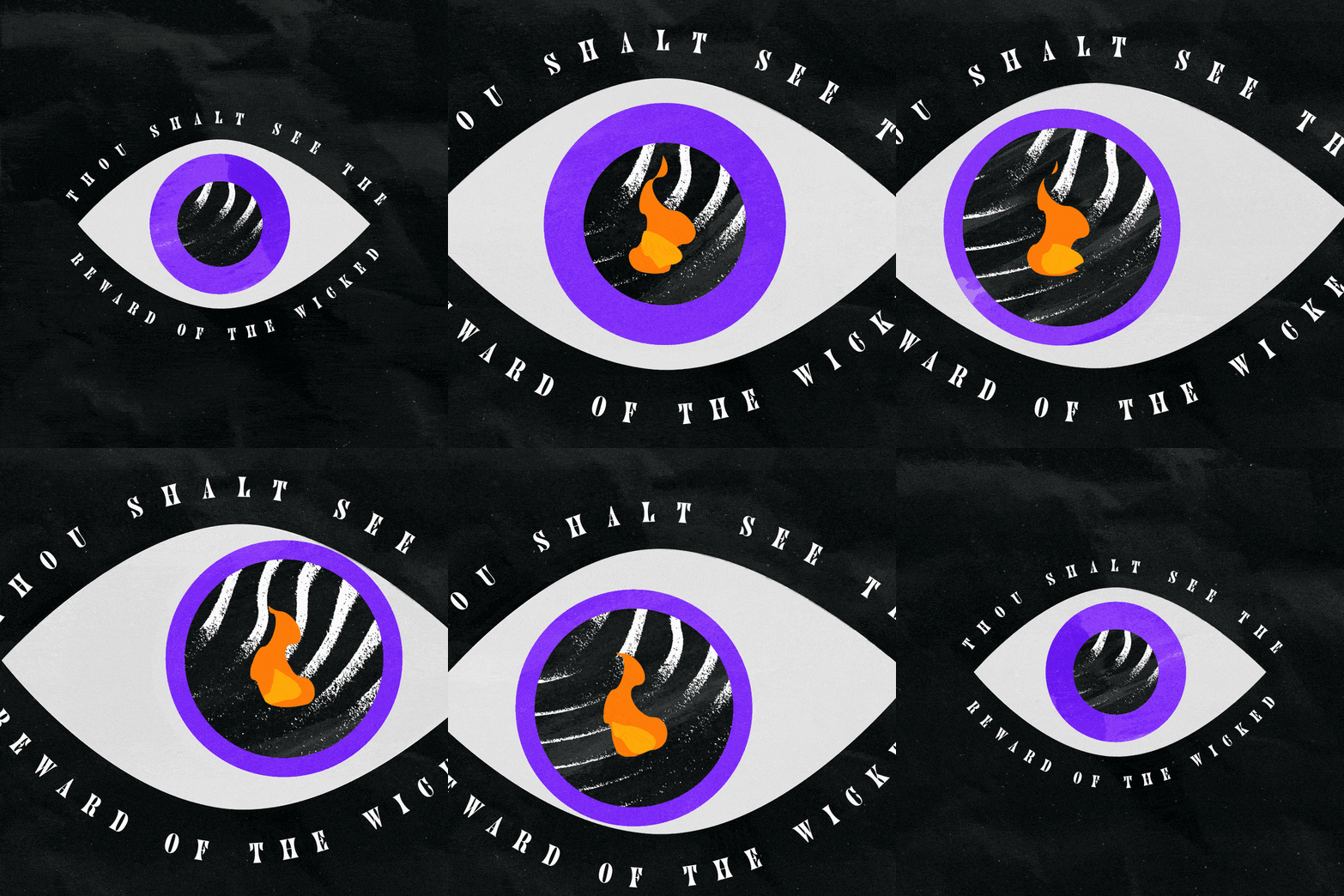
This animation is perhaps a bit more on the nose, so to speak, even though it uses a big eye. That’s a bad joke. Anyway, I was considering the line about seeing the reward of the wicked, and thought that this approach would work pretty well to have a reflection of destruction and fire in an eye.
I created the eye layers in Illustrator and used Overlord to bring them into After Effects, and then applied some various textures to the layers, using the layers as Track Mattes for those textures.
The flame was created using a few shape layers and some mattes. I applied Wave Warp to a base shape layer and then duplicated the shape layer, adjusting the Wave Warp effect and using that layer as an inverted track matte for the base layer so that it adds in some variation. I did this a few times to get more variation and make the flame appear a bit more organic and random in its movement. I could have made this loop, but since I was going to intentionally have the eye blink to reveal it, it fortunately wasn’t necessary which gave me more flexibility in the design and parameters.
The remainder was some basic scaling and rotation on the eye and offset scaling on the background to give the scene a tiny bit of parallax for visual interest, even though there wasn’t any difference in Z depth. Sometimes you can fake it with offset scaling, which is often easier to work with for simple scenes.
Enjoy.
But thou shalt consider with thy eyes: and shalt see the reward of the wicked.
(Psalm 90:8 DR)
View a higher quality version of this gif here: