

Psalm 9:1
everyone loves a good mystery
Unto the end, for the hidden things of the Son. A psalm for David. (Psalm 9:1 DR)
I have always greatly enjoyed almost anything within what might be generally called the “mystery” genre. Whether reading and re-reading Sherlock Holmes or video games based on Hercule Poirot mysteries; even things like escape rooms and other such puzzles—there is something about the process of searching out the solution to something that at present doesn’t have a solution that is very satisfying.
And while this might not manifest itself in those particular ways, searching out mysteries is hardwired into our being on some level by means of our rationality. For though we are finite beings, our minds are capable of at least recognizing infinite things and of certainly laying hold of universals, by which we are able to reason about the world around us.
Yet even we ourselves are on some level a mystery to ourselves, and while philosophy is not in the mystery genre per se, the discipline is prompted by trying to makes sense of existence, to bring the universe into a coherent whole where all the pieces fit together.
As this Psalm begins the Psalmist ascribes this Psalm unto the end, which St. Augustine notes always refers to Christ:
What is said, “To the end,” always ought to be understood of Christ. For “Christ is the end of the law for righteousness to every one that believes.” [Romans 10:4] But The End He is called, not because He consumes, but because He perfects. (St. Augustine, Expositions on the Psalms, 45, 1.)
This end is then further explicated by means of the hidden things of the Son, which St. Augustine also applies directly to our Lord:
This Psalm is then sung for the hidden things of the only-begotten Son of God. For the Lord Himself too, when, without addition, He uses the word Son, would have Himself, the Only-begotten to be understood; as where He says, “If the Son shall make you free, then shall you be free indeed.” [John 8:36] For He said not, the Son of God; but in saying merely, Son, He gives us to understand whose Son it is. (St. Augustine, Expositions on the Psalms, 45, 1.)
But since this is a mystery of sorts, the real question is—what are the hidden things of the Son? The first obvious implication is that if they are truly hidden, then they by definition are not immediately obvious or known. There is thus required either a searching out or a revealing of the mystery. The interpretive key is in the phrase unto the end, for our Lord Jesus Christ becomes the means by which the mysteries of God are revealed unto humanity:
The mystery which hath been hidden from ages and generations, but now is manifested to his saints, to whom God would make known the riches of the glory of this mystery among the Gentiles, which is Christ, in you the hope of glory. (Colossians 1:26-27 DR)
However, unlike Hercule Poirot or Sherlock Holmes who would reveal the solution to the mystery externally to it, Christ is both Himself the mystery and the One who reveals it, as St. Paul proclaims:
God, who, at sundry times and in divers manners, spoke in times past to the fathers by the prophets, last of all, in these days hath spoken to us by his Son, whom he hath appointed heir of all things, by whom also he made the world. Who being the brightness of his glory, and the figure of his substance, and upholding all things by the word of his power, making purgation of sins, sitteth on the right hand of the majesty on high. (Hebrews 1:1-3 DR)
It is thus the Incarnation which is the means by which the mystery of God is revealed to mankind. St. Paul in his epistle to the Colossians speaks of this mystery being made known among the Gentiles, which occurred because of the rejection of our Lord by His own people (cf. John 1:10-11; Romans 11:25). The universality of God’s plan of salvation for all humankind was foretold by the prophets and made manifest by our Lord and brought to fulfillment in His mystical Body the Church:
For you are all the children of God, by faith in Christ Jesus. For as many of you as have been baptized in Christ have put on Christ. There is neither Jew nor Greek: there is neither bond nor free: there is neither male nor female. For you are all one in Christ Jesus. And if you be Christ's, then are you the seed of Abraham, heirs according to the promise. (Galatians 3:26-29 DR)
There is a further spiritual sense which St. Augustine develops, in that the judgment on God’s people for their disbelief in our Lord (and the subsequent grafting of the Gentiles—cf. Romans 11:11-24) corresponds spiritually to two judgements: that which is hidden and that which is manifest:
The hidden judgment accordingly is the pain, by which now each man is either exercised to purification, or warned to conversion, or if he despise the calling and discipline of God, is blinded unto damnation. But the manifest judgment is that in which the Lord, at His coming, will judge the quick and the dead, all men confessing that it is He by whom both rewards shall be assigned to the good, and punishments to the evil. (St. Augustine, Expositions on the Psalms, 45, 1.)
This hidden judgment—by which we are convicted of sin and brought to repentance—vouchsafes us, as it were, against the final manifest judgment, when all that is hidden will be revealed. Our Lord’s Incarnation—which is the revelation of the hidden things of the Son— was explicitly to free us from our sin, as St. John declares:
He that committeth sin is of the devil: for the devil sinneth from the beginning. For this purpose, the Son of God appeared, that he might destroy the works of the devil. (1 John 3:8 DR)
In the Proverbs we read that “It is the glory of God to conceal the word, and the glory of kings to search out the speech” (Proverbs 25:2 DR). We must therefore seek out the hidden things of the Son—Who is that very hidden Word (cf. John 1:1)—that by uniting ourselves to His mystical Body through faith and the grace of the sacraments we might be taken up into that great mystery which He has revealed unto us: freedom from sin and life eternal in Him:
And we know that the Son of God is come: and he hath given us understanding that we may know the true God, and may be in his true Son. This is the true God and life eternal. (1 John 5:20 DR)
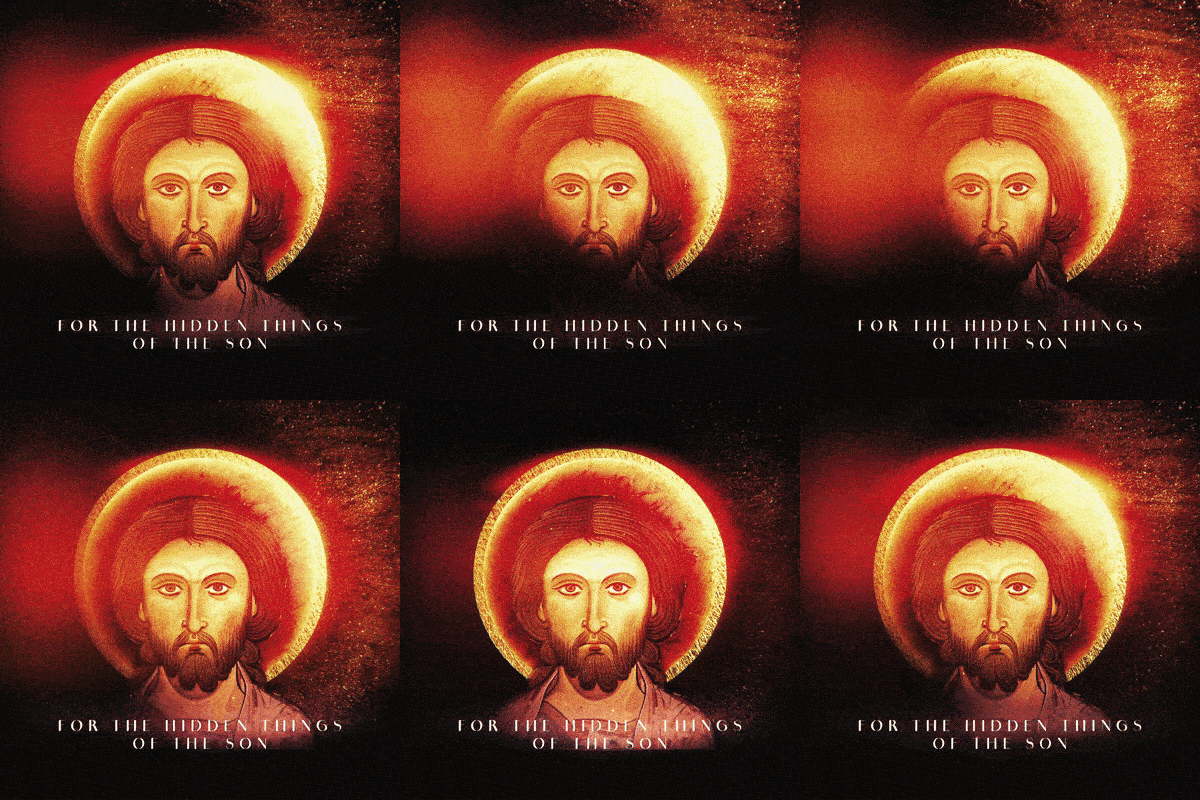
For this animation I found this striking miniature from an early to mid 13th century medieval Psalterium Feriatum, possibly from the monastery at Hildesheim.
In Photoshop I isolated the face and brought the layer into After Effects. I drew a couple ellipses and used them as Mattes for some gold textures which I animated using loopFlow. I then precomped all those layers and made it a 3D layer and added in a light so I could get some dramatic lighting in keeping with the hidden theme. I also added Shadow Studio 3 to the layer and linked the source of the shadow to the light so the shadows would follow the movement of the light, to which I added a looping wiggle expression because of efficiency laziness.
I then added in some glows and color correction to complement to dramatic lighting, as well as some light particles for a bit of depth.
Enjoy.
Unto the end, for the hidden things of the Son. A psalm for David.
(Psalm 9:1 DR)
View a higher quality version of this gif here: