

Psalm 9:10
leaving it all behind
And the Lord is become a refuge for the poor: a helper in due time in tribulation. (Psalm 9:10 DR)
Perhaps nothing elicits such a sense of vulnerability as when a situation arises in which one’s resources are insufficient to meet its challenges. This paucity of sufficiency can quickly reveal just how fragile this life is and how close the edge we often are, despite our protestations of self-sufficiency.
The Psalmist thus dovetails from the equitable judgment of God to His being a refuge for the poor and those in tribulation. In the ancient world—and also sadly today—there was often not equitable justice for the rich and the poor, which allowed the rich to take advantage of the poor, often in horrific ways. A judge should adjudicate between parties based on the law rather than on their class or wealth or other such considerations, but in this vale of tears just judges are hard to come by.
This is why the Psalmist does not place his hope in earthly judges, but in the Heavenly Judge. The Lord is a refuge (refugium) for the poor, meaning a place where they can find safety. God becomes, as it were, their patron or protector.
In the Law of Moses (cf. Numbers 35:6-34) were set aside cities of refuge where fugitives who had accidentally caused someone’s death could flee to find refuge from the revenge of the person’s family. By fleeing to one of these cities they were guaranteed a trial, and—if found not guilty—were offered protection as long as they stayed in the city. After the death of the high priest—which acted as a sort of statute of limitations—they were free to return to their home. Curiously, this later gave rise to the tradition (at least as stated in the Mishnah) that the mother of the High Priest would provide provisions to the refugee to induce him to not pray for the death of her son:
Therefore, the mothers of High Priests would provide those exiled to cities of refuge with sustenance and garments so that they would not pray that their sons would die. The more comfortable their lives in the city of refuge, the less urgency they would feel to leave, and the less likely it would be that they would pray for the death of the High Priests. (Mishnah Makkot 2.6)
Our Lord fulfills the type of these cities of refuge. In the Scriptures the devil is called the accuser (cf. Apocalypse 12:10), who accuses us before God (cf. Job 1:9-11). However, the Lord is our protector and refuge from this accuser who is also a liar and a murderer. As we flee to our Lord as a city of refuge and remain in Him we are kept from our enemy the devil who prowls about seeking to devour us (cf. 1 Peter 5:8). But even further the death of the High Priest in the city of refuge is transfigured in our Great High Priest whose death frees us from the guilt of sin and allows us to return to our home, which is the eternal city of our God. We are no longer subject to sin but made citizens of heaven.
In this world we will have troubles and persecutions and distress—such is the lot of us, poor banished children of Eve. But these evils can themselves be transfigured and turned to good, and our poverty made great richness, if we cleave to the Lord and find our refuge in Him:
Whatsoever be the persecutions of that enemy, who has been turned behind, what harm shall he do to them whose refuge the Lord has become? But this will be, if in this world, in which that one has an office of power, they shall choose to be poor, by loving nothing which either here leaves a man while he lives and loves, or is left by him when he dies. For to such a poor man has the Lord become a refuge, “an Helper in due season, in tribulation.” (St. Augustine, Expositions on the Psalms, 9, 10.)
If we are honest with ourselves, it is our clinging to the things of this world that causes us distress, for we fear to lose them and we see all troubles as a threat to those things. St. Augustine’s point here is that if you become poor in spirit—that is, if you hold in contempt the things of this world and instead seek after the things of heaven—then this is when the Lord becomes a refuge for the poor. We then find our sufficiency not in ourselves or our stuff but in God alone, and thus find the refuge we have been seeking in other things.
The corollary of this is that we will not find this refuge in the Lord if we are trying to store up things in this life or building our security and sufficiency upon them. The man who fled to the city of refuge had to abandon all his property and family and entrust himself to those who would judge him in that city of refuge. But if he stayed behind to take care of his property or whatnot he would be open-season for revenge.
Our holding tightly to the things of this world is like refusing to flee to the city of refuge, but imagining we can insulate ourselves from the dangers (and sins) that surround us by means of the things we possess. But we must be willing to give it all up to follow us Lord, who is the only means of refuge:
And another said: I will follow thee, Lord; but let me first take my leave of them that are at my house. Jesus said to him: No man putting his hand to the plough and looking back is fit for the kingdom of God. (Luke 9:62-63 DR)
One purpose of the trials and tribulations that we face in this life is to wean us off of the things of this world, for as we find them unable to provide sufficiency, we are given the opportunity to turn our minds and hearts to higher things. God in effect wants to make us poor—in spirit, certainly, but sometimes also materially—so that we can find our refuge in Him:
Lo, He makes poor, for “He scourges every son whom He receives.” [Hebrews 12:6] For what “an Helper in due season is,” he explained by adding in tribulation. For the soul is not turned to God, save when it is turned away from this world: nor is it more seasonably turned away from this world, except toils and pains be mingled with its trifling and hurtful and destructive pleasures. (St. Augustine, Expositions on the Psalms, 9, 10.)
As St. Augustine notes, if our heart is turned towards the things of this world, it is not only harder for it to be turned towards God, it simply cannot be turned towards God. As our Lord said, we cannot serve two masters. God uses the trials and troubles of this life to dull the pleasures of this world, to show them for how trifling and temporary and pathetic they are. The suffering we face is thus a means of God’s mercy and a way in which He is drawing us to lift our souls to him and turn them from their desire for this world. In our pains and hurts we can then truly find refuge in Him and be delivered from our sins.
For the divine help never comes so opportunely, as when we are overwhelmed in trouble, with no human being to console us; and this promise will be most surely fulfilled to all who truly seek and fear God. (St. Robert Bellarmine, A Commentary on the Book of the Psalms, 9, 8-9.)
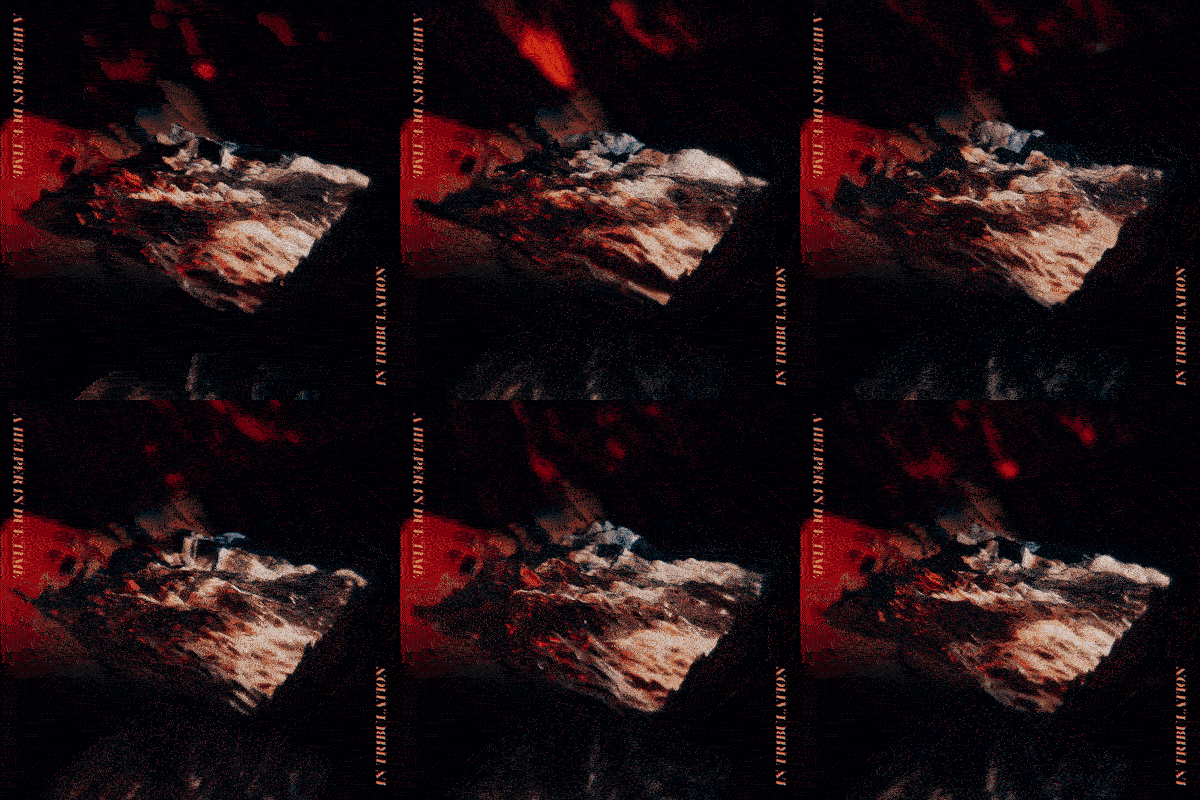
I didn’t have a great idea in mind for how to depict tribulation, so I decided to go a little more abstract. I thought that tribulation has the sense of roiling circumstances, and so I used Trapcode Mir to create this constantly agitated geometric plane.
Enjoy.
And the Lord is become a refuge for the poor: a helper in due time in tribulation.
(Psalm 9:10 DR)
View a higher quality version of this gif here: