

Psalm 9:16
it's a trap!
I will rejoice in thy salvation: the Gentiles have stuck fast in the destruction which they have prepared. Their foot hath been taken in the very snare which they hid. (Psalm 9:16 DR)
As hard as it is to learn to do a new thing, perhaps even more difficult is to unlearn a habitual thing. Once we become accustomed to something it tends to work its way down inside of us so as to in some manner become a part of us, and we only with great difficulty can give it up.
This is true even if something is objectively harmful—and perhaps more so—because the more harmful it is the more pleasurable or desirable it must have been to compel us to engage in it in the first place. The ravages of the addiction crisis that we currently face are manifest evidence of this and how we become enslaved to our our appetites and desires. What seemed to be the exercise of freedom becomes a taskmaster that requires more and more without end until instead of us using the thing, we become used and eventually used up.
The Psalmist creates another series of contrast in this passage piggy-backing off of the juxtaposition between the gates of death and the gates of the daughter of Sion. In effect he is taking a retrospective look, for his rejoicing in the salvation he has received is directly related to being lifted up from the gates of death. Perhaps in the midst of those gates he did not have as clear vision, but now having been lofted to the heights of Sion and salvation he can see his former state, which he sees in the figure of the nations opposed to God. St. Paul reminds the Corinthians that prior to the sacrament of Baptism they too were outside of Sion, the kingdom of God:
Know you not that the unjust shall not possess the kingdom of God? Do not err: neither fornicators, nor idolaters, nor adulterers, nor the effeminate, nor liers with mankind, nor thieves, nor covetous, nor drunkards, nor railers, nor extortioners, shall possess the kingdom of God. And such some of you were; but you are washed, but you are sanctified, but you are justified in the name of our Lord Jesus Christ, and the Spirit of our God. (1 Corinthians 6:9-11 DR)
Importantly, the Psalmist speaks here as one who is still a sojourner, for the nations opposed to God still press in around him. However, this rejoicing in God’s salvation is grounded in hope, expecting vindication from the Lord in the end:
Then follows, “I will exult for Your salvation:” that is, with blessedness shall I be holden by Your salvation, which is our Lord Jesus Christ, the Power and Wisdom of God. Therefore says the Church, which is here in affliction and is saved by hope, as long as the hidden judgment of the Son is, in hope she says, “I will exult for Your salvation:” for now she is worn down either by the roar of violence around her, or by the errors of the heathen. (St. Augustine, Expositions on the Psalms, 9, 15.)
The translation from the gates of death to the gates of Sion, from the kingdom of darkness to the kingdom of light is accomplished by God’s grace and the washing of water in Baptism, which cleanses the soul from Original Sin and pours into the soul the charity of God through the Holy Ghost (cf. Romans 5:5). This newness of life (cf. 2 Corinthians 5:17) in our Lord Jesus Christ reorients the soul to Him through the the theological virtues of faith, hope and charity, which stand in marked contrast to the former way of life in which we were slaves to sin. The Psalmist sees in the Gentile nations this former way of life and how the sins they commit become the very source of their destruction.
They are stuck fast or fixed in the coming destruction which—the Psalmist tells us—they have themselves prepared. That is, their sin becomes its own punishment because they have chosen the wages of sin over the gift of God (cf. Romans 6:23), and much like the addict whose addiction leads to ruin even as its pleasures compel further indulgence, so the soul’s addiction to sin leaves it stuck fast or fixed in that same sin even in the face of approaching destruction. St. Augustine considers how there seems to be a fitting analogy between the sin desired and the destruction due to it:
Consider ye how punishment is reserved for the sinner, out of his own works; and how they that have wished to persecute the Church, have been fixed in that corruption, which they thought to inflict. For they were desiring to kill the body, while they themselves were dying in soul. (St. Augustine, Expositions on the Psalms, 9, 15.)
Dante in his Inferno famously links punishments of sins to the root cause of the sin itself, so that the sin in effect becomes—as it were—its own punishment. In Canto 5 he describes the punishment of the lustful who are blown to and fro and battered by horrific winds because their appetites in life led them like gale-force winds and were not subject to reason:
I learned that those who undergo this torment
are damned because they sinned within the flesh,
subjecting reason to the rule of lust.And as, in the cold season, starlings’ wings
bear them along in broad and crowded ranks
so does that blast bear on the guilty spirits:now here, now there, now down, now up, it drives them.
There is no hope that ever comforts them—
no hope for rest and none for lesser pain. (Dante, Inferno, Canto V, 37-45.)
He speaks to two lovers who are forever bound together in their lust for each other, and this now unbroken bond which was in life a simulacrum of holy matrimony now becomes the source of their eternal misery:
Love, that can quickly seize the gentle heart,
took hold of him because of the fair body
taken from me—how that was done still wounds me.Love, that releases no beloved from loving,
took hold of me so strongly through his beauty
that, as you see, it has not left me yet.Love led the two of us unto one death. (Dante, Inferno, Canto V, 100-106.)
The fixity of the soul in sin is well evidenced here, for the souls still speak of “love” in its diabolical aspect of lust, which is in reality the counterfeit of love since it is the appetite overruling reason. It seeks to take that to which it has no claim and to enjoy the pleasures of love without the ordering of love within marriage. In this manner these two souls find that their lust became the source of their eternal destruction, and St. Augustine concurs with Dante’s assessment:
“In that snare which they hid, has their foot been taken.” The hidden snare is crafty devising. The foot of the soul is well understood to be its love: which, when depraved, is called coveting or lust; but when upright, love or charity... And the Apostle says, “That being rooted and grounded in love, you may be able to take in.” [Ephesians 3:17-18] The foot then of sinners, that is, their love, is taken in the snare, which they hide: for when delight shall have followed on to deceitful dealing, when God shall have delivered them over to the lust of their heart; that delight at once binds them, that they dare not tear away their love thence and apply it to profitable objects; for when they shall make the attempt, they will be pained in heart, as if desiring to free their foot from a fetter: and giving way under this pain they refuse to withdraw from pernicious delights. (St. Augustine, Expositions on the Psalms, 9, 15.)
This is precisely the dynamic that Dante describes of the lustful souls in hell, and it is why they cannot let go of their lust even though it is the cause of their eternal pain. The delight of the indulgence of the appetites creates pain when it is not indulged, and the more it is indulged, the greater the pain. This is why we find habits—especially bad habits—so hard to break, because the pain of giving them up is often greater than what our reason tells us is a greater good. It becomes like those finger traps that the harder you pull to get out, the tighter they become.
On the natural level there is no hope to escape this, for while we may in some respects be able to adjust some habits or give up some pleasures for better things, we cannot hope to overcome sin by our own efforts. We inevitably find ourselves with perhaps the desire to do good, but the inability to perform what we know to be right, as St. Paul describes:
I find then a law, that when I have a will to do good, evil is present with me. For I am delighted with the law of God, according to the inward man: But I see another law in my members, fighting against the law of my mind, and captivating me in the law of sin, that is in my members. (Romans 7:21-23 DR)
Apart from grace it is impossible to free ourselves from this reality, and our only destiny is that of the lustful in the Inferno, forever tied to our lusts and appetites and incapable of withdrawing from their delights and ultimately their tyranny. The wound of Original Sin—which is the loss of sanctifying grace—is a fatal wound unless treated and healed, which is precisely what occurs in the sacrament of Baptism in which that grace lost in the Fall is poured once again into our souls. This renewal in the soul sets us free from the dominion of sin and frees us to serve God in justice:
Let no sin therefore reign in your mortal body, so as to obey the lusts thereof. Neither yield ye your members as instruments of iniquity unto sin; but present yourselves to God, as those that are alive from the dead, and your members as instruments of justice unto God. For sin shall not have dominion over you; for you are not under the law, but under grace. (Romans 6:12-14 DR)
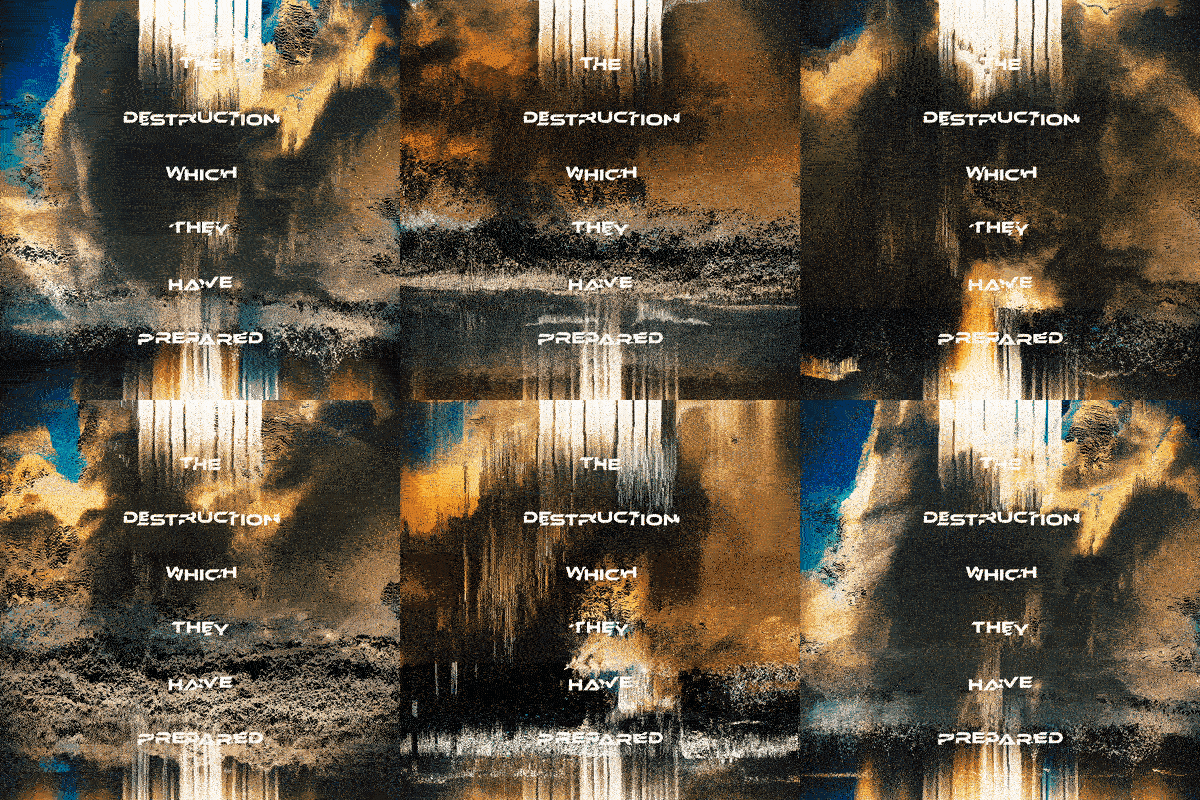
I thought the image of destruction in the form of a whirling wind was an interesting one, and so I decided to try something along those lines. I used I Ate Mushrooms to create a series of machine-learning transitions between various images and then added in some multipliers and such to make it more chaotic and unsettled.
I applied an adjustment layer using CC Ball Action to make it feel like it was breaking apart a little and had some dept, and then added in some shutter streaks to pull the design more into the center.
Enjoy.
I will rejoice in thy salvation: the Gentiles have stuck fast in the destruction which they have prepared. Their foot hath been taken in the very snare which they hid.
(Psalm 9:16 DR)
View a higher quality version of this gif here: