

Psalm 9:2
stop backing up the stairs
I will give praise to thee, O Lord, with my whole heart: I will relate all thy wonders. (Psalm 9:2 DR)
A sadly common temptation throughout human history for a fallen humanity has been that of mistaking emotions or appetites for discernment about what is right or wrong. That is, we have this wound in our soul from Original Sin that creates an imbalance in which our reason—which is meant to govern our appetites and direct them towards the good—instead is led by those same appetites.
As aforementioned, this temptation is common to both every man and every society, but there is perhaps a “depth”—so to speak—to that temptation in a society in which prosperity and technology make the satisfaction of appetites more perverse and more effortless. In such a situation (such as our own, sadly), the Hedonist philosophers of the ancient world might blush in that we have traded in the (in retrospect) relatively modest hedonism of Epicurus for the in-your-face sadism of Marquis de Sade.
For we have sacralized our emotions and appetites, which has led not to greater promised freedom and the elevation of the human person, but rather an abject slavery to our appetites (as the crisis of addiction of all forms demonstrates), the denial of the dignity of the person (vis-a-vis the horror of abortion) and the outright denial of the soul (e.g., legislation equating human and animal life). All this can be ornamented with lofty language, but at bottom it is merely that old itch of Original Sin clamoring to be scratched.
Thus we end up in insanity, for our appetites belong to our lower or animal nature; that is, it is something we share in common with the animals. The desire for food, for sex, etc., is natural and is as constitutive of our human nature as they are for a dog’s nature. But we are not merely animals, but—as Aristotle maintained—rational animals. Reason is an endowment from God that makes us like unto Him, and analogously provides us the spiritual appetite for the Good, the True and the Beautiful, which all coalesce ultimately in Him.
Whenever I think about how our current society has sacralized feelings, I cannot help but think of my dog Luna. Like all dogs she has her quirks, and one of them is some sort of emotional hang-up with stairs. It is—to be fair—pretty amusing, as she will sometimes turn around and back up the stairs, usually onto the first step at the bottom of the stairs, and then turn around on the stairs and walk the rest of the way up. She used to walk all the way up and then turn around on the last three and then back up the rest of the way, but I guess she’s grown emotionally or something.
This is, of course, irrational, but she has no reason and thus is merely a construct of emotions and appetites and instincts and cannot rise above them. If I were a better trainer I might be able to break her of that, but only by means of appealing to other appetites.
When we as humans reduce ourselves to our emotions and appetites and allow them to dictate to us the good, the true and the beautiful, all we end up getting are the bad, the false and the ugly, as a cursory examination of our society demonstrates convincingly. Yet the tug of concupiscence is so strong that we either acknowledge this reality yet still desire the sating of our appetites, or we convince ourselves that good is evil and evil is good. The only other alternative is a complete interior renovation that can only be accomplished in the grace of Baptism.
This long digression is meant to describe precisely what the Psalmist is not talking about when he speaks of giving praise to God with his whole heart. For us in the modern world who are shackled to the tyranny of the appetites and the dictatorship of sentimentality, we often judge the quality or sincerity or even goodness of something by the intensity of our emotional response to it. The wave of emotions that rush in upon us when our appetites are indulged can give the appearance of goodness, since the temporary fulfillment of that longing—the scratching of that itch—brings the desired result.
But just like scratching an itch usually makes it worse, so indulging our flesh only prompts the need for greater exultations in emotional fulfillment, leading us to need more and more of what can never satisfy.
The Psalmist’s use of the term “heart” does not leave out the emotions entirely, but is intended to express the intention and orientation of his will. After all, he says “I will give praise to Thee, O Lord,” which is a description of his interior disposition rather than an inventory of his emotional excitement. This is further buttressed by the parallelism in the second half of the passage where he speaks of “relating” all of God’s wonders.
Thus, the relation that his being has to God is properly ordered, even though he describes it in reverse form. His intellect apprehends the goodness and wonder of God, and this intellectual movement gives rise to the act of the will by which he will then praise the Lord with his entire being. The will follows the intellect, and his body and emotions and the rest follow and accentuate that act of the will. It is not because he is overcome by some sentimentality that he declares his intention to praise the Lord, but rather because in the eye of his mind he has seen the goodness of the Lord which then enlightens the rest of his being.
In this manner he can truly give praise to the Lord with all of his heart, for the entirety of his being is truly involved. This then becomes a rightly ordered exultation in the Lord, the “sober inebriation” of which St. Ambrose writes in his splendid hymn for Lauds on Mondays, Splendor paternæ gloriæ:
Christusque nobis sit cibus,
potusque noster sit fides;
laeti bibamus sobriam
ebrietatem Spiritus.May Christ be our food,
Faith our drink;
Let us joyfully drink
The Spirit’s sober drunkenness.
Our praise to God may involve times of exultation, but in reality most of the time it must come in the midst of us slogging through this life which is a constant warfare (cf. Job 7:1). The Holy Sacrifice of the Mass is the most powerful expression of this worship that we offer to God, which must correspond with the offering of the sacrifice of ourselves (cf. Romans 12:1) to be joined with that of our Great High Priest. This is ultimately what our Lord meant when he said that the kind of worshippers the Father seeks are those who would worship in Spirit and in truth (cf. John 4:24). Our Lord immediately followed this by explaining the content of this statement:
I am he, who am speaking with thee. (John 4:25 DR)
The Samaritan woman in this account comes to understand Who she is speaking to, and manages to connect these ideas together, for she immediately fulfills the Psalmist words in that she goes back to her town to “relate all Thy wonders.” In her case it wasn’t any outward miracle or spectacle but rather our Lord’s understanding of her heart and the interior conversion brought about. This is the ultimate wonder that the Psalmist speaks about, in that his worship springs forth from the very charity which Gid pours into our hearts (cf. Romans 5:5).
He tells all God's marvels, who sees them performed not only openly on the body, but invisibly indeed too in the soul, but far more sublimely and excellently. For men earthly, and led wholly by the eye, marvel more that the dead Lazarus rose again in the body, than that Paul the persecutor rose again in soul. But since the visible miracle calls the soul to the light, but the invisible enlightens the soul that comes when called, he tells all God's marvels, who, by believing the visible, passes on to the understanding of the invisible. (St. Augustine, Expositions on the Psalms, 9, 2.)
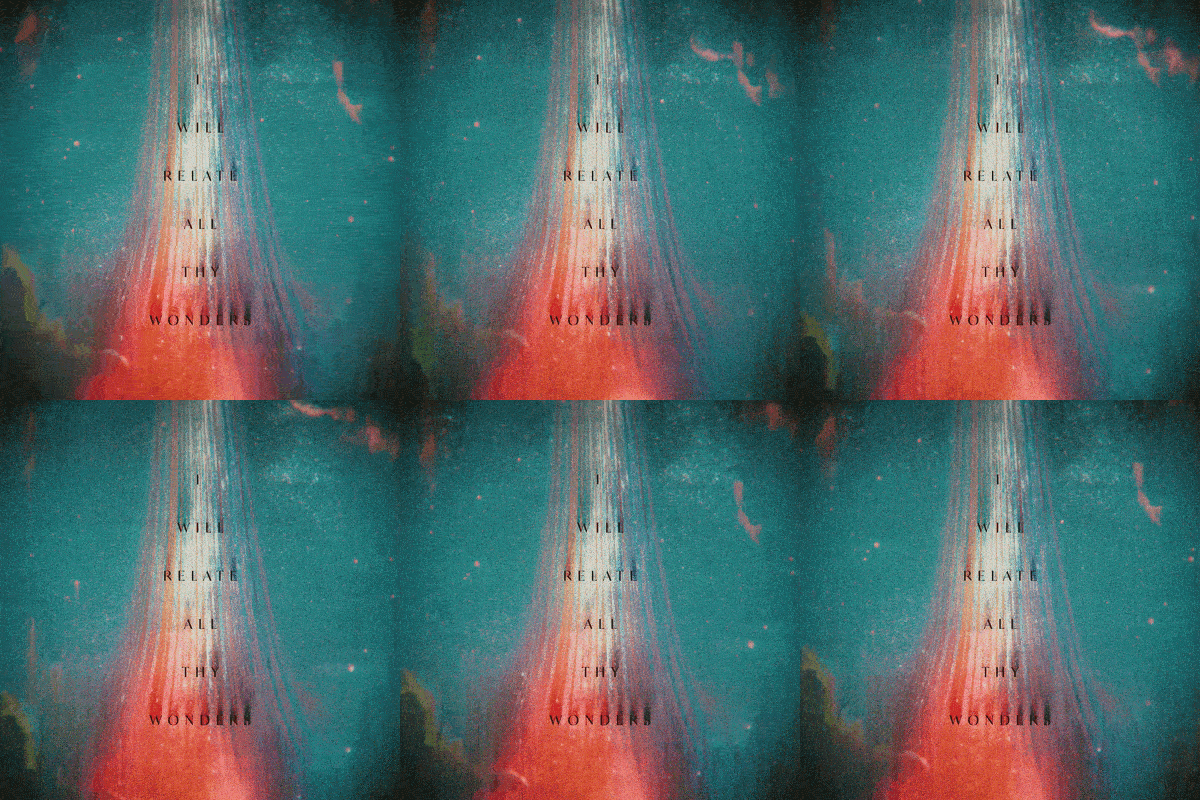
In this animation I wanted to keep it simple and play with the idea of lifting up praise to God for His wonders. I found this great image and added instances of loopFlow and Stretch to get the image to move, as well as to stylize it as I wanted.
Enjoy.
I will give praise to thee, O Lord, with my whole heart: I will relate all thy wonders.
(Psalm 9:2 DR)
View a higher quality version of this gif here: