

Psalm 9:28
the coming hell on earth
His mouth is full of cursing, and of bitterness, and of deceit: under his tongue are labour and sorrow. (Psalm 9:28 DR)
The tongue is a fire and a world of iniquity, set on fire by hell itself, so St. James tells us (cf. James 3:6). The tongue is often used metaphorically for the proud heart, in that the mouth makes boasts that reflect the interior disposition that sets itself against heaven.
The Psalmist considers further the depths of the depravity of the wicked as it will be fully manifested in the coming antichrist. The cursing is prompted by his hatred of God and thus he sets his mouth against heaven (cf. Psalm 72:9) and believes himself to ascend to the highest as did his father the devil. The prophet Isaiah is given insight into this desire:
And thou saidst in thy heart: I will ascend into heaven, I will exalt my throne above the stars of God, I will sit in the mountain of the covenant, in the sides of the north. I will ascend above the height of the clouds, I will be like the most High. (Isaiah 14:13-14 DR)
There is a curious side to humanity in which we are often beguiled by great boasts, and the more confidently and outlandishly such boasts are made, the more inclined we are to believe them. We might prefer to think this is untrue, but the political history of humanity (and the subsequent body-count) is sure proof otherwise. The Antichrist will drink fully from the well of pride that the devil did and make great boasts so as to set himself up as God:
Let no man deceive you by any means, for unless there come a revolt first, and the man of sin be revealed, the son of perdition, who opposeth, and is lifted up above all that is called God, or that is worshipped, so that he sitteth in the temple of God, shewing himself as if he were God. (2 Thessalonians 2:3-4 DR)
This rebellion is not merely a political rebellion among many but one comprised of a fundamental choice for good or for evil, for God or for self—the same choice that Satan himself made at the moment of his creation. What St. Paul describes is (as we saw in the previous passage) not sinfulness by means of mere human frailty but the fundamental orientation of the world and its inhabitants against God. The world will know that it is rejecting God for a lie and do so with eyes wide open. This will be wrought through the deception of the Antichrist who will seduce the world with the promise that his father the devil first promised himself and then our first parents, and this rebellion will be such that God lets go of the rope, as it were, so that they will believe the lies and desire them nevertheless:
Whose coming is according to the working of Satan, in all power, and signs, and lying wonders, and in all seduction of iniquity to them that perish; because they receive not the love of the truth, that they might be saved. Therefore God shall send them the operation of error, to believe lying: That all may be judged who have not believed the truth, but have consented to iniquity. (2 Thessalonians 2:9-11 DR)
The Psalmist foresees this reality and describes the prototype in those who behave in this manner, just as St. John prophesies the Antichrist yet also describes antichrists who follow a similar path. The frustration of the plans of the Antichrist form the basis of his cursing, for although he knows (as his father the devil does) that he cannot overcome God, he nevertheless raises his fist to heaven in defiance, and in the bitterness of his pride he lies and promises to himself and the world that he can—as Milton had it—make a Heaven of Hell and a Hell of Heaven:
“Whose mouth is full of cursing and bitterness and deceit.” For it is a great curse to seek heaven by such abominable arts, and to get together such earnings for acquiring the eternal seat. But of this cursing his mouth is full. For this desire shall not take effect, but within his mouth only will avail to destroy him, who dared promise himself such things with bitterness and deceit, that is, with anger and insidiousness, whereby he is to bring over the multitude to his side. (St. Augustine, Expositions on the Psalms, 9, 25.)
It is the height of the devil’s pride to know his future damnation due to his rebellion yet still desire it rather than to bow his knee to God, for pride desires the misery that it possesses for itself rather than joy and goodness on terms not its own. It may be a wonder how the Antichrist will deceive the world with such a fantastic and ultimately nihilistic philosophy, but in reality every time we choose to sin we fall for the same deception and participate in the same rebellion.
We also need only look at our surrounding culture to notice that we make these sorts of nihilistic decisions all the time.
The barbarism of human sacrifice that is abortion not only offers up the most innocent and defenseless to the bloodthirsty gods of convenience and self (not to mention the very real demons which lurk behind them with arms extended), but also on the societal level wounds a nation’s soul and on the practical level creates future population problems such that we cannot even replace ourselves anymore. It is a fundamentally anti-human orientation that we justify in the name of the rights of humans.
“Freedoms” and license such as pornography inflame the basest impulses of our fallen nature and coarsen a culture, destroy families and enslave its users like any other addiction, yet we protect it to the death as a freedom we are owed, even though it contributes to and enables the exploitation of the most vulnerable such that the slavery of the ancient world will soon (if not already) be a golden era relative to that which we practice today in the so-called enlightened world.
Further examples could be multiplied without end, but it is the hubris of antichrist that allows us to imagine that we are somehow immune to such a widespread deception, or that we are somehow so enlightened or intelligent or evolved so as to avoid the prophesied rebellion. A more sober analysis might lead one to think that we are far more likely than any previous era or people to be taken in by the deception with eyes wide open, and will no doubt imbibe the deception so fully as to call evil good and good evil. The fig leaves of modern ersatz virtues like consent and tolerance prime the pump, so to speak, for such deceptions to cloud us in the miasma of lies that we will claim to be the truth.
The fascinating aspect is that the Psalmist notes that the Antichrist’s lies hide a world of pain and grief; thus these things are under his tongue:
“Under his tongue is toil and grief.” Nothing is more toilsome than unrighteousness and ungodliness: upon which toil follows grief; for that the toil is not only without fruit, but even unto destruction. Which toil and grief refer to that which he has said in his heart, “I shall not be moved from generation to generation without evil.” And therefore, “under his tongue,” not on his tongue, because he will devise these things in silence, and to men will speak other things, that he may appear good and just, and a son of God. (St. Augustine, Expositions on the Psalms, 9, 25.)
It might be wondered if the pain induced by the reign of the Antichrist might induce people to wake up, to express dissatisfaction with events and perhaps turn to repent. But is that plausible? Currently we do not (as far as we know) live under such a regime, but nevertheless we have all that we desire at our fingertips and can indulge our passions without end and seemingly without consequence, yet perhaps have never been more miserable as the decision to opt-out of life, so to speak, is at unprecedented levels. This discontent is apparently not solved by the increasing indulgence that we are constantly sold, yet we generally refuse to turn to God in repentance even though the grace is available to do so. This hardening of hearts is not abated by pain but—as the case of Pharaoh demonstrates—can be exacerbated by it.
However, the deception will be so great and thus the buy-in of the will of man so complete that they will find the suffering due to their rebellion preferable to the subjection of their wills to God. This ultimately is the mindset of Hell and its denizens, who choose its torments over the forfeiting of their pride and what they feel is owed to them. Milton’s Satan gives voice to this lofty pride after being expelled from Heaven:
Farewel happy Fields,
Where Joy for ever dwells: Hail horrours, hail
Infernal world, and thou profoundest Hell
Receive thy new Possessor: One who brings
A mind not to be chang'd by Place or Time.
(Milton, Paradise Lost, Book I, Lines 249-253)
St. Augustine notes that the Antichrist will appear good and just, which means a complete inversion of good and evil in this world as part of the deception such that men call good evil and evil good (cf. Isaiah 5:20). This inversion is the culmination of the primordial temptation in the garden, where the devil tempted our first parents to know good and evil as God did, by which is meant that they become the arbiters of good and evil, which is precisely what the Antichrist will establish. This deception has been present from the beginning and echoes down through all of history, with each temptation deriving from this desire to call evil good and good evil based on our own lights, deriving from our own intellect and will.
The subtlety and seduction of this temptation is no less powerful today, and perhaps more so as our prosperity and technology make the effectuation of evil more accessible and effortless, which dulls the conscience and makes the intellect more susceptible to the serpent’s whispers.
The Psalmist reminds us not only that a time is coming when this temptation will be institutionalized in the Antichrist’s reign, but that it lies in wait for each heart in every choice for good or for evil that we make. While grace is available we must strive to hold on to the good and reject the evil.
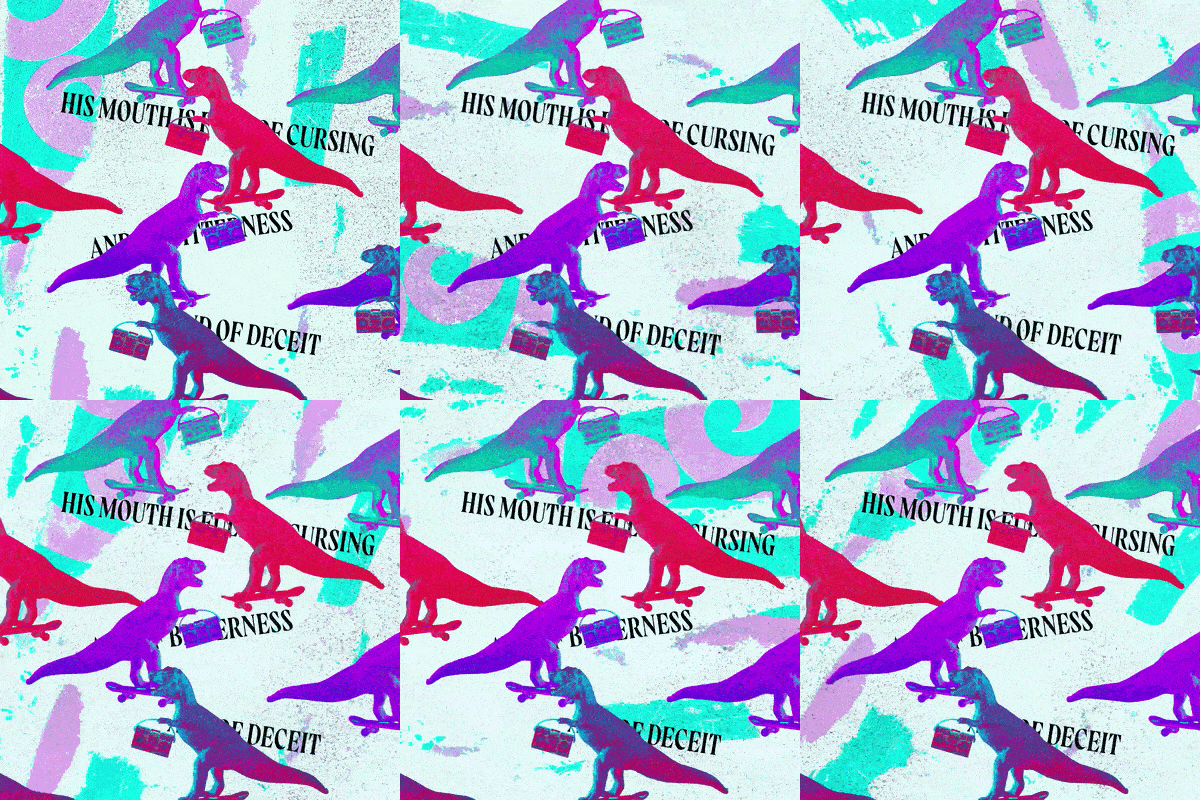
I’m not exactly sure why I went this direction for this animation, but I guess I saw this image of a dinosaur skateboarding with a boombox and simply had no choice in the matter.
I cut out the dino in Photoshop and precomped it in After Effects and then added some buffer space around the pixels in the precomp so I could apply Motion Tile which uses the pixel dimensions of the layer for the spacing of the duplicates. This is why whenever I use Motion Tile I precomp the layer so I can later on make adjustments to the spacing.
I then animated the position of the center point and made sure it looped and then duplicated the precomp and repositioned it and reversed the direction of the animation. I also duplicated the precomp in the project panel to make a separate instance and reversed the dinosaur so it would face the opposite direction. I then applied some fun color correction and text.
Enjoy.
His mouth is full of cursing, and of bitterness, and of deceit: under his tongue are labour and sorrow.
(Psalm 9:28 DR)
View a higher quality version of this gif here: