

Psalm 9:32
who is one being oblivious here?
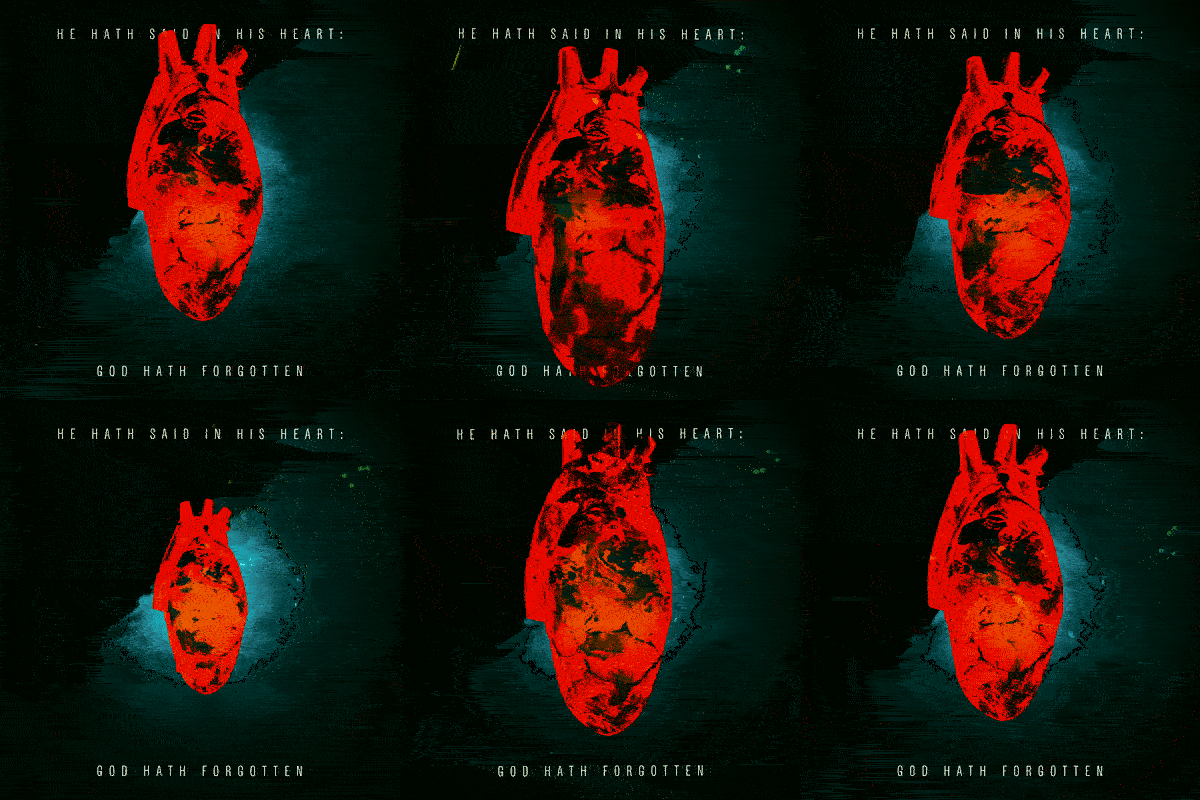
For he hath said in his heart: God hath forgotten, he hath turned away his face not to see to the end. (Psalm 9:32 DR)
Oblitus est Deus is how the Vulgate renders the thought of the heart of the wicked man who imagines that the current lack of judgment for his iniquity entails a deficiency of forgetfulness on the part of God’s justice.
Oblitus is a form of obliviscor which has an uncertain origin, although it is speculated that it is partially formed from the root levis which has the sense of “smooth;” as such, obliviscor is to smooth over something that has texture or detail, to “start to erase” it, as it were (Etymological Dictionary of Latin and the other Italic Languages, 422). The idea then becomes an erasure of memory when it comes to the mind, which we more commonly call forgetting. Hence the English oblivious comes from this same Latin root and idea.
However, when we speak of someone who is oblivious to something, we generally use it in a somewhat pejorative manner. It is simply that they are forgetful or ignorant of something, but rather that they are naive to something that should either be obvious to someone of normal intelligence or something that they in particular should know. Thus if someone has a child which everyone else knows behaves like a devil, yet that same parent thinks he is an angel, we would call that parent oblivious to his child’s true character.
The Psalmist sees the wicked man—as paradigmatically represented in the Antichrist—as thinking of God as oblivious to his sin and iniquity. It is, in fact, this hubris by which he thinks God does not know or see that confirms and emboldens him in his wickedness. In some respect all the guardrails are off, for we often will sin through human weakness yet stop short of further sin because of fear of punishment, but what happens when even this fear is cast off? If God is not the judge, the man becomes the measure of all things, and depravity is only limited by the bounds of nature, even though the wicked will even attempt to transgress those.
But the depraved heart goes even further, for not only does he believe that God does not see, but he thinks that God intentionally turns His face away not to see to the end. What the Psalmist means by this is that the wicked thinks that God does perceive his sins in respect to the final judgment—that is, the end—and thus he does not live in fear of that judgment. The reason for this is that he imagines in his hubris that every sin should be immediately punished by a lightning bolt from heaven, and since it doesn’t then either God does not exist (cf. Psalm 52:1) or is indifferent towards wickedness. After all, the man reasons, if God truly cared about justice, then why would he allow the wicked to prosper in their sins?
This mindset seems to itself to ascend the heights, for now even the heart and conscience of man has overcome divine retribution. He thinks (with the forked-tongue whispering in his ear) that he will not surely die but will become like God. However, the blindness of sin actually makes him oblivious to the truth, that the hidden judgment of the Son is being prepared for the end:
But how shall he decline, and fall? “For he has said in his heart, God has forgotten; He turns away His face, that He see not unto the end.” This is declining, and the most wretched fall, while the mind of a man prospers as it were in its iniquities, and thinks that it is spared; when it is being blinded, and kept for an extreme and timely vengeance: (St. Augustine, Expositions on the Psalms, 9, 29.)
The Psalmist foresees that the Antichrist and those who follow him will all share this mindset in that they think that God’s judgment is not forthcoming, that they can engage in their wickedness with impunity. This deception—which was given to our first parents in the garden—will be, as it were, perfected in its power and seduction with the coming of the man of sin. However, the delaying of God’s judgment for their misdeeds will be misinterpreted by them as Him forgetting, when in fact the delay of judgment is itself a judgment, for He has, so to speak, let go of the reins and given them over to their sinful hearts so as to be deceived:
And then that wicked one shall be revealed whom the Lord Jesus shall kill with the spirit of his mouth; and shall destroy with the brightness of his coming, him, whose coming is according to the working of Satan, in all power, and signs, and lying wonders, and in all seduction of iniquity to them that perish; because they receive not the love of the truth, that they might be saved. Therefore God shall send them the operation of error, to believe lying: That all may be judged who have not believed the truth, but have consented to iniquity. (2 Thessalonians 2:8-11 DR)
This deception comes because they do not believe that their actions will be judged, and this lack of belief is compounded by their continuance in sin, a vicious spiral of sin into damnation:
Now they deny that God sees unto the end, who say that He cares not for things human and earthly, for the earth is as it were the end of things; in that it is the last element, in which men labour in most orderly sort, but they cannot see the order of their labours, which specially belongs to the hidden things of the Son. (St. Augustine, Expositions on the Psalms, 9, 29.)
St. Augustine draws this out in a fascinating way. He begins by noting that this world is the end of things in that it is where this pilgrimage through the vale of tears takes place; all of our virtues and sins occur within this life. Yet even within this life there is a certain ordering; we work at something so as to achieve a certain end, and this ordering is a natural part of the world and its laws and the foundation of all our reasoning and striving. Yet this seemingly natural ordering also holds within it a higher or deeper ordering, in that all our labors and actions have a supernatural end, which is all held together by the providence of God. The natural ordering of the worlds and our labors should direct us toward this higher or deeper end, but the sinful heart becomes oblivious to this end. In a supreme irony, the heart that thinks God is oblivious to sin only thinks so because it is oblivious to the judgment that is to come and to which the entire ordering of the world is directed.
The Antichrist in setting himself up as God will thus diabolically pervert this ordering to the end so that this world and its goods and pleasures becomes that that end. To be sure, all sin has this as its goal, but there is a culmination or consummation of sinfulness—the mystery of iniquity—that will be brought about by the man of sin. The operation of error to believe lying that St. Paul talks about is the heart described by the Psalmist here, who deliberately turns his face to not see the end and then projects this obliviousness onto God. But as St. Paul says, they will be judged because they consented to iniquity; that is, there is no ignorance here but rather deliberate rejection of God in totality.
In the face of the seeming prosperity of the wicked, the righteous must not lose heart so as to join them in their apostasy from the truth. The souls under the altar in St. John’s vision ask how long until they avenged, and are told to wait patiently until the number of their brethren be filled up (cf. Apocalypse 6:9-11). Patience thus becomes the operative virtue for the just, trusting in God’s promises and waiting on His vengeance, rather than taking on the mindset of the antichrist who thinks in his heart that God does not see:
Do not therefore lose your confidence which hath a great reward. For patience is necessary for you: that, doing the will of God, you may receive the promise. For yet a little and a very little while, and he that is to come will come and will not delay. But my just man liveth by faith: but if he withdraw himself, he shall not please my soul. But we are not the children of withdrawing unto perdition, but of faith to the saving of the soul. (Hebrews 10:35-39 DR)
For this animation I found a great 3D model of a heart and used Trapcode Mir to create the mesh for this model. I applied some animation to the amplitude of the mesh to create the “beating” of the heart and added in some textures and color correction along with the text to which I applied some slight wiggle hold animation. Pretty simple overall but I liked how it turned out.
Enjoy.
For he hath said in his heart: God hath forgotten, he hath turned away his face not to see to the end.
(Psalm 9:32 DR)
View a higher quality version of this gif here: