

Psalm 9:37
beginning to end and back again
The Lord shall reign to eternity, yea, for ever and ever: ye Gentiles shall perish from his land. (Psalm 9:37 DR)
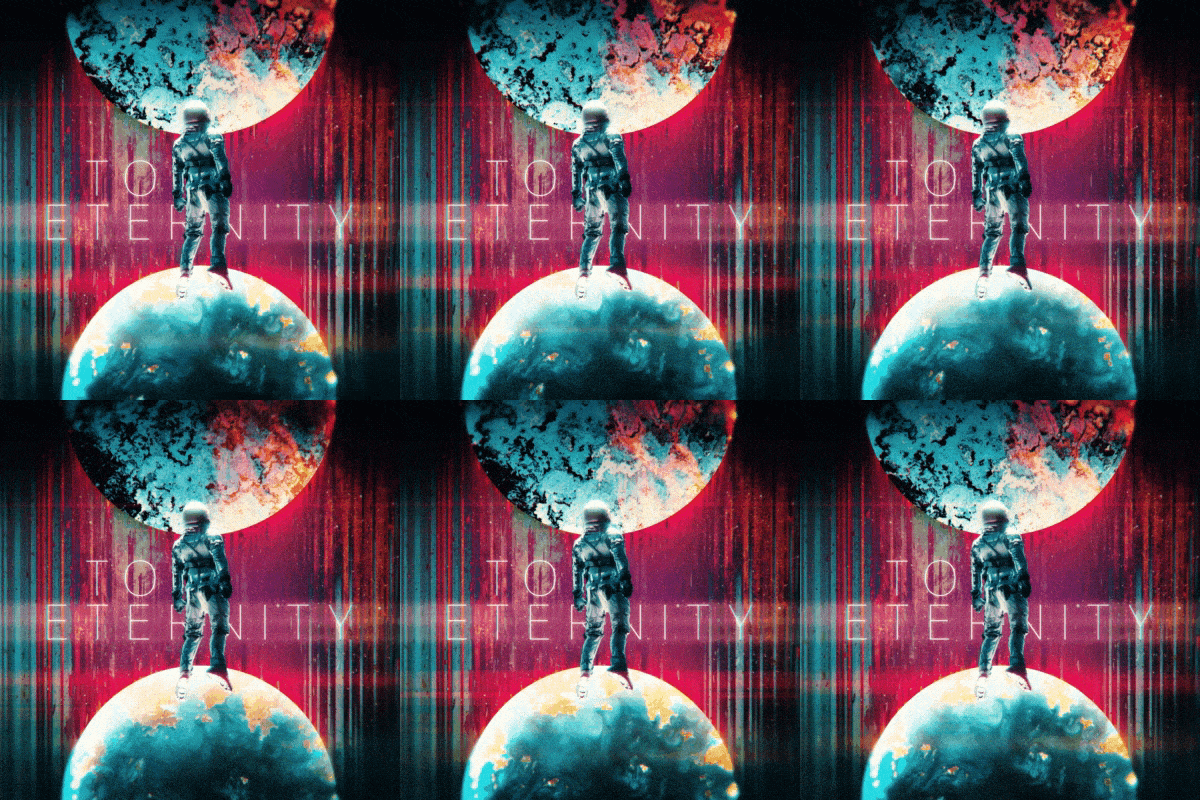
The coming kingdom of the Antichrist that the Psalmist has been describing exalts itself to heaven like the tower of Babel of old, yet its destruction is sure and the judgment of God unrelenting, giving the man of sin and all who follow in his ways the just recompense for their deeds.
The Psalmist now pulls out to take an even wider view of things, for while the reign of the wicked seems to last foe a long time, yet in comparison to the reign of the Lord it is as nothing. For, he says, the Lord “shall reign to eternity, yea, for ever and ever.” This parallelism creates what seems on the surface to be an unnecessary intensification; after all, eternity can not be extended in scope or quantity—there is nothing one can add to eternity.
However, in our limited view of time we perceive things linearly as having happened in the past, occurring in the present and coming to be in the future. And while eternity certainly means having no beginning and no end, there is a sense in which we associate it more with having always been, whereas forever we tend to lean more towards the future and something that will always be.
The parallelism here—which is certainly present in the Septuagint, rendered as αἰῶνα καὶ εἰς τὸν αἰῶνα τοῦ αἰῶνος—thus serves to bring the mind to the far reaches of eternity past (so to speak) and to the never-ending stretches of that to come. The irony for our limited intellects is that we tend perceive eternity in quantitative sense, as if there are years or any other period of time that have made up time unto eternity past and into the future. We thus project a forced linearity onto eternity. However, our experience of past, present and future gives a false conception of eternity if we apply that same experience to it, for the present time we experience is of that which passes away, of a present that only exists in the past or the future:
But, then, how is it that there are the two times, past and future, when even the past is now no longer and the future is now not yet? But if the present were always present, and did not pass into past time, it obviously would not be time but eternity. If, then, time present—if it be time—comes into existence only because it passes into time past, how can we say that even this is, since the cause of its being is that it will cease to be? Thus, can we not truly say that time is only as it tends toward nonbeing? (St. Augustine, Confessions, Book XI, Chapter XIV, 17.)
God’s eternality is thus not of successive times like we experience them or of time passing into non-being as it becomes the past, but of an ever-present present. To God Who is infinite all moments and all times in that which He has created are present. We only experience things in succession but God sees all things in totality. For God there is no such thing as that which has been or that which will be:
Thy “today” yields not to tomorrow and does not follow yesterday. Thy “today” is eternity. Therefore, thou didst generate the Coeternal, to whom thou didst say, “This day I have begotten thee.” Thou madest all time and before all times thou art, and there was never a time when there was no time. (St. Augustine, Confessions, Book XI, Chapter XIII, 16.)
St Jerome’s translation from Hebrew renders this as Dominus rex saeculi, et aeternitatis—The Lord, King of ages, and of eternity—gets at the same idea from the different sides, for whereas the Septuagint and Vulgate look at it from the side of God’s reign in respect to all things, this sees it from the standpoint of God Himself as originator of eternity; not simply existing in eternity as if it were outside of Himself or He within it, but as existing in Him since He is infinite and eternal. That is, there is no eternity outside of God but He truly is Him unto Whom are all things (cf. Romans 11:36).
In this manner the Psalmist tries to encapsulate in limited human expression the grandeur and scope of God’s rule and reign which has always been and always will be. In respect to our perception this reign is seen following the defeat and judgment of the Antichrist, but in reality it has always been, even if occluded in our minds by the temporal rule of the wicked. But the temporality of the wicked is therefore even more contrasted with the eternality of the Lord:
Once the universal calamity has been expunged, the Psalmist passes to the order of future events, for once the Antichrist has been slain, the eternal, holy, generous kingdom of the Lord will come. Wicked evil is allowed to run far ahead so the Lord’s kingdom for which we long may be more welcome when attained, for in it the blessed now become untroubled and take rest. The traps that the holy person is compelled to endure in this world are no longer feared. (St. Cassiodorus, Explanation of the Psalms, 10.37., ACCS.)
St. Cassiodorus draws out an interesting parallel here between the kingdom of the Antichrist (as symbolized in the Gentiles) and the traps of this world, which are the temptations that attempt to lead us into sin. Both are ultimately brought to an end in the eternal reign of God as manifested in the final judgment, and thus we must see those temptations truly as traps. They are not to be played around with, for they belong to the kingdom of this world, and each sin beings us into the mindset and thus reign of antichrist. The temptations we face are to test and strengthen us in virtue, for as we resist them and thus temporal the kingdom of this world we set our eyes on the eternal kingdom of God.
In the present these assaults of temptation can seem overwhelming, and when the Antichrist does set up his kingdom the persecution will be very real, but our confidence cannot be in our own strength but rather in our Lord Who is eternal. The spiritual life is in many ways retuning our hearts and minds towards eternity by holding in contempt the things of this world and fixing them on heavenly things. The more loosely we hold to the things of this world—including our own lives, well-being, success, etc., the less of a hold they can have on us, and the more insignificant they appear in the light of eternity, as St. Paul concludes:
For that which is at present momentary and light of our tribulation, worketh for us above measure exceedingly an eternal weight of glory. While we look not at the things which are seen, but at the things which are not seen. For the things which are seen, are temporal; but the things which are not seen, are eternal. (2 Corinthians 4:17-18 DR)
I was fascinated by the phrase to eternity and so I wanted to try and capture that as much as I could in an admittedly limited manner. I found this image of a person in an astronaut outfit and thought something space-ish might work, simply because the vastness of the space can be a less inadequate metaphor than other things.
I precomped the figure and added some slight motion to the precomp with some wiggle hold on the position and rotation. I created some ellipses and precomped them and then added in some abstract textures and used loopFlow on them to create their movement. I then added a background image in the main comp and used Stretch on it to create the animated streaks.
I finally added in the text and some other textures and some final color correction.
Enjoy.
The Lord shall reign to eternity, yea, for ever and ever: ye Gentiles shall perish from his land.
(Psalm 9:37 DR)
View a higher quality version of this gif here: