

Psalm 9:39
the end of the matter is better than the beginning
To judge for the fatherless and for the humble, that man may no more presume to magnify himself upon earth. (Psalm 9:39 DR)
As this Psalm concludes the Psalmist sets forth the finality of the hidden things of the Son as the judgment of the righteous and the wicked commences. The Antichrist and those who follow him are judged for their wickedness and cast down whereas the righteous find vindication at the hand of the Lord and enter into blessedness.
This passage begins with the Lord judging for the fatherless and the humble; that is, judging in their favor over against the wicked who oppressed them. In this life—especially in the reign of the Antichrist—the orphans or fatherless where those who cast off their father the devil in baptism and refused to be conformed to his pride in their lives and thus refused to go along with the deeds of the man of sin. During his reign they will be persecuted and seen as enemies of mankind, but their fidelity to the King of Kings will not go unnoticed by God, and He will judge for them against the wicked of their day who oppressed them:
“To judge for the orphan and the humble,” that is, not for him who is conformed to this world, nor for the proud. For it is one thing to judge the orphan, another to judge for the orphan. He judges the orphan even, who condemns him; but he judges for the orphan, who delivers sentence for him. (St. Augustine, Exposition on the Psalms, 9, 34.)
As has been seen earlier, the wicked are confirmed in their wickedness because of the seeming delay of God’s judgment. They continue in their sins because they seem to get away with it, and thus righteousness seems to them to have no benefit since they obtain the desires of their perverse hearts:
For because sentence is not speedily pronounced against the evil, the children of men commit evils without any fear. (Ecclesiastes 8:11 DR)
But the vision and hope of the righteous extends beyond this life, which is why they will reject the fleeting pleasures and sin for a kingdom that will endure. And though the wicked seem to prosper in their ungodly ways, the hidden judgment of God will eventually be manifest, as the vindication of the righteous is concomitant with the overthrow of the Antichrist and those who follow him.
Thus the Psalmist refers both the wicked in general and the Antichrist in particular in respect to the second half of this passage. In their pride and presumption—which contrasts with the humility of the righteous—they chose to magnify themselves upon the earth, which is to exalt their own will above that of God’s, to persist in the inversion of good and evil that characterizes all sin but will be consummated in the reign of the Antichrist. They will seem to prevail over the Church and bring her to nothing will simultaneously ruling over all men—both heart and body—which to the proud heart will seem to have finally supplanted God upon the earth. Like at the Tower of Babel they will have seemingly reunited all men and believe that nothing is outside of their reach, not even heaven itself.
But as the Tower of Babel serves as a type of the rise and fall of the Antichrist, so the same judgment will come upon them and their plans and machinations will be brought to naught. They will see their pride laid bare and their presumption brought low as the Lord judges in favor of the righteous whom they persecuted but who are vindicated in the sight of all creation. The pride of the wicked is also shown in its pathetic smallness, for the magnification of man is ultimately limited to “earth”—homo super terram.
This “super terram” can be taken in two ways, the first being that man magnifies himself upon the earth (as the Douay-Rheims has it) and thus makes his kingdom in this world and reduces all of reality to it. In this manner he in his pride recenters and reduces all things into this one point of his will, around which all else must revolve.
The second is that he presumes to magnify himself above the earth, in that his pride becomes like the Tower of Babel that intends to reach beyond its grasp. He is in this case it content with the givenness of his being and like the devil desires to ascend to highest and make himself like God.
Both renderings are essentially two sides of the same coin, as it were, for pride reaches beyond its grasp and in doing so reduces all things into itself. The manifest judgment of the Lord in the Last Day lays bare these pretensions and shows them in their utter futility, as the pride of all men and of the man of sin is laid low in humility as all will bow the knee and confess the Lordship of Christ (cf. Philippians 2:10-11).
The righteous therefore have cause to hope, for in humility they imitate our Lord who humbled Himself and suffered but was thus exalted. This exaltation is the vindication, as it were, of His humility and of His righteousness, for He is righteousness Itself, and is why He Who made Himself low will be the Just Judge who judges for the fatherless and the humble:
Because he hath appointed a day wherein he will judge the world in equity, by the man whom he hath appointed; giving faith to all, by raising him up from the dead. (Acts 17:31 DR)
Ultimately in the providence of God this life is a time of testing and proving in this vale of tears wherein the wicked seem to prosper and the righteous suffer. But far from being a bug, this is a feature, as it were, for suffering is the means by which we are purified from the attachments to this world and sanctified and conformed to the likeness of Christ. Rather than a means of sorrow it should be a source of joy (cf. Matthew 5:10-12) for in suffering both the slings and arrows of outrageous fortune and the persecution at the hands of the wicked we imitate our Lord who humbled Himself for our sake and will come again as the Judge who will pronounce sentence in justice:
For unto this are you called: because Christ also suffered for us, leaving you an example that you should follow his steps. Who did no sin, neither was guile found in his mouth. Who, when he was reviled, did not revile: when he suffered, he threatened not: but delivered himself to him that judged him unjustly. (1 Peter 2:21-23 DR)
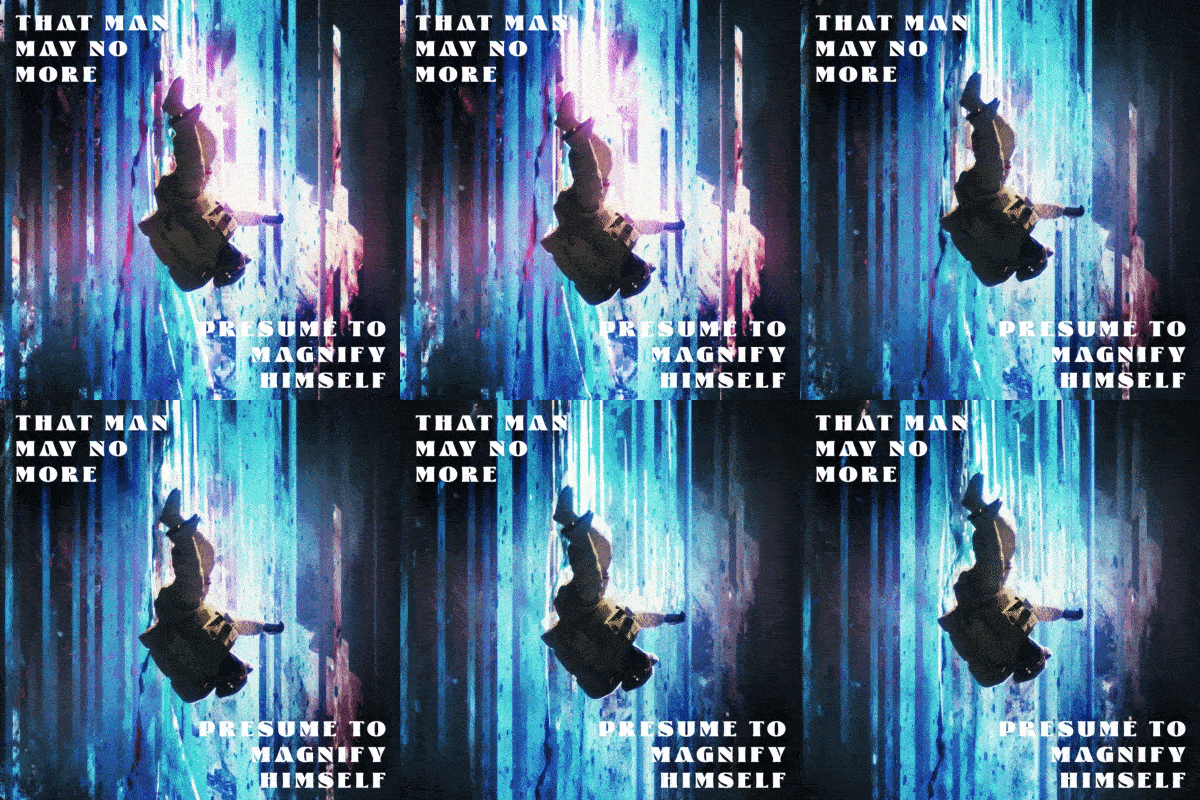
To finish out this Psalm’s animations I wanted to capture this notion of not exalting or magnifying oneself. I found this image of an astronaut and thought I could use it for this so I isolated it in Photoshop and applied some light wiggle hold animation in After Effects.
I found a nice abstract background and applied Stretch to it to create the quickly moving streaks, and tried to make it fast enough to simulate the rapid downward velocity of the astronaut. I then animated the Y position of the figure to give it a bit of presence.
I then added in the text, some other textures and color correction.
Enjoy.
To judge for the fatherless and for the humble, that man may no more presume to magnify himself upon earth.
(Psalm 9:39 DR)
View a higher quality version of this gif here: