

Psalm 95:1
the song you can't get out of your head
A canticle for David himself, when the house was built after the captivity. Sing ye to the Lord a new canticle: sing to the Lord, all the earth. (Psalm 95:1 DR)
Music can have profound effects on us, of which we are often unaware. A familiar song will trigger a memory, and suddenly the melody and lyrics bring you right back to that very moment, with all the feelings and thoughts associated with it.
For myself there are songs from each period of my life that have this effect where merely listening to them functions almost like a time machine where I can remember where I was and what I was doing and how I was feeling. It can be a little surreal, and if I am not careful the nostalgia or moodiness—the latter especially when I was a teenager—can be overwhelming and fabricate a false reality, even if only briefly.
It is also incredible how music can aid in memorization. There are songs I listened to decades ago that I haven’t heard for a long time, yet to this day I can still remember the lyrics perfectly. Music becomes an excellent medium to teach, whether for good or ill, which is why it is important to have discernment about the music we listen to.
In the early Church the arch-heretic Arius set his blasphemies to music, imitating popular and lewd styles so as to make his doctrine memorable. St. Athanasius describes the vulgarity and flippancy of his doctrine and hymns:
For with them for Christ is Arius, as with the Manichees Manichæus; and for Moses and the other saints they have made the discovery of one Sotades , a man whom even Gentiles laugh at, and of the daughter of Herodias. For of the one has Arius imitated the dissolute and effeminate tone, in writing Thaliæ on his model; and the other he has rivalled in her dance, reeling and frolicking in his blasphemies against the Saviour; till the victims of his heresy lose their wits and go foolish, and change the Name of the Lord of glory into the likeness of the “image of corruptible man,” and for Christians come to be called Arians, bearing this badge of their irreligion. (St. Athanasius, Discourses Against the Arians, Discourse I, Chapter 1, 2.)
Sotades was a Greek poet known especially for his vulgarity and satire, and the poetic meter named after him was variable, although generally half ionic and half trochaic. The sotadean meter was generally frowned upon by pagan grammarians as it had a reputation for effeminacy and indecency. St. Athanasius is of the same opinion of Arius’ work the Thaliae, which was written in a modified sotadean meter:
And hence a man may marvel, that, whereas many have written many treatises and abundant homilies upon the Old Testament and the New, yet in none of them is a Thalia found; nay nor among the more respectable of the Gentiles, but among those only who sing such strains over their cups, amid cheers and jokes, when men are merry, that the rest may laugh; till this marvellous Arius, taking no grave pattern, and ignorant even of what is respectable, while he stole largely from other heresies, would be original in the ludicrous, with none but Sotades for his rival. For what beseemed him more, when he would dance forth against the Saviour, than to throw his wretched words of irreligion into dissolute and loose metres? That, while “a man,” as Wisdom says, “is known from the utterance of his word,” so from those numbers should be seen the writer's effeminate soul and corruption of thought. (St. Athanasius, Discourses Against the Arians, Discourse I, Chapter 1, 4.)
Despite St. Athanasius’ campaign against Arius and the Council of Nicea’s condemnation of his doctrine, Arius did manage to spread his errors far and wide which would plague the Church for centuries to come.
This musical battle would be later joined by St. Ambrose who would become a prolific hymn writer using the iambic dimeter (8.8.8.8.) to present orthodoxy in song. And while the hymns of Arius have been largely lost to history, many of St. Ambrose are still sung to this day in the Divine Office.
The Psalmist speaks to the power of song by drawing an implicit distinction between the old song and the new song. By this he does not necessarily imply a temporal sense but rather a moral one; that between a life that has been and that which is to come.
The superscription as found in the Septuagint and retained in the Vulgate and Old Latin is that this Psalm is for “David himself, when the house was built after the captivity.” This is generally seen as historically referring to king David’s transfer of the Ark of the Covenant from the house of Obed-Edom to Jerusalem after the first failed attempt:
He made also houses for himself in the city of David: and built a place for the ark of God, and pitched a tabernacle for it. Then David said: No one ought to carry the ark of God, but the Levites, whom the Lord hath chosen to carry it, and to minister unto himself for ever. And he gathered all Israel together into Jerusalem, that the ark of God might be brought into its place, which he had prepared for it. (1 Chronicles 15:1-3 DR)
It might seem odd at first glance that the residence of the Ark at the house of Obed-Edom would be referred to as a captivity, but this speaks to the state of David’s mind in respect to the Ark after his first attempt to bring it to Mount Sion:
And David was troubled because the Lord had divided Oza: and he called that place the Breach of Oza to this day. And he feared God at that time, saying: How can I bring in the ark of God to me? And therefore he brought it not home to himself, that is, into the city of David, but carried it aside into the house of Obededom the Gethite. (1 Chronicles 13:11-13 DR)
Thus, when he finally builds a tabernacle for the Ark in Jerusalem and makes the proper preparations for its passage, he proclaims in this Psalm that a new song should be sung. The Ark had always been mobile within the Tabernacle, but now it will have a permanent home on Mount Sion, and eventually in the Temple (cf. Psalm 131). In this manner the old state of things has passed and the new has come, which is mirrored in king David’s own heart and mind. He had built houses for himself—which signifies the old manner of life that is fixated on the things of this world—but now builds a house in which the Ark can dwell, which signifies the turning of the heart towards the things of heaven. This act of building is then transferred to the entirety of the world, which prophetically describes the coming of the Messiah our Lord and the establishment of His throne in the Church:
With His cross He has vanquished kings, and fixed upon their forehead, when vanquished, that very cross; and they glory in it, for in it is their salvation. This is the work which is being wrought, thus the house increases, thus it is building: and that you may know, hear the following verses of the Psalm: see them labouring upon, and constructing the house. “O sing unto the Lord all the earth.” (St. Augustine, Expositions on the Psalms, 95, 2.)
This act of building is not only made concrete corporately in the Church but even more specifically in her members, who are as living stones (cf. 1 Peter 2:5, Ephesians 2:20-22) to her edifice. The distinction in the song that is sung thus becomes the translation from death to life and from sin to righteousness:
If all the earth sings a new song, it is thus building while it sings: the very act of singing is building: but only, if it sings not the old song. The lust of the flesh sings the old song: the love of God sings the new. Hear why it is a new song: the Lord says, “A new commandment I give unto you, that you love one another.” [John 15:12] The whole earth then sings a new song: there the house of God is built. All the earth is the house of God. If all the earth is the house of God, he who clings not to all the earth, is a ruin, not a house; that old ruin whose shadow that ancient temple represented. For there what was old was destroyed, that what was new might be built up. (St. Augustine, Expositions on the Psalms, 95, 2.)
St. Bellarmine concurs:
“Sing ye to the Lord a new canticle,” praise and thank him in joy and song, and it must be “a new canticle,” a beautiful canticle, and elegantly composed; also a canticle for fresh favors; in like manner, a canticle befitting men who have been regenerated, in whom avarice has been supplanted by charity; and, finally, a canticle not like that of Moses, or Deborah, or any of the old canticles that could not be sung outside the land of promise according to Psalm 136, “How shall we sing the song of the Lord in a strange land?” but a new canticle that may be sung all over the world; and he, therefore, adds, “Sing to the Lord all the earth,” not only Judea, but the whole world. (St. Robert Bellarmine, A Commentary on the Book of the Psalms, 95, 1.)
Just like an old song can trigger a memory and bring us back in mind to the time and place in which we heard it, so the temptations of this life and of the flesh can draw us back into our old way of life. If we keep singing the same songs that we knew in our old ways of life, we will always stay in that moment and be slaves to the allures of this world and the vices therein.
This is why the Psalmist on the moral level speaks of singing a “new song,” one that arises from that transformation of heart that only the work of grace and the outpouring of the Holy Ghost in Baptism can accomplish (cf. Romans 5:5). In our sins we were truly in captivity to our lusts and desires, but in the Church we are built into Christ and set free from that captivity of sin to live a new life. The Psalmist elsewhere speaks of this triumph of Christ over our captivity:
Thou hast ascended on high, thou hast led captivity captive; thou hast received gifts in men. (Psalm 67:19 DR)
The new song that we sing is thus the gift of ourselves that we give to our Lord, who redeemed us by His most precious blood. We no longer live for ourselves and our earthly desires but for the One Who gave Himself up for us. The renovation of the heart is the gift of God in His mercy to us, and He is the One Who transforms us. This new song is not something we generate out of ourselves but is the response of the soul in whom the Trinity dwells:
And he put a new canticle into my mouth, a song to our God. Many shall see, and shall fear: and they shall hope in the Lord. (Psalm 39:4 DR)
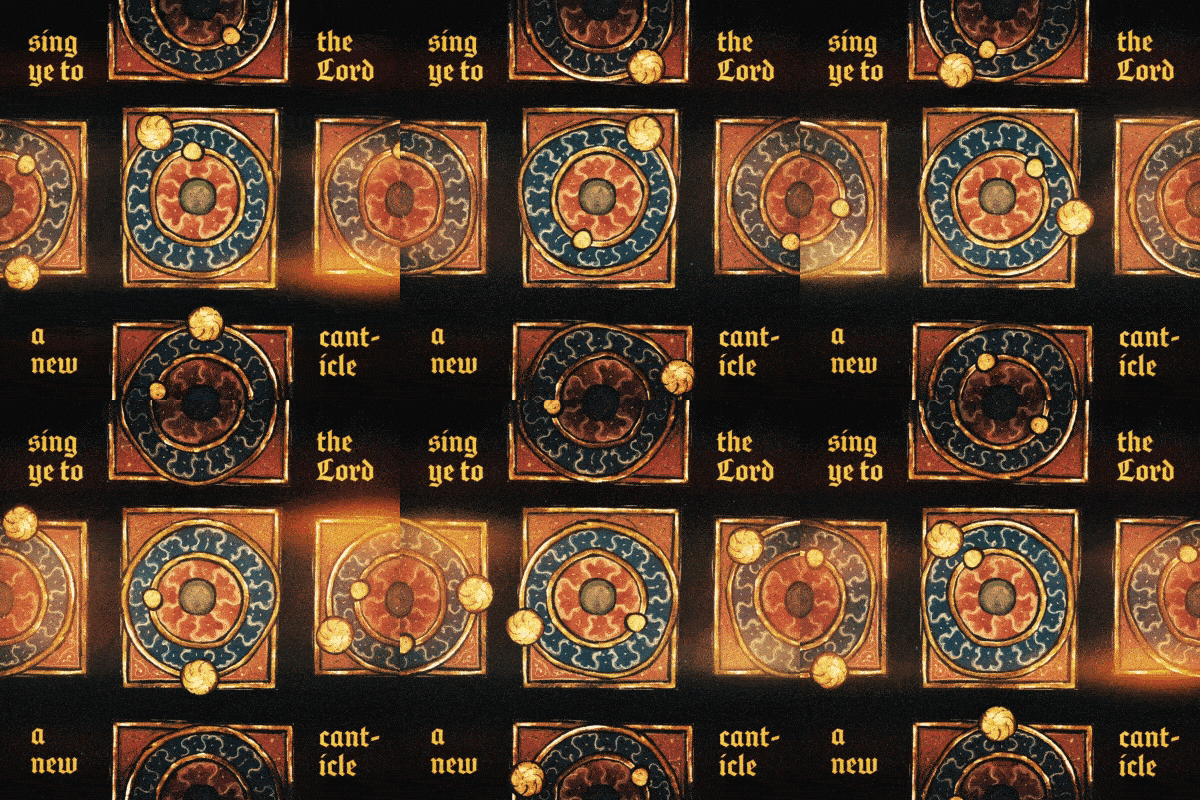
For this animation I found some interesting cosmological diagrams from a medieval manuscript (Ms. Ludwig XV 4 (83.MR.174), fol. 148) and decided to use this as the basis for this. I tediously separated the images from the background and then each object from the others, and used Generative Fill to fill in the missing pixels.
The animation part was much easier, as I precomped all the layers and then just animated the rotation, parenting the rings and celestial bodies concentrically. I then duplicated this precomp and added Time Remapping so I could offset the animations of the precomps.
I added in the text and applied some slight animation and then some color correction.
Enjoy.
A canticle for David himself, when the house was built after the captivity. Sing ye to the Lord a new canticle: sing to the Lord, all the earth.
(Psalm 95:1 DR)
View a higher quality version of this gif here: