

Before the face of the Lord, because he cometh: because he cometh to judge the earth. He shall judge the world with justice, and the people with his truth. (Psalm 95:13 DR)
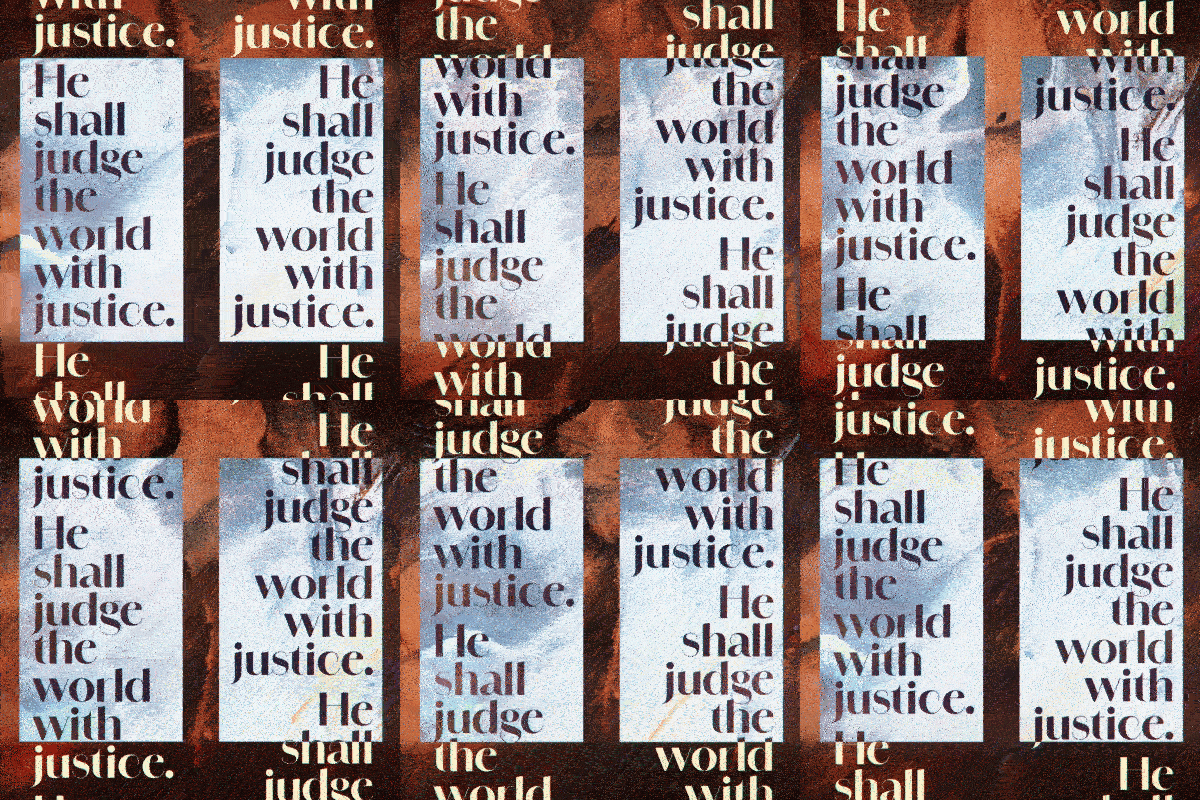
In the previous passages the two-fold advent of our Lord was presaged, but now the coming for the final judgment is fully in view as the culmination of our Lord’s salvific action. This passage carries over the thought of “rejoicing” from the previous, the idea being that this rejoicing is because the Lord comes to judge.
The plains and trees of the wood from the previous passage are those who have received mercy from the Lord and have been grafted into Him and built into His holy Church; thus, the coming judgment of the Lord is not for them a time of dread but rather of joy, for their redemption is at hand (cf. Luke 21:28):
All the things above named will rejoice in the presence of the Lord, “because he cometh” to redeem the world in his mercy, and because he will come again to judge it in his justice. Then they will have to say that the last judgment will be, at once, most terrible and most joyous; terrible to the wicked, a source of unbounded joy to the just. (St. Robert Bellarmine, A Commentary on the Book of the Psalms, 95, 13.)
In the Gospels the Lord gives warnings about His second coming in judgment, specifically in regards to being prepared for this advent:
Take ye heed, watch and pray. For ye know not when the time is. (Mark 13:33 DR)
In the Vulgate the word for “watch” is vigilate, which in this case means “to be watchful,” from whence English derives the word vigilance. A vigil in the ancient world was one of the four “watches” of the night, during which military units would literally watch or be on guard for that period of time. There could be severe penalties for soldiers who failed to stay awake while on duty, and thus this admonition of our Lord is that our watching for His return should be like the soldier on alert.
St. Augustine reads further into this Gospel account and notes that when our Lord speaks of the woe that is for those who are with child or breastfeeding at the time of these things, it should be understood figuratively for those who still cling in hope to the desires of this world. For these desires of the world dull our senses and lull us to sleep, making us slothful in our watching, like the five foolish virgins who were not prepared for the bridegroom’s coming (cf. Matthew 25:1-13). Rather, we should be sober and watch, as St. Peter exhorts (cf. 1 Peter 5:8), and look with expectation for the coming of our Lord in judgment, not with fear but with hope:
For what sort of love is it of Christ, to fear lest He come? Brethren, are we not ashamed? We love Him, and yet we fear lest He come. Are we sure that we love Him? Or do we love our sins more? Therefore let us hate our sins for their own sake, and love Him who will come to punish our sins. He will come, whether we like or not: for because He comes not just now, it is no reason that He will not come at all. He will come, and when you know not; and if He shall find you ready, your ignorance is no hurt to you. “Then shall all the trees of the wood rejoice before the Lord;” for He comes: at His first coming. And what afterwards? “For He comes to judge the earth. And all the trees of the woods shall rejoice.” He came first: and later to judge the earth: He shall find those rejoicing who believed in His first coming, “for He comes.” (St. Augustine, Expositions on the Psalms, 95, 14.)
It is precisely because we await the “redemption of our bodies” (Romans 8:23) that the second coming of our Lord in judgment should be a source of joy rather than of fear. For in that day of judgment all accounts will be settled, all wrongs made right, and the vindication of the righteous will be manifest to all. As St. Augustine noted above, if we truly love God, then we will desire what He desires, which is His judgment of the world with justice. The will and heart that is united to our Lord loves the things that He loves and thus desires that justice be done.
In our limited and finite faculties we do not always see how God’s justice is worked in the world, and it is far too easy to project our own impoverished notions of justice upon God, which inevitably leads us into error. But as St. Paul exhorts:
Revenge not yourselves, my dearly beloved; but give place unto wrath, for it is written: “Revenge is mine, I will repay, saith the Lord.” (Romans 12:17 DR)
It is the part of faith to trust in the perfect justice of God, that He will judge in justice and in truth. We ultimately cannot adjudicate these things for ourselves by our own lights, but must submit our intellect and wills to Him, trusting that “there is one lawgiver, and judge, that is able to destroy and to deliver” (James 4:12 DR).
This judgment of the Lord is complete in its scope, for He shall judge “the world” and “the people.” This parallelism expands the thought by means of specificity, for “the world” embraces the scope of God’s judgement, whereas “the people” is more specifically about what is being judged; namely, men and their actions. This judgment is both “in justice” (in æquitate) and “in truth” (in veritate). The word “æquitate” means uniformity, equanimity or impartiality, and thus the judgment of God is not based upon status or race or wealth or any of the other things that man is prone to judge or be influenced by, but is purely determined by the correspondence (or lack thereof) of man’s deeds to God’s law. “Veritate” is truthfulness or “the” true, and since God is truth Himself, God is the truth by which all things are judged to be true or false.
St. Bellarmine notes that this reality of the coming judgment is a prime motivation to be watchful as our Lord commands:
He concludes by predicting what sort the judgment will be; one that will be in accordance with the justice and the truth that always characterized him, and by virtue of which he always fulfills what he promises, and he has promised to reward every one according to his works; to have no regard of persons, and to judge in all justice. Such will be his mode of judging, and in no other way will he judge. Such an expression ought to knock the sleep out of men’s eyes and arouse them; nor should we imagine, for a moment, that because God deals patiently with us, and defers the sentence, that we will escape the judgment; for he that promised so much, and was so true to his promises, cannot possibly lead us astray in this one thing of so much importance. Is it possible, says St. Augustine, that God could have been so faithful in everything, and so false as to the day of judgment? (St. Robert Bellarmine, A Commentary on the Book of the Psalms, 95, 13.
St. Augustine concludes his exposition on this Psalm by noting that this judgment of the world includes the totality of it:
“For with righteousness shall He judge the world:” not a part of it, for He bought not a part: He will judge the whole, for it was the whole of which He paid the price. (St. Augustine, Expositions on the Psalms, 95, 15.)
As proof of this, he quotes from the Gospel about the Lord gathering His elect from the four winds (cf. Mark 13:27), seeing in this a picture of the entire world, not only at the time of His coming, but for all time, for in the four winds is the name Adam signified and thus representative of the entire world:
For Adam himself (this I had said before) signifies in Greek the whole world; for there are four letters, A, D, A, and M. But as the Greeks speak, the four quarters of the world have these initial letters, 'Ανατολὴ, they call the East; Δύσις, the West; ῎Αρκτος, the North; Μεσημβρία, the South: you have the word ADAM. Adam therefore has been scattered over the whole world. He was in one place, and fell, and as in a manner broken small, he filled the whole world: but the mercy of God gathered together the fragments from every side, and forged them by the fire of love, and made one what was broken. (St. Augustine, Expositions on the Psalms, 95, 15.)
Thus, from the earliest days of our first parents to the end of time at the coming of our Lord, God in His mercy will gather together the elect and bring them to redemption, which is signified from the very creation of man. The upshot of this is that God desires that man come to salvation; this in fact is the impetus for the first coming of our Lord to redeem us, and the second coming in judgment will bring that to completion. Our hope, therefore, is in the Lord Who is coming to redeem us, and those who are members of His Body and are united to Him as the branch is to the vine should lift up their eyes and look for their salvation, which is close at hand:
That Artist knew how to do this; let no one despair: it is indeed a great thing, but reflect who that Artist was. He who made, restored: He who formed, reformed. What are righteousness and truth? He will gather together His elect with Him to the judgment, but the rest He will separate one from another; for He will place some on the right, others on the left hand. But what is more just, what more true, than that they shall not expect mercy from their Judge, who have refused to act mercifully, before their Judge come? But those who chose to act with mercy, with mercy shall be judged. (St. Augustine, Expositions on the Psalms, 95, 15.)
I wanted to keep this final animation for this Psalm kind of simple and focus on the text, and so I created these looping movements of blocks of text. I started by laying out the text and precomping it, and then adding a bit of padding to sides of the precomp. Back in the main composition I added Motion Tile and animated the Source Point to get the loop.
Next I created a simple box to use as a Matte, and then duplicated the text block and changed the color and matted it to that box to reveal it. I precomped these layers and duplicated that in the Project panel to create a new instance and repeated the same operation, justifying the text to the right and reversing the animation. I then moved this over to the other side to have opposite moving text blocks.
I found an abstract texture and applied a couple instances of loopFlow to animate the texture. I finally added in some color correction.
Enjoy.
Before the face of the Lord, because he cometh: because he cometh to judge the earth. He shall judge the world with justice, and the people with his truth.
(Psalm 95:13 DR)
View a higher quality version of this gif here:


