

For the Lord is great, and exceedingly to be praised: he is to be feared above all gods. (Psalm 95:4 DR)
As humans we are not very good at dealing with large numbers of anything, whether it be stacks of money or the stars in the sky. You have probably seen those charts that compare the size of a thousand dollars to a million to a billion to a trillion, and the exponential nature of the increase in size is staggering. We have to create visuals that fit into our frame of reference to be able to even begin to contemplate them.
After all, I could say the number “trillion” and you would intellectually know what that means, but there would be almost nothing you could compare it to. I could then say two trillion and you would intellectually grasp that it is twice as much, but what that actually entails for any given thing or set of things would be beyond anyone’s capability.
In my own work I have experienced this scaling up on an everyday basis. When I first started in graphic design and animation it was just as things were transitioning from SD to HD. SD (standard definition) was generally defined as 720x480 as measured in pixels, whereas the first form of HD (high definition) was 1280x720. For SD this amounted to a total of 345,600 pixels, which means that the jump to HD was to 921,600 pixels, or more than 2x more pixels, which makes a difference depending on the hardware of your computer.
HD eventually increased again to 1920x1080 or 2,073,600 pixels, again more than 2x as many pixels. 4K doubled the resolution to 3840x2160, which in terms of pixels is 8,294,400, or 4x more pixels. Needless to say, the early days of 4K projects were always a struggle, as that is a lot of pixels to push.
As I’m working I don’t generally notice each individual pixel unless there’s something very specific I am working on, but even then I am zoomed in enough that there are only hundreds rather than millions of pixels in view. It is in zooming out that I can take in the entirety of what I am working on, even though it is comprised of millions of pixels. I cannot possibly take in each one individually at once, and if I tried to I would never get anywhere. I am thus forced to hold all these pixels at a conceptual distance, to treat them as one thing so that I can actually make some progress in my work.
The Psalmist pulls back in this passage to take a macroscopic view. God is infinite and cannot be fully known or comprehended by anyone but Himself; thus all our concepts of God are necessarily limited in scope. I cannot hold the millions of individual pixels on my screen in mind at once, let alone God Who is above all things and yet as present to each of the millions of pixels of my screen as to anything else in the created order.
This mind-blowing reality causes the Psalmist to retreat to the most generic of language as he says: The Lord is great. This greatness implies a loftiness of dignity and supremacy, and our speech is too poor to even begin to unpack this greatness. We are thus forced by our limitations to compare God to other great things, such that we rightly say He is above them. Yet even this smuggles in our finitude, for to compare God with other created things starts off incorrectly from the beginning, for God is not a created being but is rather Being itself and that from which all that is derives its being.
Such a reality caused many of the Church Fathers (such as St. Dionysius the Areopagite) to speak of God apophatically, which is to not speak of God in respect to what He is but rather by means of what He is not. By doing so we can help to purify our concepts so that when we do speak of God in terms of what He is, we are not deceived by our own limitations and finite manners of description.
To speak of God as great is thus to recognize that this greatness is not in terms of degree in comparison to created things but instead in terms of kind, for the essence of God is completely different than that of any created essence, so much so that even to use the term essence for God and for created things can lead into problems if we imagine that God’s essence is just a higher or greater form than our own. Rather, His greatness is praised in absolute terms, as St. Bellarmine notes:
In this consists his glory, that he is absolutely great, whether in regard of his power, his wisdom, his goodness, his authority, his riches, or in any other point of view; and that he should be, and is actually praised in proportion to such greatness, and hence the heavens and the earth are full of his glory. (St. Robert Bellarmine, A Commentary on the Book of the Psalms, 95, 4-5.)
However, since our language has difficulty in speaking in absolute terms full stop, the Psalmist expands upon this greatness through the poetic parallelism of the second clause, in which this greatness of the Lord is exceedingly to be praised. The word exceedingly in the Vulgate is nimis which as an adverb speaks of doing something excessively or too much. It can also modify a previous verb in the sense of likewise. And since we are speaking of God Whose greatness is unparalleled and unfathomable, both senses can be appropriate here.
In English the term excessive tends to have the connotation of something disordered or over the top, but perhaps gets at what the Psalmist is trying to convey. Whenever we are overly profusive in our praise of something it tends to feel forced and artificial, but that is because the object of praise is not worthy of such adulation. But in the case of God there is no amount of praise sufficient to declare His greatness, and thus the idea here is that it is not possible for man to overdo it in His declaration of God’s wonder and greatness.
The other sense places the impetus on man to muster the utmost of his efforts and will to glorify the Lord, for if God’s greatness is being spoken of in absolute terms, then it demands a commensurate response. That is, the greatness of God requires an equally great measure of worship. For created beings this is of course impossible, and it is this realization that is behind the Psalmist’s words, for God’s greatness will thus always be beyond what we can ascribe unto Him. The interplay between the apophatic and cataphatic is thus fittingly and concisely realized in this passage.
St. Augustine teases this out by noting the paradox that exists in the Incarnation, in which the greatness of God is manifested in the lowliness of our Lord:
“For the Lord is great, and cannot worthily be praised.” What Lord, except Jesus Christ, “is great, and cannot worthily be praised?” You know surely that He appeared as a Man: ye know surely that He was conceived in a woman's womb, you know that He was born from the womb, that He was suckled, that He was carried in arms, circumcised, that a victim was offered for Him, that He grew; lastly, you know that He was buffeted, spit upon, crowned with thorns, was crucified, died, was pierced with a spear; ye know that He suffered all these things: “He is great, and cannot worthily be praised.” Despise not what is little, understand what is great. He became little, because you were such: let Him be acknowledged great, and in Him you shall be great... For what can a small tongue say towards the praise of the Great One? By saying, Beyond praise, he has spoken, and has given to imagination what it may conceive: as if saying, What I cannot utter, do thou reflect on; and when you shall have reflected, it will not be enough. What no man's thought utters, does any man's tongue utter? “The Lord is great, and cannot worthily be praised.” Let Him be praised, and preached: His honour declared, and His house built. (St. Augustine, Expositions on the Psalms, 95, 4.)
The translator of St. Augustine here takes a bit of liberty with St. Augustine’s quotation of this passage, which matches the Vulgate. For he translates et laudabilis nimis as “and cannot worthily be praised.” But he presumably senses in St. Augustine an attempt to probe deeper into the paradox, as demonstrated by the small tongue being unable to utter the praises of the greatness of God. The apophatic thus manifests itself and provides another approach to understanding God’s greatness, which cannot be fully understood and thus cannot be “worthily praised.”
However, that this occurs within the context of the Incarnation opens up the reconciliation (as it were) of the apophatic and the cataphatic, for in our Lord’s Incarnation the Godhead is hypostatically united to the human nature, the Creator to the created. The God Who is invisible can be seen by our eyes, and in this great condescension the majesty and power of God dwells among us in a more comprehensible form. We cannot ever grasp the mystery of the Godhead fully, but we can grasp the hand of our Savior who stretched out His hands on the cross for our salvation.
This mystery is brought to its perfection and consummation in the Holy Sacrifice of the Mass, for while we cannot offer to God praise and sacrifice that is worthy of His absolute greatness, our Lord Jesus Christ Who is both High Priest and God Himself can and does offer this sacrifice, and thus renders to God what His greatness is due. As we join ourselves to the offering of that One Sacrifice through the offering of the priest acting in persona Christi at Mass, we as the Body of Christ are joined to our Head in that perfect rendering of thanksgiving, praise, worship and honor.
The pagan sacrifices of antiquity were meant to placate or ingratiate oneself to the gods who were not the absolute, but were simply higher in degree than the rest of the world. In fact, some of the gods had previously been men who through heroism or other such great deeds had ascended to godhood. Their purported greatness was thus comprehensible and therefore capable of offerings and declaration.
But the greatness of the Lord is altogether different in kind, which is why He is to be feared above all gods. This is not simply because He is more powerful or older or any other such degrees that did exist between the pagan gods, but rather because He is altogether distinct from them in kind, as will be seen in the next passage. His greatness, after all, is absolute and thus not comparable to what men know as gods.
This forms the paradox and scandal of the Incarnation, for our Lord was not some god-human hybrid like a Hercules nor merely divinity hiding behind the visage of created being like Zeus in his various scandalous escapades or the fever dreams of the Docetists with their laughing Christ on the cross. The union between the divine and human natures in the Incarnation was one of unmingled union in which the subject of the union was God Himself, the Eternal Word made flesh:
Who is the image of the invisible God, the firstborn of every creature: For in him were all things created in heaven and on earth, visible and invisible, whether thrones, or dominations, or principalities, or powers: all things were created by him and in him. And he is before all, and by him all things consist. And he is the head of the body, the church, who is the beginning, the firstborn from the dead; that in all things he may hold the primacy: Because in him, it hath well pleased the Father, that all fullness should dwell; and through him to reconcile all things unto himself, making peace through the blood of his cross, both as to the things that are on earth, and the things that are in heaven. (Colossians 1:15-20 DR)
The fullness of divinity as it exists in the Incarnation was not only made present in the Incarnation, but is continually done so in the Blessed Sacrament, which is truly the Body, Blood, Soul and Divinity of our Lord Jesus Christ. Through this sacrament in the Holy Sacrifice of the Mass the greatness of God—which is beyond comprehension—is manifest in terms that we can see and touch and make one with ourselves through reception of the Eucharist. In this manner the language that the Scriptures use of the mystery of Christ and the Church is revealed and brought to fruition, for as members of Christ’s Mystical Body we are joined to the Eternal greatness of God and made to participate in it (cf. 2 Peter 1:4), which will one day transform faith into seeing and believing into knowing.
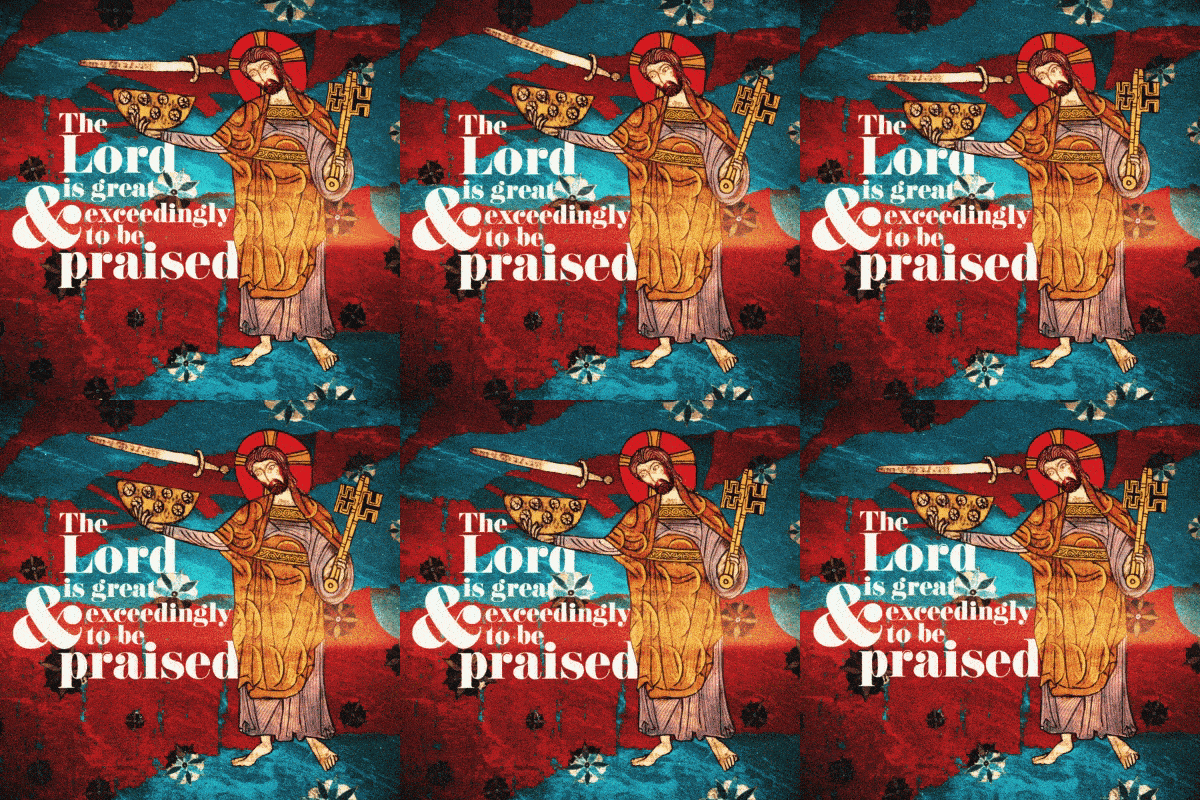
As I was thinking through what to do for this animation, I was thinking of the mystery of God’s greatness, and how mystery in Greek—μυστήριον—means something hidden that is revealed. Naturally, the Apocalypse is this great revealing (revelation) or (literally) unveiling of our Lord Jesus Christ, and I was struck by the first chapter in which St. John is given this vision of our Lord which makes him fall down as though dead.
This Apocalypse has proved fertile ground for many artistic representations, and often the medievals crafted intriguing depictions of the Apocalypse. This particular representation is derived from one of the many Beatus manuscripts that treat of the Apocalypse, this one from the Navarra Beatus.
I isolated the figure and various elements in Photoshop and used Generative Fill to fill in many of the missing pixels, which worked fairly well. In After Effects I rigged up the main portion of the figure using the Puppet Tool and mapped the pins to Nulls using Puppet Tools 3. I then animated the various elements to create the looping animations and offset them to give it a bit of a more organic feel. In the original the sword is further behind the face (as the sword is coming forth from the mouth in the account) , but I placed it a bit further away to not have things bumping into each other too much.
I added in some textures and the laid out the text and added in some color correction and a little bit of noise.
Enjoy.
For the Lord is great, and exceedingly to be praised: he is to be feared above all gods.
(Psalm 95:4 DR)
View a higher quality version of this gif here:


