

For all the gods of the Gentiles are devils: but the Lord made the heavens. (Psalm 95:5 DR)
After twenty centuries of Christianity we perhaps take monotheism for granted, but for fallen humanity this is not some sort of default mode. Indeed, the current reassertion of paganism in many forms even in the Western world—the so-called Rise of the Old Gods—demonstrates that these old gods die hard.
For while modern man in his supposed sophistication and self-assessed superiority is not wont to bow before images made of stone and render homage to them, we erect gods of all kinds in ways our forebears could not have imagined. Some pagans perhaps thought that the idol itself was the god, but many recognized that the idol stood for something beyond the materials out of which it was made and was a conduit of sorts to that greater reality.
The problem with idolatry is that it is worship given to something other than God, as only God is due adoration, known in Latin as latria. The representations of the divine in the idols of old were specifically of man- made realities, but not realities that he discovered for himself. Rather, lurking behind the gods and the idols of man are malignant spirits that wish to deceive and turn the heart of man to lesser things.
The Psalmist in the previous passage described how God is to be feared above all gods, and now in this passage qualifies this use of the term “gods.” He does not intend God to be understood as one divinity among many, but as categorically different from the gods of the nations. For these gods, the Psalmist bluntly states, are actually devils or demons. It is interesting that St. Jerome’s Hebrew translation leaves out this assignation of the gods of the nations to the devils; instead it at best hints at this reality, as it reads:
Omnes enim dii populorum sculptilia : Dominus autem caelos fecit.
For all the gods of the nations are idols, but the Lord made the heavens.
The Septuagint, on the other hand, reads δαιμόνια, which the Vulgate and Old Latin render as daemonia, which is devils or demons. St. Paul certainly was making use of the Septuagint when he alludes to this passage:
But the things which the heathens sacrifice, they sacrifice to devils, and not to God. And I would not that you should be made partakers with devils. (1 Corinthians 10:20 DR)
In this manner the worship of these false gods is not merely some innocent act of ignorance in which man is reaching out for God or finding some other path to God, but is rather a diabolical deception that is specifically meant to blind him from the worship of the true God. Origen of Alexandria describes how the very rituals demonstrate this:
We may also learn the true nature of demons if we consider the practice of those who call on them by charms to prevent certain things or for many other purposes. For this is the method they adopt, in order by means of incantations and magical arts to invoke demons and induce them to further their wishes. (Origen, Against Celsus, 7.69. ACCS.)
At the root of paganism is thus the primordial temptation in the Garden, when our first parents were tempted to further their own desires in disobedience to God, to make themselves into gods, knowing good and evil by their own lights. This is the choice that the devils also made and thus continually tempt all men to make, whether in terms of statues of gold and silver or of following their own desires and ideologies.
Various currents of thought within what I term the “Rainbow Reich,” wherein one rejects the givenness of one’s own sex for that of trans-ideology, is no less idolatrous, for it sets itself up as the master of one’s own nature, rather than accepting in gratitude what God has given within the order that God has established. Abortion is nothing less than the revival of the infant sacrifices to Moloch with perhaps even less sophisticated reasoning, for at least the pagans of old had the hope of better harvests and future marital fertility, whereas the immolations performed today get much less in the bargain.
But at base is the same desire as the pagans offering incense to statues of stone, that this act of adoration will gain favors of some sort which the god offers in return. And the demons are often initially generous, which forms an integral part of the deception. Our race’s lust for power easily blinds us to the darkness we let into our hearts, and eventually we worship because we begin to love the darkness.
In his disputation with the philosophers in Athens, St. Paul notices that they have this altar dedicated to the Unknown God (cf. Acts 17:23) amongst all the other idols. It is perhaps significant that they only had an altar and not an idol, for as this Unknown God was Unknown, they could not develop a likeness for Him. They implicitly understood that He should be worshipped (hence the altar), but they had no concept of Him like the other gods by which to represent Him.
In this manner their worship of the Unknown God was not idolatrous in the same sense, for they were not constraining the divine to an image like Zeus or Apollo or any other such god, who each had specific attributes, histories, were linked to certain cities or nations, etc. These other gods of the pantheon were self-circumscribed beings; that is, they were not imagined themselves to be the Supreme Principle, but at best parts of the divine in some pantheistic conception. This Unknown God they did not know yet still understood to exist; their worship of Him was thus not explicitly to demons, but also not yet to Him.
The Stoics with whom St. Paul disputed had some conception of the Supreme God, in that the “gods” were facets or representations of the attributes of divinity, although this was only hazily understood and the gods often blended into the world in a pantheistic miasma. The Epicureans were just as likely to imagine the gods didn’t exist and often held to a chaotic and providence-free universe, whether the gods existed or not. St. Paul thus mocks them for their superstition, for they—presumably of all the sophisticated philosophers—should be aware of the silliness of a city full of idols to all and sundry.
However, St. Paul focuses in on this altar to the Unknown God. They worship what they do not know (presumably so they do not leave anyone out!), but now they will have what they do not know proclaimed to them. In contrast to the Epicureans it is the providence of God in the world that works in all things, and in contrast to the Stoics this God is utterly distinct from creation. And unlike the gods of the nations whom man has discovered and rendered images of in the likeness of man or of beasts, fashioned in wood or stone or metal, the Unknown God has made Himself known by taking flesh in our Lord Jesus Christ, through Whom He will judge the nations.
In the case of the gods of the nations, man takes the initiative to seek out divinity, to create rituals and such so as to lay ahold of the divine and gain power and favor as a result. But in true religion God is the cause of man’s redemption, Himself acting through human history and preeminently revealing Himself in our Lord Jesus Christ.
The rituals of the gods are the rituals of demons, for in the worship of them man offers sacrifice of his own substance and for his own advancement, like the heroes of old offering hecatombs for success in battle or to ward off pestilence.
But in the true worship of God in the Holy Sacrifice of the Mass it is the God-man Jesus Christ our High Priest Who offers Himself as the Sacrifice of Atonement. This is the High Priest that has passed into the Heavens (cf. Hebrews 4:14), signifying that He is the One of Whom the Psalmist speaks here. For while the gods of the pagans are demons, “the Lord made the Heavens.” It is precisely because our Lord Jesus Christ is the One by Whom all things were made that He could pass into the heavens, and thus He is alone the One Who is to be worshiped:
The Church, in speaking of the good Angels, who are sometimes called gods, says, “The Angels praise, the dominations adore, the powers tremble before thy majesty;” and of the fallen angels, who, too, are improperly called gods by the ignorant, St. James says, “the devils also believe and tremble;” and, as David alludes to false gods, especially in this Psalm, he, therefore, assigns a reason for our God being feared above all gods, when he says, “For all the gods of the gentiles are devils; but the Lord made the heavens;” that is to say, God is to be feared above all false gods, erroneously adored by the gentiles, because the gods of the gentiles are not true gods, but demons, who, through pride, have revolted from the God who created them, and have been doomed by him to eternal punishment; “but the Lord,” instead of being a spirit created, is a creating spirit, who “made the heavens,” the greatest and the most beautiful things in nature, as well as everything under its canopy, that is, all things created. (St. Robert Bellarmine, A Commentary on the Book of the Psalms, 95, 4-5.)
His greatness that above all things and His divinity as Creator of all is what ultimately makes Him above all gods, not simply that He is higher than the other gods but rather because He is the Creator of the heavens and all within, including those fallen angels whom men mistake for “gods:”
If he were to say, “above all gods, for the gods of the heathen are devils,” and if the praise of our Lord stopped here, he had said less than we are accustomed to think of Christ; but when he said, “But it is the Lord that made the heavens;” see what difference there is between the heavens and devils: and what between the heavens and Him who made the heavens; behold how exalted is the Lord. He said not, But the Lord sits above the heavens; for perhaps some one else might be imagined to have made them, upon which He was enthroned: but, “It is the Lord that made the heavens.” If He made the heavens, He made the Angels also: Himself made the Angels, Himself made the Apostles. The devils yielded to the Apostles: but the Apostles themselves were heavens, who bore the Lord... O heavens, which He made, declare His honour unto the heathen! Let His house be built throughout the earth, let all the earth sing a new song. (St. Augustine, Expositions on the Psalms, 95, 6.)
The worship which we thus rightly owe to God is not something we generate out of ourselves but is done by our uniting ourselves to the One Sacrifice of the Mass which our Lord Jesus Christ offers to the Father. All other devotions and acts of piety which we render to God issue forth from this act of religion and worship, and in doing so we order our worship rightly and keep ourselves from the worship of demons.
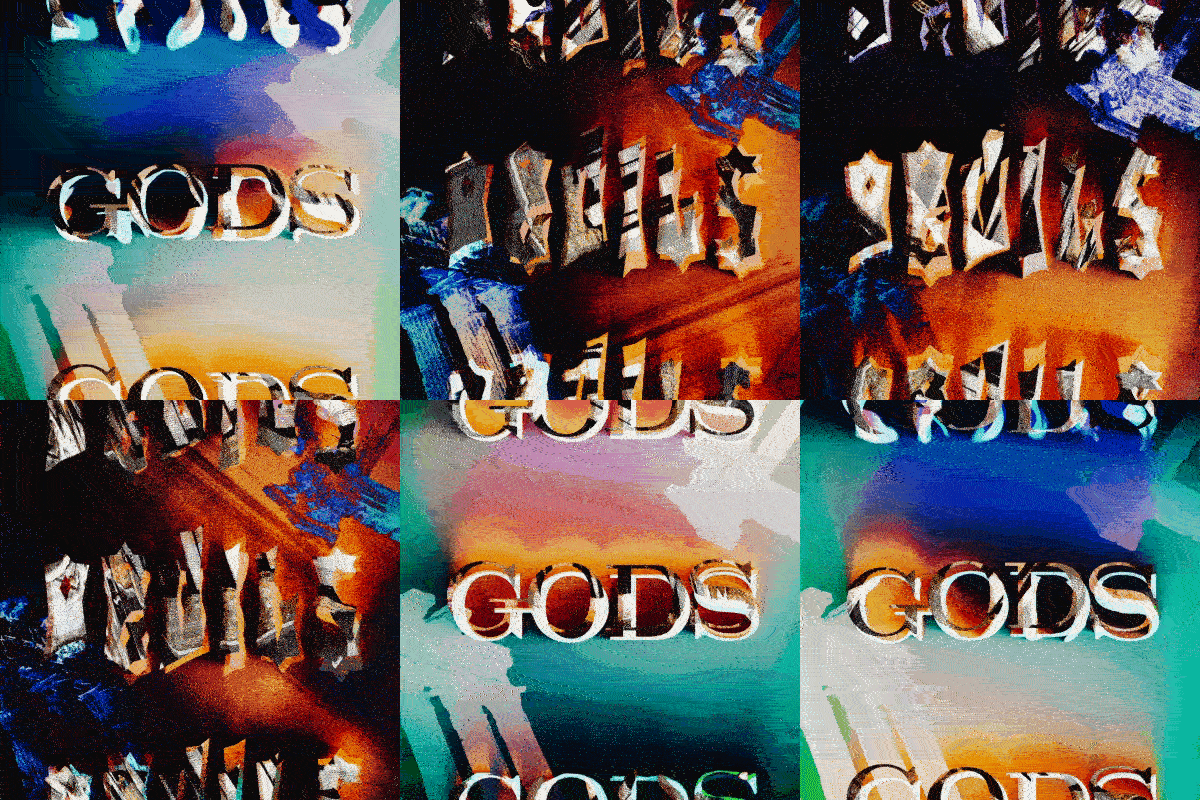
I wanted to somehow give the idea of how the devils are lurking behind the gods, and so I thought some sort of text morph might work.
I started y laying out both pieces of text in a precomp and animating the Opacity of both layers to blend into each other. I then applied a Gaussian Blur as this was animating and then applied a Levels Adjustment and moved the Black and White value sliders in towards the middle to constrain the amount of blurred pixels. This creates the blobby effect without the overly soft edges of the Gaussian Blur.
I added some Layer Styles and duplicated the precomp a few times to offset a bit for visual interests and added Shadow Studio 3 to the bottom layer to pull it out from the background a bit. I precomped all this and put it into the main composition and animated the background color during the transition to create the overall effect. I added in some final textures and color correction and called it done.
Enjoy.
For all the gods of the Gentiles are devils: but the Lord made the heavens.
(Psalm 95:5 DR)
View a higher quality version of this gif here:


