

Praise and beauty are before him: holiness and majesty in his sanctuary. (Psalm 95:6 DR)
Confession is good for the soul, so it is said, and this is because confession at its root is a realization and performance of what is true. Not only in the banal sense of saying what is true, but actually doing so in a manner that is difficult, for in confession one admits a truth this is not flattering to oneself, a truth that pertains to some defect or failure or sin, and we as a race are not inclined to this sort of truth-telling.
God is the ultimate truth, and in fact is Truth Himself, and so any approach unto God necessarily involves confession, both in terms of Who He is in terms of His perfection, and in terms of ourselves in relation to that perfection.
The saints and angels—although not divine—nevertheless have a perfect conformity to the truth, for their intellects and wills are completely in sync with what it true, and thus what is perfect and good. St. Michael in his battle with Lucifer made this confession of the truth from when he derives his name: Who is like God? In this manner he serves as a paradigm of all the saints and angels, for his entire identity is derived from the confession of Who God is and the conformity of his will and intellect with that confession.
The Psalmist contrasts the so-called gods of the pagans—who are actually demons—with the perfection of the Lord Who made the heavens, speaking of how praise and beauty are before Him. These two designations speak to a cause and effect of sorts, as the praise or confession leads the soul to beauty.
In the Vulgate the word that is translated as praise in the Douay-Rheims is confessio, from which we derive confession in English. In the Latin of the Vulgate it is not restricted to the type of confession that we normally associate with the word in modern English, but was broader to include the sense of acknowledge. And since the object of this confessio is God, the acknowledgement is one of praise. In later Ecclesiastical Latin confessio would become more restrictive in sense to that of a creedal formulation or of the type of confession the martyrs made of Christ, this ultimate formulation of praise as offered in the sacrifice of their very lives.
St. Augustine—knowing full well the semantic range of confessio—nevertheless develops his interpretation of this passage based on the sense in which modern English tends to give it, that of the confession of one’s sins. He sees in the very word order the movement from death to life that confession brings about in the soul:
“Confession and beauty are before Him.” Do you love beauty? Wishest thou to be beautiful? Confess! He said not, beauty and confession, but confession and beauty. You were foul; confess, that you may be fair: you were a sinner; confess, that you may be righteous. You could deform yourself: you can not make yourself beautiful. But of what sort is our Betrothed, who has loved one deformed, that he might make her fair? How, says some one, loved He one deformed? “I came not,” said He, “to call the righteous, but sinners.” [Matthew 9:13] Whom callest Thou? sinners, that they may remain sinners? No, says He. And by what means will they cease to be sinners? “Confession and beauty are before Him.” They honour Him by confession of their sins, they vomit the evils which they had greedily devoured; they return not to their vomit, like the unclean dog; [2 Peter 2:22] and there will then be confession and beauty: we love beauty; let us first choose confession, that beauty may follow. (St. Augustine, Expositions on the Psalms, 95, 7.)
This reading is fascinating as it draws from the very mission of our Lord to rescue us from our sins, noting that this act of redemption redounds to the praise and glory of His name. As our Lord says:
I say to you, that even so there shall be joy in heaven upon one sinner that doth penance, more than upon ninety-nine just who need not penance. (Luke 15:7 DR)
In confession and penance we are conformed more and more to the likeness of our Betrothed, as St. Augustine says, for our wills and hearts and turned towards Him and what He desires and away from the things that deform us. Sin deforms; confession transforms.
St. Augustine draws out a similar thought in that we look at the angels who are ontologically higher than us, and when we consider them as they are in their power, we might we might wish to be like unto them. Our race’s thirst for power certainly tends to reach beyond its grasp. However, very rarely do we consider the purity and holiness of the angels, which is what chiefly characterizes their splendor:
Again, there is one who loves power and greatness: he wishes to be great as the Angels are. There is a certain greatness in the Angels; and such power, that if the Angels exert it to the full, it cannot be withstood. And every man desires the power of the Angels, but their righteousness every man loves not. First love righteousness, and power shall follow you. (St. Augustine, Expositions on the Psalms, 95, 7.)
After all, the demons who have become the gods of the nations once had this same purity as the good angels; Lucifer himself had the name “Light-bringer.” Yet in their pride they turned their wills from God and lost the very righteousness and holiness that makes the good angels what they are. The devils are more powerful than humans on the ontological level, but when the human heart is aligned with God’s will and cooperating with His grace, then even the demons stand powerless before them:
Be subject therefore to God, but resist the devil, and he will fly from you. (James 4:7 DR)
The second half of this passage builds and expands upon the first, for the holiness flows forth from the praise or confession and the majesty is the culmination of the beauty. In a way the first half of this passage describes the experience of the Church Militant and her members who struggle against sin in this life and go—through God’s grace—from virtue to virtue (cf. Psalm 83:8), from confession and praise to the beauty of friendship with God.
But in the second half of the passage the ultimate unity of God and His beloved is described, for praise and beauty were before Him; now holiness and majesty are in His sanctuary. That is, the innermost reality of the holiness and wonder of God is in view here, for now we see in a glass in a dark manner, but then face to face (cf. 1 Corinthians 13:12). This is none other than the Beatific Vision, the total union of God and man which St. John foretells (cf. Apocalypse 21:3) and which is the end for which we are all created. This greatness for which we are destined is not gained through grasping after it as our first parents did but was rather prepared by our Lord Jesus Christ Who in humility lowered Himself to our state so as to raise us to Him.
Confession is our means of imitating this humility, for in our lowliness we allow God’s grace to work into our souls and transform us through the power of the sacrament. In confession we tell the truth about God, which is in and of itself an act of praise; this confession aligns the intellect and will with God’s and draws out the beauty of the transformed heart. We are meant for the heights, but require God’s gracious hand to lift us there. If we are to ascend to such lofty realms we must seek first righteousness (cf. Matthew 6:33) so as to attain all that God has prepared for those Who love Him:
For what follows here? “Holiness and greatness are in His sanctification.” You were before seeking for greatness: first love righteousness: when you are righteous, you shall also be great. For if you preposterously dost wish first to be great, you fall before you can rise: for thou dost not rise, you are raised up. You rise better, if He raises you who falls not. For He who falls not descends unto you: you had fallen: He descends, He has stretched forth His hand unto you; you can not rise by your own strength, embrace the hand of Him who descends, that you may be raised up by the Strong One. (St. Augustine, Expositions on the Psalms, 95, 7.)
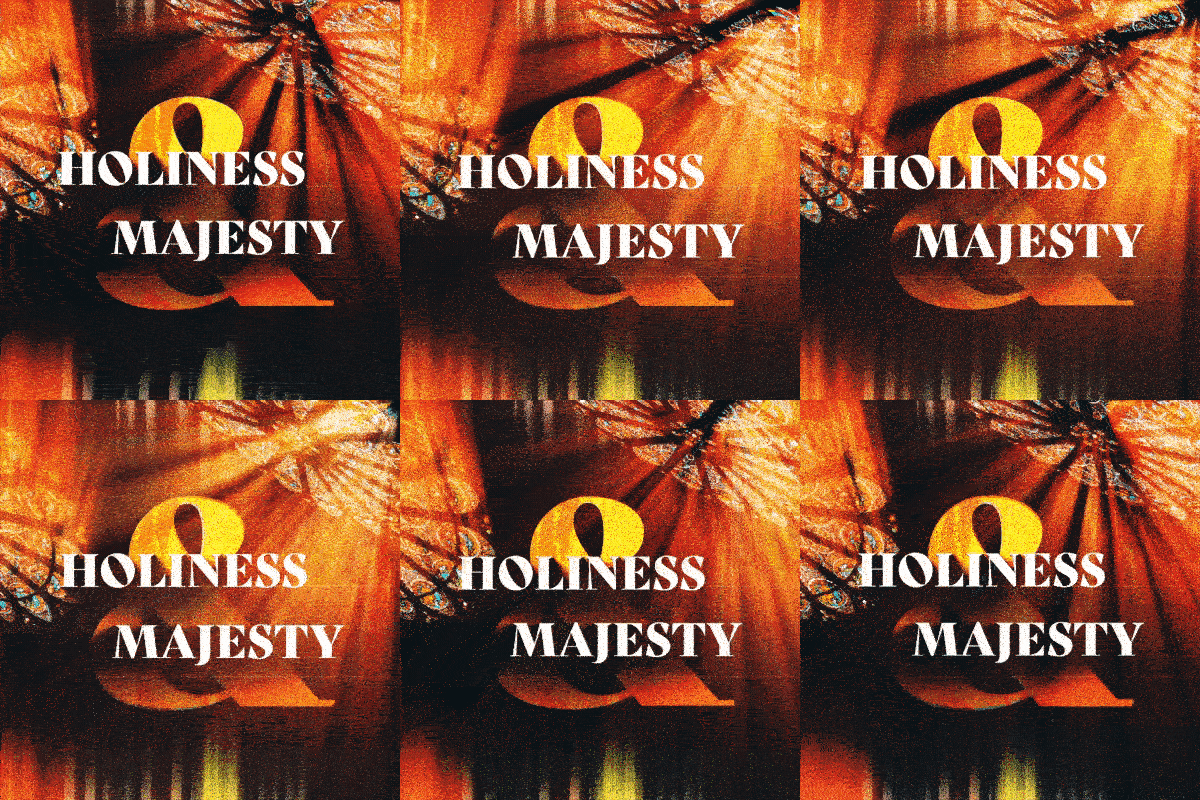
I wanted something with a bit of elegance, and so I found these great stained glass rose windows. I used UnMult in them in After Effects to remove most of the black pixels surrounding them and made them 3D layers and had them spinning a bit.
I added in an Adjustment Layer with a Radial Blur that I then mapped via some expressions to a 3D Null and used that to create the volumetric light rays in this piece. I was trying to use Trapcode Shine but it just wasn’t doing as a good of a job as the built-in effect, so go figure.
I placed the text and added a bit of wiggle hold motion and applied Shadow Studio 3 to give some separation and depth. I then added some final color correction and a bit of glow.
Enjoy.
Praise and beauty are before him: holiness and majesty in his sanctuary.
(Psalm 95:6 DR)
View a higher quality version of this gif here:


