


Bring to the Lord glory unto his name. Bring up sacrifices, and come into his courts: (Psalm 95:8 DR)
The concept of sacrifice is one that is largely lost in the modern west, or has been so bowdlerized that we use it ironically for things that are not sacrifices, or even for plays in baseball. By sacrifice we tend to mean the giving up of some thing for another thing that is better, which is not an untrue use of sacrifice, but we tend to make this largely about self-improvement or self-aggrandizement.
For example, one might sacrifice eating certain foods for the sake of working out and getting healthier, or one might sacrifice banal activities for the sake of advancing a career. These are, I suppose, sacrifices in the sense that one is giving up one thing for another thing. But perhaps not present is the utter immolation of the thing offered in sacrifice. After all, when one gives up time spent playing video games or whatever so as to improve one’s career, the thing being given up—in this case time—is not truly being lost but rather redirected. In both cases the activity is for the sake of oneself, and thus it is perhaps only a sacrifice in a proximate sense.
In English the word sacrifice comes from the Latin sacrificium though the Old French sacrifise, and initially had connotations specifically related to propitiation, especially as it relates to our Lord’s offering of Himself on the cross as a propitiation (cf. Online Etymological Dictionary, sacrifice.) It was glossed in some manuscripts by the Old English ansegdniss which I can neither pronounce nor find more information about. Up until the latter part of the 16th century it retained this propitiatory sense but eventually expanded to become the modern sense of giving up one thing for another thing or for a better thing. (cf. Online Etymological Dictionary, sacrifice.)
For the Psalmist sacrifice had a very specific connotation that was both conceptual and experiential. The many laws and regulations surrounding worship in the Old Covenant would have impressed this upon his mind and those of his countrymen, for they were required to bring sacrifices at various times and of various kinds. It should be remembered that the Old Covenant was originally given to the people of Israel while they were nomadic, and thus the giving up of fruits or animals had a very visceral meaning for them, as it was truly a sacrifice. After all, that sheep that is being immolated on the altar might have been the difference between life and death if there’s a drought or a pestilence.
Even after conquering the Promised Land there was still in the ancient world a constant struggle for survival. Sacrifice would still have had this experiential reality, for war and plague and drought did not stop. The act of sacrifice thus underscored the reality of sin and the need for atonement, for it required that something precious to the sinner be offered. It was also a great act of faith that God would provide even as one was sacrificing the thing that might be the difference between life and death.
As the Psalmist looks forward prophetically to the coming of the Messiah in our Jesus Christ, he sees the Gentiles coming into the courts of the Lord and bringing sacrifices. As was seen in the previous passages, there is this movement from confession to adoration, the latter of which is embodied in these sacrifices. However, there is a shift here, for the sacrifices that the Gentiles will bring in the New Covenant are not the sacrifices of sheep and bulls as in the Old Covenant, but that of the entirety of themselves:
Confession is a present unto God. O heathen, if you will enter into His courts, enter not empty. Bring presents. What presents shall we bring with us? The sacrifice of God is a troubled spirit: a broken and a contrite heart, “O God, shall not Thou despise.” Enter with an humble heart into the house of God, and you have entered with a present. But if you are proud, you enter empty. For whence would you be proud, if you were not empty? For if you were full, you would not be puffed up. How could you be full? If you were to bring a present, which you should carry to the courts of the Lord. (St. Augustine, Expositions on the Psalms, 95, 9.)
These presents or sacrifices are thus, as St. Paul says, the very immolation of our self-will and the consequent transformation of the interior man:
I beseech you therefore, brethren, by the mercy of God, that you present your bodies a living sacrifice, holy, pleasing unto God, your reasonable service. And be not conformed to this world; but be reformed in the newness of your mind, that you may prove what is the good, and the acceptable, and the perfect will of God. (Romans 12:1-2 DR)
The language St. Paul uses here is probably so familiar that it might lose its striking quality. A sacrifice, in his usage, is a victim offered on the altar as a holocaust, something completely consumed in fire as a propitiatory oblation. Our lives as living sacrifices are thus to be a perpetual offering of everything to God. This is the attitude of having a “humbled and contrite” heart that the Psalmist speaks of in Psalm 50, the kind of sacrifice that God will not despise. In this manner confession is a sacrifice to God, as St. Augustine noted, and forms part of the “spiritual sacrifices” that St. Peter speaks of when the holy priesthood of the baptized offer them unto God:
He alludes here to a custom of the Jews, who, when they went up to the temple, offered their victims, and after having adored God, returned to their homes. Now, as the gentiles are here invited to come to the Church of the Lord, such sacrifices are to be understood of those spiritual sacrifices of which St. Peter speaks, “to offer up spiritual sacrifices, acceptable to God by Jesus Christ.” Those spiritual sacrifices are, the sacrifices of a contrite heart, confession of sins, prayer, fasting, alms, and the like. (St. Robert Bellarmine, A Commentary on the Book of the Psalms, 95, 8.)
All of these sacrifices involve becoming a living sacrifice, for in this sacrifice one prefers God’s will to one’s own will and offers the substance of one’s heart and life in His service. In Confession we offer all our weaknesses and failures and sins to God, laying them open before Him Who knows all things, and thus agree by the confession of our mouths that we have offended Him and are in need of His mercy. The contrition that accompanies confession is the sacrifice of one’s own will, for by admitting that we have followed our own will rather than God’s, we turn our will back towards God which is this very act of sacrifice.
In prayer and fasting and alms we likewise turn our affections and desires and will away from ourselves and direct them towards our Lord and what He desires. This is an immolation of will, for it done for God’s sake rather than our own, but since God is infinitely generous He does not fail to reward such acts of devotion, and spiritual growth and sanctification are the supernatural result of turning our hearts and minds to God and immolating our self-will before Him. We see our Lord model this in His own Holy Sacrifice, for prior to the offering of Himself on the cross He spoke the words that characterize this immolation of self-will:
Father, if thou wilt, remove this chalice from me: but yet not my will, but thine be done. (Luke 22:42 DR)
The immolation of one’s own heart and will is perhaps the most difficult sacrifice of all, for all other sacrifices are to some extent external to us. The offering of sheep and goats or of alms are things that can be done without this turning of the heart to God. But the living sacrifice that we must offer cannot exist without this immolation of the will and is thus the kind of sacrifice that God desires:
But the hour cometh, and now is, when the true adorers shall adore the Father in spirit and in truth. For the Father also seeketh such to adore him. God is a spirit; and they that adore him, must adore him in spirit and in truth. (John 4:23-24 DR)
All of these spiritual sacrifices are enabled and joined to the Eucharistic Sacrifice of our Lord Jesus Christ, Who offered in Himself the One Perfect and Holy Sacrifice to the Father. All of the sacrifices of the Old Covenant are consummated and perfected in Him, and we as His Body the Church are united to that sacrifice which He offers to the Father in the Holy Sacrifice of the Mass. The prophet foretold that the Gentiles would bring this very sacrifice to the Lord, and that it would be offered in all the world:
For from the rising of the sun even to the going down, my name is great among the Gentiles, and in every place there is sacrifice, and there is offered to my name a clean oblation: for my name is great among the Gentiles, saith the Lord of hosts. (Malachi 1:11 DR)
As the priests of the Church offer this sacrifice in persona Christi, this prophetic utterance is everyday fulfilled, and the Psalmist’s words made good, as the Gentiles bring up sacrifices and enter into the courts of the Lord:
This may also apply to the Eucharistic sacrifice, that took the place of all the Jewish sacrifices, according to the prophecy of Malachy, and which is offered, “from the rising of the sun even to the going down,” to God, by the converted gentiles, through the hands of the priests of the New Testament. (St. Robert Bellarmine, A Commentary on the Book of the Psalms, 95, 8.)
In this manner the house of the Lord is continually built up, for as the nations are converted to the Lord they are, as living stones, built into the house of God—our Lord’s Mystical Body the Church—and are thus joined to that One Holy Sacrifice:
Behold the house increasing: behold the edifice pervade the whole world. Rejoice, because you have entered into the courts; rejoice, because you are being built into the temple of God. For those who enter are themselves built up, they themselves are the house of God: He is the inhabitor, for whom the house is built over the whole world, and this “after the captivity.” “Bring presents, and come into His courts.” (St. Augustine, Expositions on the Psalms, 95, 9.)
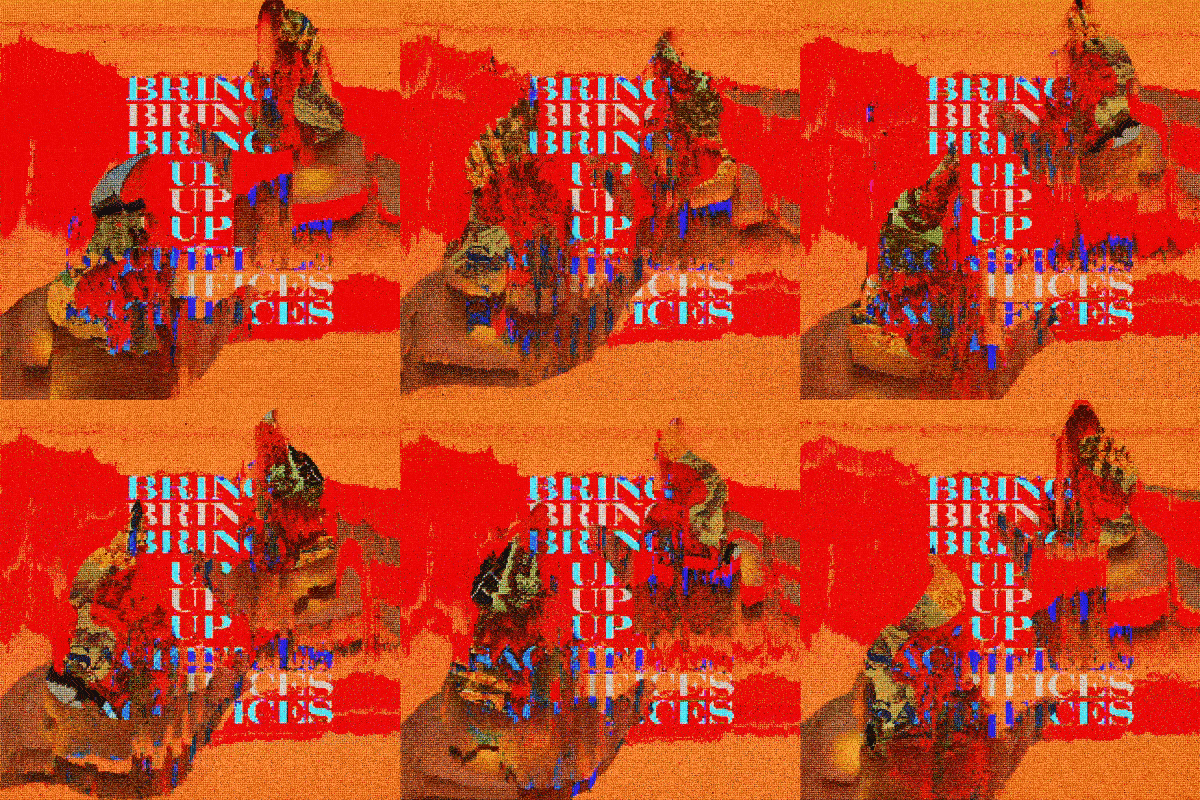
In this animation I wanted to try and get at the sense of offering a sacrifice, but without being too literal. I had an animation of some flames that I had created for a different project and brought them into this one. I composited that over a hand and then parented the flame to the hand and added in some slight animation.
However, I wanted there to be less distinction between the hand and the flame, and so I used some effects to create halftone like effect to crush the colors a bit and remove some of the separation.
I added in the text and duplicated it a few times to give it more space within the composition without making it overtake the composition.
I finally added in some pixel sorting and placed it below the half-tone effect to have the entirety of the composition feel like it was part of the flame, at least a little bit.
Enjoy.
Bring to the Lord glory unto his name. Bring up sacrifices, and come into his courts:
(Psalm 95:8 DR)
View a higher quality version of this gif here:


